
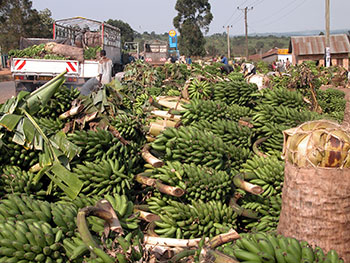
 A team of international researchers implementing an international project with the goal to boost banana production in Ug anda and Tanzania, will this week, 23‒27 April, gather at Nelson M andela African Institution of Science and Technology (NM-AIST), Arusha, Tanzania, to review their progress and plan next years’ activities.
Banana is an important staple food crop and major source of income for millions of smallholder banana farmers in Tanzania and Ug anda which grow over half of all bananas in Africa, valued at $4.3 billion annually. However, the farmers are producing just a small proportion, about 9%, of what is possible. This is largely due to the devastating impact of pests and diseases.
The project, Breeding Better Bananas, seeks to deliver to farmers much-needed, improved, high-yielding, and disease-resistant hybrid banana varieties that are expected to have 30% higher yield compared to the current varieties grown by farmers under the same conditions.
The project is focusing on the two most popular cooking bananas in the region—the East Africa Highl and banana (EAHB) also known as Matooke, and Mchare, which is grown mostly in Tanzania.
“The Breeding Better Bananas project is focused on breeding varieties that farmers like and with resistance against the key problems. Bananas are difficult to breed because they are sterile and do not produce seeds. Breeders deal with this by using fertile parent varieties that do produce seed but this process takes a very long time,” said Prof Rony Swennen, Lead Banana Breeder at the International Institute of Tropical Agriculture (IITA) and the project’s team leader.
“The researchers in this project are working together using cutting edge techniques in state-of-the-art laboratories across the world to overcome these issues, speed up the process, and increase the generation of new varieties with good resistance to pests and diseases,” he said.
The project brings together leading banana researchers from Australia, Belgium, Brazil, the Czech Republic, India, Kenya, Malaysia, South Africa, Sweden, Tanzania, Ug anda, and the USA.
The project, now on its third year, has established the first banana breeding program in Tanzania and the first Mchare hybrids, produced by hybridization with multiple disease-resistant wild bananas, planted in 2018. The breeding of Matooke is more advanced with more than 250 hybrids selected for advanced yield and consumer trials in both Ug anda and Tanzania.
The major diseases that are being addressed by the project are Fusarium Wilt and Black Leaf Streak diseases (Sigatoka disease), while the major pests are the plant parasitic nematodes (microscopic worms) and banana weevils.
The breeding efforts are complemented by studies to underst and the spread and damage caused by these pests and diseases, as well as to develop rapid diagnostic tools and faster screening mechanisms to quickly identify resistant varieties. The project has ascertained that the pathogens spreading black Sigatoka disease are spreading to new areas perhaps due to climate change.
For sustainability, the project is also nurturing the next generation of banana researchers, through training of postgraduate students and technical staff in advanced breeding techniques. It is also facilitating the exchange of genetic plant material across countries and even continents to use the best material for developing improved hybrids, establishing the foundations of a globally connected banana breeding system.
The project is led and coordinated by IITA but works h and-in-h and with the national partners in Tanzania and Ug anda. The regional breeding activities are being conducted at NM-AIST in Arusha, Tanzania, in close collaboration with regional agriculture research institutes (ARIs) in the banana growing areas and at the Ug anda Banana Breeding Programme of the National Agricultural Research Organization (NARO), at Kaw anda, and Sendusu, Kampala.
This project is being conducted within the framework of the CGIAR Research Program on Roots, Tubers and Bananas (RTB).
For more information see: http://breedingbetterbananas.org/
Contributed by
Recent stories