
IITA NEWS

Sudan delegation visits IITA, initiates collaboration, and signs MoU for introducing cassava
November 16, 2018

A 6-member delegation from the University of Khartoum (UofK), and the Office of the President, Sudan, visited IITA on 6–10 November to familiarize themselves with the Institute, exchange ideas, explore areas for collaboration, and sign a memor andum of underst anding (MoU).
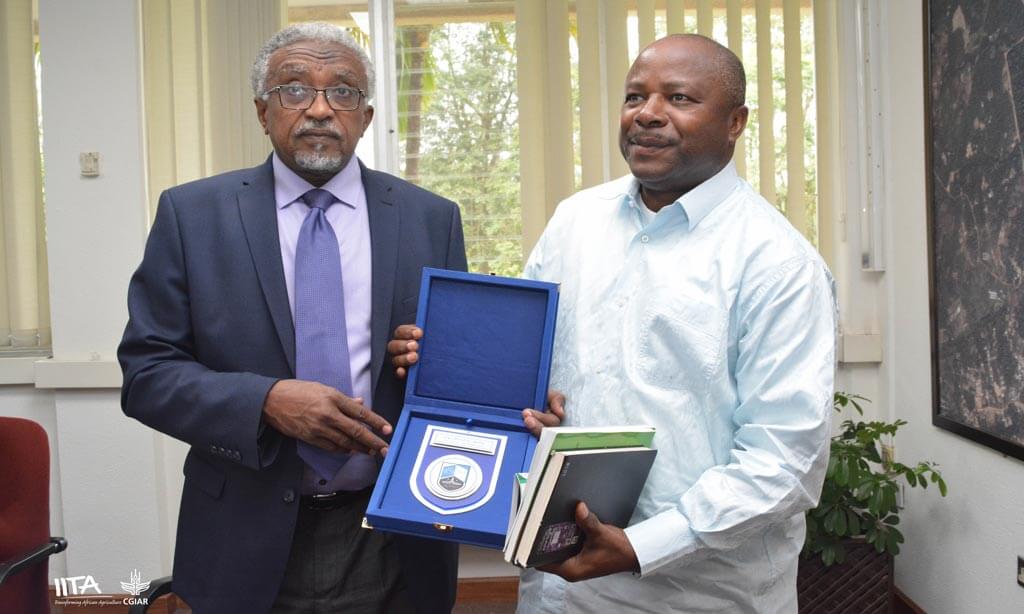
Picture of UofK VC, Professor Ahmed Mohamed Suliman(left) presenting a gift to IITA Director General, Nteranya Sanginga
UofK VC, Professor Ahmed Mohamed Suliman(left) presenting a gift to IITA Director General, Nteranya Sanginga.

The 5-day exploratory visit was led by Prof Ahmed Mohamed Suliman, Vice-Chancellor of UofK, and Dr Abuelgasim Elzein, Head, Department of Agricultural Biotechnology, also a former scientist with IITA, and accompanied by Abdalla Higazi and Hala Ahmed Elamin, both from the Internal Political Affairs unit of the office of the Sudan President and two other professors from the University. Receiving the delegation, IITA Director General Nteranya Sanginga gave an overview of the Institute’s achievements and success stories from inception to date and highlighted the efforts made to generate agricultural innovations to meet Africa’s most pressing challenges of hunger, malnutrition, and poverty, and secure the path to food security.

“We are ready to exp and into Sudan with a strengthened diversified portfolio to contribute to improved livelihoods and incomes for small-scale farmers in the country. We are optimistic that this collaboration will put smiles on the faces of the Sudanese,” he added.

Stating the purpose of their visit, Suliman said, “UofK is leading an initiative to adopt one of the best-bet proven technologies developed by IITA which is High Quality Cassava Flour (HQCF) and its processing techniques for which IITA is known worldwide and has made significant breakthroughs, achievements, and impacts. UofK has plans to adopt and promote this technology with strong support of the Presidential Office of the Republic of the Sudan to make up for the shortage in wheat flour. Our Presidential Office is very much interested in supporting the inclusion of HQCF in bread and other forms of confectionery as part of efforts to improve food security and the livelihoods of farmers in the country. On that note, I would initiate an immediate development of an MoU with IITA to serve as a guide to common interests between the two institutions,” he added.

Elzein corroborated this stating, “Even though the Republic of Sudan is not a cassava-producing country, I know that as soon as the cassava breeding program is replicated in our farming system, agriculture will take a new dimension. With that in place, HQCF will be available to make bread and other confectionary. As an IITA alumnus, I assure you that I will continue to be an active ambassador for IITA in my home country Sudan and in other relevant occasions. I am optimistic that this collaboration would open more opportunities for Sudan and strengthen future fruitful linkages with IITA and other institutional partners.’’

Due to the strong motivation indicated by the Sudanese delegates, the two organizations officially signed a memor andum of underst anding.
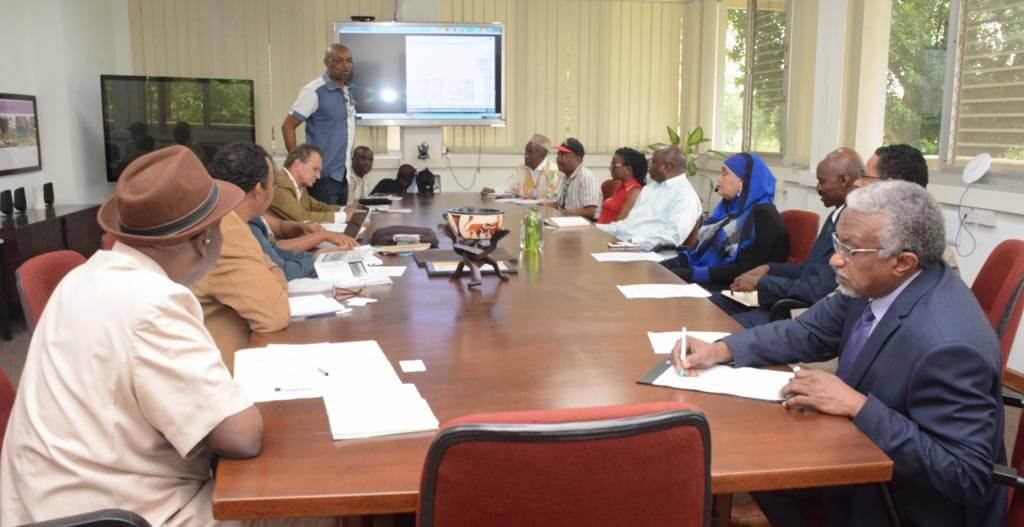
Picture of Iheanacho Okike, Cassava Peel Technologist, giving a presentation during the Sudan delegates’ visit to IITA
Iheanacho Okike, Cassava Peel Technologist, giving a presentation during the Sudan delegates’ visit to IITA.

Discussions were held regarding the type of cassava technology to be introduced in the country, soil topography, climatic conditions and action plans for immediate implementation. Alfred Dixon, Director of the Development and Delivery Office said, “Cassava is the third largest crop in the tropics, and a major staple food in sub-Saharan Africa, providing a basic staple for over half a billion people. It is one of the most drought-tolerant crops, capable of growing on marginal soils. However, with the help of cassava experts from IITA and good agronomic and weed management practices, I am certain that in no distant time, Sudan will be known for cassava production,” he added.

During the tour of the Institute’s facilities including the GoSeed facility, Semi Autotrophic Hydroponics, Bioscience laboratory, fabrication workshop, and I-House pastry section, VC Suliman asserted: “Having taken a close look at IITA’s unique innovation and with the Institute’s technology developers, I must confess that I have identified more areas of collaboration. But first, we will start with the production and processing of cassava, machine fabrication for cassava processing, and rapid multiplication of clean seeds. I am sure the Sudan President will be excited to know that our mission was successful!”

Highlights of the 5-day visit include presentations by key IITA staff; Frederick Schreurs, CEO Business Incubation Platform; Ismail Rabbi, IITA Molecular Geneticist/Breeder, Festus Okunlola, IITA Youth Agripreneur (IYA); Iheanacho Okike, IITA Cassava Peel technologist; and Thierno Diallo, IITA Machine Fabricator, all directed towards showcasing the benefits of cassava and its role in economic development. The delegates also had the opportunity to undergo h ands-on training at the IITA Food and Nutrition Science Laboratory on how to bake bread, croissant, chin-chin, and Tidbits using HQCF.


Contributed by

Related news

No items found

Leave a Reply

Your email address will not be published. Required fields are marked *

Scroll to Top
Olaosebikan, Olamide

Olamide Deborah Nwanze is a Senior Research Associate specializing in gender mainstreaming research to inform participatory and inclusive breeding, variety development, and seed systems policies regarding root, tuber, and banana (RTB) crops in the International Institute of Tropical Agriculture Headquarters, Ibadan, Nigeria. She is a PhD candidate at the University of Ibadan and holds an MSc and B. Agric in Agricultural Extension and Rural Development. Olamide is a fellow of the African Women in Agricultural Research and Development – Gender Responsive Agricultural Systems Policy (AWARD-GRASP) and the Gender Responsive Researchers Equipped for Agricultural Transformation (GREAT). She seeks to apply her gender-mainstreaming learnings, gender-responsive research, and policy development, and review expertise to facilitate women, youth, children, and vulnerable social group’s access to and adoption of agricultural Innovations that guarantee food, nutrition, income, and livelihood security in Africa. Her current roles include mentoring research fellows, development of guides and training manuals, implementation and adaptation of gender frameworks and tools, value chain actors’ engagement as citizen science partners, policy review and redesign, data management, and analysis. Her current research explores mixed methods and participatory and interdisciplinary approaches to capture and highlight gender dynamics, needs, preferences, and challenges stakeholders face within the agricultural livelihood value chain to prioritize gender-inclusive strategies in breeding programs, policy design, and implementation.

At IITA, she contributes to the implementation of the CGIAR Accelerated Breeding Initiative and Genetic Innovation Programs; participatory and gender research within the NextGen CassavaHarvestPlusRTBFoods, and Tricot-ClimMob 1000Farms Projects; and gender knowledge communication via the G-LENS webinar series, video documentary, policy briefspublications, and blogs.


Recent publications

de Sousa, K., van Etten, J., Manners, R. Bello, A., Teeken, B., Olaosebikan, O., et al. 2024. The tricot approach: an agile framework for decentralized on-farm testing supported by citizen science. A retrospective. Agron. Sustain. Dev. 44, 8. https://doi.org/10.1007/s13593-023-00937-1

Madu, T., Onwuka, S., Nwafor, S., Onyemauwa, N., Ejechi, M., Ofoeze, M., Ukeje, B., Eluagu, C., Olaosebikan, O., Okoye, B., 2024. Gender-Inclusive Consumer Studies Improve Cassava Breeding in Nigeria in: Frontiers in Sociology, volume 9, number: 1224504, doi: 10.3389/fsoc.2024.1224504

Olaosebikan, O.; Bello, A.; Utoblo, O.; Okoye, B.; Olutegbe, N.; Garner, E.; Teeken, B.; Bryan, E.; Forsythe, L.; Cole, S.; Madu, T. 2023.  Stressors and Resilience within the Cassava Value Chain in Nigeria: Preferred Cassava Variety Traits and Response Strategies of Men and Women to Inform Breeding. Sustainability 15, 7837. https://doi.org/10.3390/su15107837

Okoye, B., Ofoeze, M., Ejechi, M., Onwuka, S., Nwafor, S., Onyemauwa, N., Ukeje, B., Eluagu, C., Obidiegwu, J.*, Olaosebikan, O., Madu, T.* 2023. Prioritizing preferred traits in the yam value chain in Nigeria: a gender situation analysis in: Frontiers in Sociology, volume 8, number: 1232626, pages 1 – 9, ISSN 2297-7775, 2023. https://www.frontiersin.org/articles/10.3389/fsoc.2023.1232626/full

Olaosebikan, O., Bello, A. A., de Sousa, K., Ndjouenkeu, R., Adesokan, M., Alamu, E. O., Agbona, A., van Etten, J., Kegah, F. N.*, Dufour, D., Bouniol, A., Teeken, B. 2023. Consumer acceptability of cassava gari-eba food products across cultural and environmental settings using the triadic comparison of technologies approach (tricot) in: Journal of the Science of Food and Agriculture,

Teeken, B., Olaosebikan, O., Bello, A. A., Madu, T.*, Cole, S. M. 2023. Qualitative assessment on the positionality and preferences of dyads in relation to cassava-related activities: working with tricot trial citizen scientists https://hdl.handle.net/10568/138326 Type: Manual

Bouniol, A., Ceballos, H., Bello, A. A., Teeken, B., Olaosebikan, O., Owoade, D., Agbona, A., Fotso Kuate, A., Madu, T.*, Okoye, B.*, Ofoeze, M.*, Nwafor, S.*, Onyemauwa, N.*, Adinsi, L.*, Forsythe, L., Dufour, D. 2023. Varietal impact on women’s labour, workload and related drudgery in processing root, tuber and banana crops: focus on cassava in sub-Saharan Africa in: Journal of the Science of Food and Agriculture, pages 1 – 25, ISSN 0022-5142,

Bello, A. A., Agbona, A., Olaosebikan, O., Edughaen, G., Dufour, D., Bouniol, A., Iluebbey, P., Ndjouenkeu, R.*, Rabbi, I. Y., Teeken, B. 2023. Genetic and environmental effects on processing productivity and food product yield: drudgery of women’s work in: Journal of the Science of Food and Agriculture, pages 1 – 32, ISSN 0022-5142, 5

Cavicchioli, M., Zimbiti, T., Teeken, B., Nwanze, D.O., Liani, M., Parkes, E. & Bello, A. 2023. IITA-Gender Responsive Breeding Training Report. Genetic Resources Center, IITA-HQ, Ibadan, 21-23 September, 2022. Ibadan, Nigeria: IITA, (34 p.).https://hdl.handle.net/10568/131368

Agbona, A. Peteti P., Teeken B., Olaosebikan O. Bello, A. A., Parkes, E., Rabbi, I. Y., Mueller, L., Egesi, C., Kulakow, P. 2022. Data Management in Multi-disciplinary African RTB Crop Breeding Programs. In: Williamson, H.F., Leonelli, S. (eds) Towards Responsible Plant Data Linkage: Data Challenges for Agricultural Research and Development. Springer, Cham. https://doi.org/10.1007/978-3-031-13276-6_5

Lora Forsythe, Pricilla Marimo, Sarah Mayanja, Olamide D. Olaosebikan, Esme Stuart, Bela Teeken, Benjamin Okoye, Tessy Madu, (2021). Cross-product Gender Analysis of RTBfoods Step 2 Gendered Food Mapping on RTB Products. Understanding the Drivers of Trait Preferences and the Development of Multi-user RTB Product Profiles, WP1. London, UK: RTBfoods Field Scientific Report, 30 p.

Teeken, B., Garner, E., Agbona, A., Balogun, I., Olaosebikan, O., Bello, A., Madu, T., Okoye, B., Egesi, C., Kulakow, P. and Tufan, H.A. 2021. Beyond “Women’s Traits”: Exploring How Gender, Social Difference, and Household Characteristics Influence Trait Preferences. Frontiers Sustainable Food Systems 5:740926. https://doi.org/10.3389/fsufs.2021.740926

Teeken, B., Agbona, A., Bello, A., Olaosebikan, O., Alamu, E., Adesokan, M., Awoyale, W., Madu, T., Okoye, B., Chijioke, U., Owoade, D., Okoro, M., Bouniol, A., Dufour, D., Hershey, C., Rabbi, I., Maziya‐Dixon, B., Egesi, C., Tufan, H. and Kulakow, P. (020. Understanding cassava varietal preferences through pairwise ranking of gari‐eba and fufu prepared by local farmer–processors. Int J Food Sci Technol. https://doi.org/10.1111/ijfs.14862

Bela Teeken, Olamide Olaosebikan, Ireti Balogun, Benjamin Okoye, Tessy Madu, Steven Cole, Abolore Bello, Elizabeth Parkes. (2020). Piloting the G+ customer and product profile tools for gender-responsive cassava breeding in Nigeria. Nigeria: International Institute of Tropical Agriculture (IITA). https://hdl.handle.net/20.500.11766/13000