
NEWS

IITA DG Sanginga awarded Doctor Honoris Causa for visionary leadership in historic ceremony
May 21, 2019

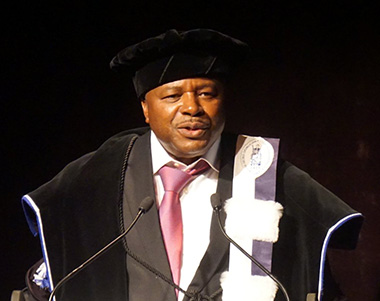
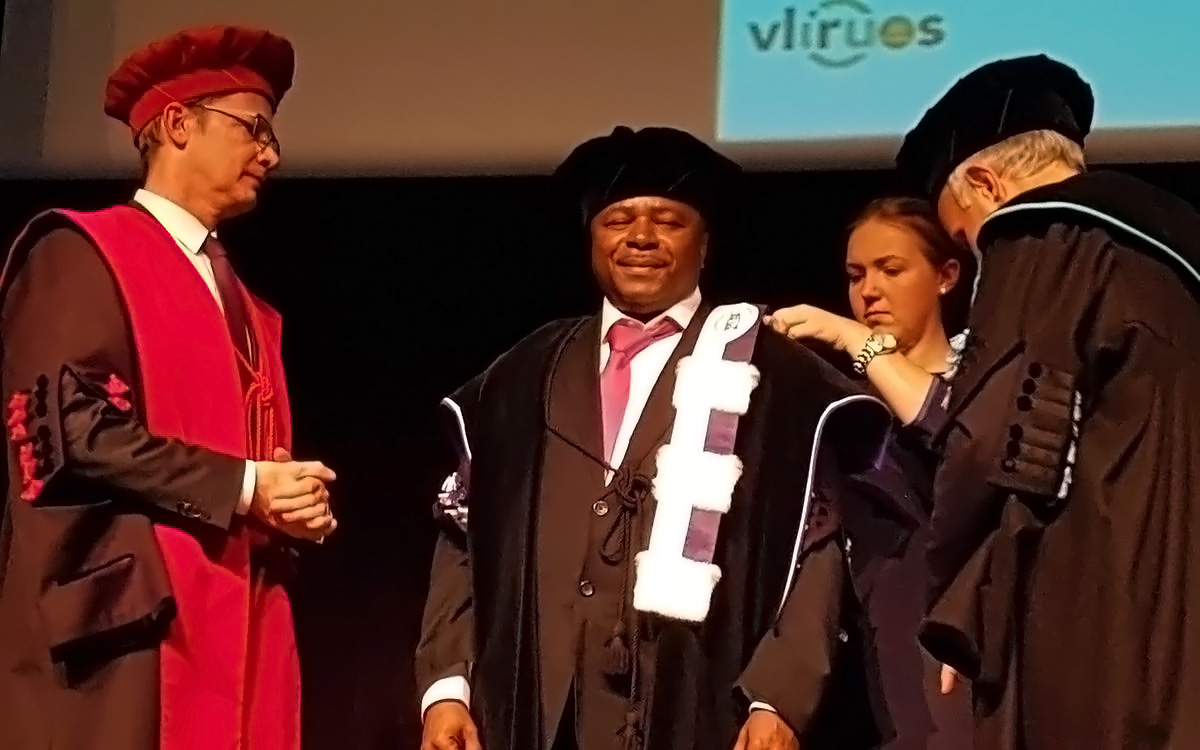
KU Leuven has awarded IITA Director General Nteranya Sanginga with the prestigious Doctor Honoris Causa. VLIR-UOS (The Flemish Interuniversity Council–University Development Cooperation) hosted the ceremony in Brussels, Belgium on 15 May as part of celebrations marking its twentieth anniversary.

History was made as this was the first time five recipients received honorary doctorates from the five Flemish universities on the same day. The awards were given in recognition of the outst anding contributions of the recipients to the field of university cooperation for development.

In his welcome address, chair of VLIR-UOS and University of Antwerp Rector, Prof Herman Van Goethem, applauded the model of cooperation between the universities who are collaborating for impact on society. As outlined in the VLIR-UOS slogan, “Sharing minds, changing lives”, he noted that the institutions are committed, not to competition but, only to collaboration.

“With these honorary degrees and the joint ceremony, we show the world that the Flemish universities are engaged universities taking up their responsibilities for the global challenges that the world is confronted with,” stated Prof Van Goethem.

“The academic authorities of all Flemish universities highly value this university cooperation for development,” he continued.

Following a brief video testimonial, the Rector of each institution presented the recipients with their awards.

In a pre-recorded message, IITA emeritus board member, Prof Roel Merckx, recounted positive memories from his decades-long collaboration with Dr Sanginga and his consistent attention to capacity building. He said, “Sanginga has a very special mission towards young academics in Africa. He really sees the importance of having the best brains in agronomical research in Africa, so he goes to great lengths to stimulate young people…”

In his presentation speech, KU Leuven Rector Prof Luc Sels noted that Dr Sanginga has been working to fight hunger and improve the quality of life for smallholder farmers and their communities in sub-Saharan Africa. He said, “Dr Sanginga’s work demonstrates that agricultural transformation can only be successful when research institutions pool capacity and pool resources. Under Dr Sanginga’s leadership, IITA has become a highly successful international research organization.”

He also stated KU Leuven’s mission to continue to strengthen the academic capacity of researchers, departments, and institutions in Africa—a mission in which they consider Dr Sanginga and IITA as strong partners.

Prof Sels continued, “We want to help create the conditions that will ultimately allow African institutions to continue capacity building by themselves, in a sustainable way, and throughout the entire region.”

He also noted that, “Dr Sanginga’s research and development approaches are an inspiration for implementing the United Nations Sustainable Development Goals (SDGs). Our university is exploring ways to systematically engage with these goals and to strengthen our commitment to realize them.”
Upon receiving the award, DG Sanginga used the opportunity to highlight three of IITA’s success stories, achieved despite challenges to food and nutrition security faced by the region, such as l and degradation and soil fertility.

One of the projects he highlighted was the Consortium for Improving Agriculture-based Livelihoods in Central Africa (CIALCA), which helped to foster “peace through science” as well as bring about poverty alleviation in the Great Lakes Region of Burundi, DR Congo, and Rw anda.

He also spoke of IITA’s role in influencing policy with regard to the use of fertilizer in African crop production at a time when the continent was at a crossroads.

Finally, Dr Sanginga recounted the inspiration for and the beginnings of the IITA Youth Agripreneurs (IYA) program, which has overseen the growth of youth participation in multiple value chains in African agriculture.

Dr Sanginga ended by dedicating the award to the young and upcoming scientists, hoping that this honor would serve as a motivation for them to continue to combat famine in Africa through better soil fertility management.

The other recipients of the honorary degrees are: Dr Clarice Garcia Borges Demétrio from Brazil, who received her honorary degree from Hasselt University (UHasselt), while Vrije Universiteit Brussel (VUB) gave the award to Dr José Ramón Saborido Loidi from Cuba. Dr Leymah Roberta Gbowee from Liberia received the Doctor Honoris Causa from Ghent University and Dr Jean-Jacques Muyembe Tamfun from DR Congo received his from the University of Antwerp.

Throwback highlights from the day: https://bit.ly/2W3gzRF

[embedyt] https://www.youtube.com/watch?v=EVJbS3N8fno[/embedyt]


Contributed by

Recent stories

No items found

Leave a Reply

Your email address will not be published. Required fields are marked *

Scroll to Top
Olaosebikan, Olamide

Olamide Deborah Nwanze is a Senior Research Associate specializing in gender mainstreaming research to inform participatory and inclusive breeding, variety development, and seed systems policies regarding root, tuber, and banana (RTB) crops in the International Institute of Tropical Agriculture Headquarters, Ibadan, Nigeria. She is a PhD candidate at the University of Ibadan and holds an MSc and B. Agric in Agricultural Extension and Rural Development. Olamide is a fellow of the African Women in Agricultural Research and Development – Gender Responsive Agricultural Systems Policy (AWARD-GRASP) and the Gender Responsive Researchers Equipped for Agricultural Transformation (GREAT). She seeks to apply her gender-mainstreaming learnings, gender-responsive research, and policy development, and review expertise to facilitate women, youth, children, and vulnerable social group’s access to and adoption of agricultural Innovations that guarantee food, nutrition, income, and livelihood security in Africa. Her current roles include mentoring research fellows, development of guides and training manuals, implementation and adaptation of gender frameworks and tools, value chain actors’ engagement as citizen science partners, policy review and redesign, data management, and analysis. Her current research explores mixed methods and participatory and interdisciplinary approaches to capture and highlight gender dynamics, needs, preferences, and challenges stakeholders face within the agricultural livelihood value chain to prioritize gender-inclusive strategies in breeding programs, policy design, and implementation.

At IITA, she contributes to the implementation of the CGIAR Accelerated Breeding Initiative and Genetic Innovation Programs; participatory and gender research within the NextGen CassavaHarvestPlusRTBFoods, and Tricot-ClimMob 1000Farms Projects; and gender knowledge communication via the G-LENS webinar series, video documentary, policy briefspublications, and blogs.


Recent publications

de Sousa, K., van Etten, J., Manners, R. Bello, A., Teeken, B., Olaosebikan, O., et al. 2024. The tricot approach: an agile framework for decentralized on-farm testing supported by citizen science. A retrospective. Agron. Sustain. Dev. 44, 8. https://doi.org/10.1007/s13593-023-00937-1

Madu, T., Onwuka, S., Nwafor, S., Onyemauwa, N., Ejechi, M., Ofoeze, M., Ukeje, B., Eluagu, C., Olaosebikan, O., Okoye, B., 2024. Gender-Inclusive Consumer Studies Improve Cassava Breeding in Nigeria in: Frontiers in Sociology, volume 9, number: 1224504, doi: 10.3389/fsoc.2024.1224504

Olaosebikan, O.; Bello, A.; Utoblo, O.; Okoye, B.; Olutegbe, N.; Garner, E.; Teeken, B.; Bryan, E.; Forsythe, L.; Cole, S.; Madu, T. 2023.  Stressors and Resilience within the Cassava Value Chain in Nigeria: Preferred Cassava Variety Traits and Response Strategies of Men and Women to Inform Breeding. Sustainability 15, 7837. https://doi.org/10.3390/su15107837

Okoye, B., Ofoeze, M., Ejechi, M., Onwuka, S., Nwafor, S., Onyemauwa, N., Ukeje, B., Eluagu, C., Obidiegwu, J.*, Olaosebikan, O., Madu, T.* 2023. Prioritizing preferred traits in the yam value chain in Nigeria: a gender situation analysis in: Frontiers in Sociology, volume 8, number: 1232626, pages 1 – 9, ISSN 2297-7775, 2023. https://www.frontiersin.org/articles/10.3389/fsoc.2023.1232626/full

Olaosebikan, O., Bello, A. A., de Sousa, K., Ndjouenkeu, R., Adesokan, M., Alamu, E. O., Agbona, A., van Etten, J., Kegah, F. N.*, Dufour, D., Bouniol, A., Teeken, B. 2023. Consumer acceptability of cassava gari-eba food products across cultural and environmental settings using the triadic comparison of technologies approach (tricot) in: Journal of the Science of Food and Agriculture,

Teeken, B., Olaosebikan, O., Bello, A. A., Madu, T.*, Cole, S. M. 2023. Qualitative assessment on the positionality and preferences of dyads in relation to cassava-related activities: working with tricot trial citizen scientists https://hdl.handle.net/10568/138326 Type: Manual

Bouniol, A., Ceballos, H., Bello, A. A., Teeken, B., Olaosebikan, O., Owoade, D., Agbona, A., Fotso Kuate, A., Madu, T.*, Okoye, B.*, Ofoeze, M.*, Nwafor, S.*, Onyemauwa, N.*, Adinsi, L.*, Forsythe, L., Dufour, D. 2023. Varietal impact on women’s labour, workload and related drudgery in processing root, tuber and banana crops: focus on cassava in sub-Saharan Africa in: Journal of the Science of Food and Agriculture, pages 1 – 25, ISSN 0022-5142,

Bello, A. A., Agbona, A., Olaosebikan, O., Edughaen, G., Dufour, D., Bouniol, A., Iluebbey, P., Ndjouenkeu, R.*, Rabbi, I. Y., Teeken, B. 2023. Genetic and environmental effects on processing productivity and food product yield: drudgery of women’s work in: Journal of the Science of Food and Agriculture, pages 1 – 32, ISSN 0022-5142, 5

Cavicchioli, M., Zimbiti, T., Teeken, B., Nwanze, D.O., Liani, M., Parkes, E. & Bello, A. 2023. IITA-Gender Responsive Breeding Training Report. Genetic Resources Center, IITA-HQ, Ibadan, 21-23 September, 2022. Ibadan, Nigeria: IITA, (34 p.).https://hdl.handle.net/10568/131368

Agbona, A. Peteti P., Teeken B., Olaosebikan O. Bello, A. A., Parkes, E., Rabbi, I. Y., Mueller, L., Egesi, C., Kulakow, P. 2022. Data Management in Multi-disciplinary African RTB Crop Breeding Programs. In: Williamson, H.F., Leonelli, S. (eds) Towards Responsible Plant Data Linkage: Data Challenges for Agricultural Research and Development. Springer, Cham. https://doi.org/10.1007/978-3-031-13276-6_5

Lora Forsythe, Pricilla Marimo, Sarah Mayanja, Olamide D. Olaosebikan, Esme Stuart, Bela Teeken, Benjamin Okoye, Tessy Madu, (2021). Cross-product Gender Analysis of RTBfoods Step 2 Gendered Food Mapping on RTB Products. Understanding the Drivers of Trait Preferences and the Development of Multi-user RTB Product Profiles, WP1. London, UK: RTBfoods Field Scientific Report, 30 p.

Teeken, B., Garner, E., Agbona, A., Balogun, I., Olaosebikan, O., Bello, A., Madu, T., Okoye, B., Egesi, C., Kulakow, P. and Tufan, H.A. 2021. Beyond “Women’s Traits”: Exploring How Gender, Social Difference, and Household Characteristics Influence Trait Preferences. Frontiers Sustainable Food Systems 5:740926. https://doi.org/10.3389/fsufs.2021.740926

Teeken, B., Agbona, A., Bello, A., Olaosebikan, O., Alamu, E., Adesokan, M., Awoyale, W., Madu, T., Okoye, B., Chijioke, U., Owoade, D., Okoro, M., Bouniol, A., Dufour, D., Hershey, C., Rabbi, I., Maziya‐Dixon, B., Egesi, C., Tufan, H. and Kulakow, P. (020. Understanding cassava varietal preferences through pairwise ranking of gari‐eba and fufu prepared by local farmer–processors. Int J Food Sci Technol. https://doi.org/10.1111/ijfs.14862

Bela Teeken, Olamide Olaosebikan, Ireti Balogun, Benjamin Okoye, Tessy Madu, Steven Cole, Abolore Bello, Elizabeth Parkes. (2020). Piloting the G+ customer and product profile tools for gender-responsive cassava breeding in Nigeria. Nigeria: International Institute of Tropical Agriculture (IITA). https://hdl.handle.net/20.500.11766/13000