
IITA NEWS

Novel and effective technique to control Banana Xanthomonas wilt is suitable for Rwandan agroecology
December 14, 2020

Banana is a major commodity in Rwanda, used as both a cash and (staple) food crop; it covers 23% of Rwanda’s land and is grown by 90% of households. Rwanda is one of the largest banana producers in the East Africa Region and ranks second in banana consumption globally with an annual per capita consumption of approximately 144 kg.

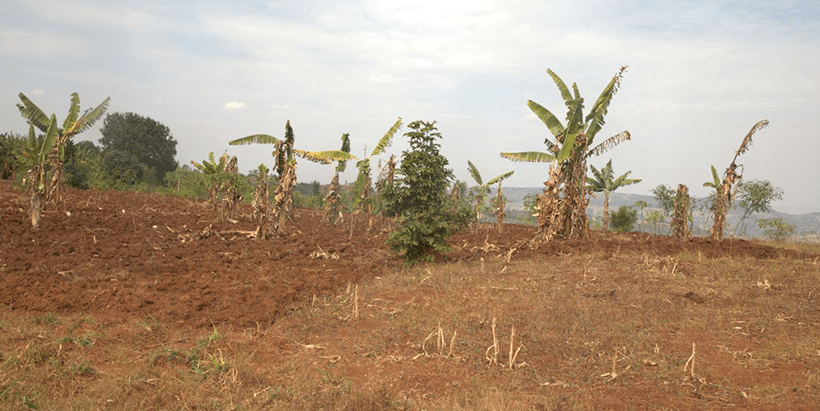
For the last 10 plus years, the yield and production of this important crop in Rwanda have been severely affected by the Xanthomonas wilt of banana (BXW) disease, affecting yield and production for Rwandan farmers.
Novel and effective technique to control Banana Xanthomonas wilt is suitable for Rwandan agroecology
Xanthomonas wilt of banana can cause yield losses up to 100%.

BXW is a bacterial disease that has seriously affected banana production in the East and Central African (ECA) region, with yield losses of up to 100% reported. The disease was first discovered on Enset (a banana-relative, also called false banana) in Ethiopia in 1967 and first spread to the ECA region (Uganda) in 2001. In Rwanda, BXW was officially reported in 2005 and reportedly caused reduced banana availability in households and markets, making it a considerable threat to food security and income.

There is no cure for BXW, but scientists have formulated technical recommendations to reduce the probability of infection and to manage and control existing infections.

The Government of Rwanda set up various approaches to address BXW, such as working through Umuganda, a monthly holiday of community service in Rwanda, where people uprooted infected banana mats and buried them in the soil. This practice to control BXW is referred to as “Complete Diseased Mat Uprooting (CDMU)”.

In Rwanda, CDMU has been proposed as the only correct measure to control BXW, though it has only been partially effective because it is costly, time-consuming, and severely affects the continuity of bunch harvests.
Novel and effective technique to control Banana Xanthomonas wilt is suitable for Rwandan agroecology
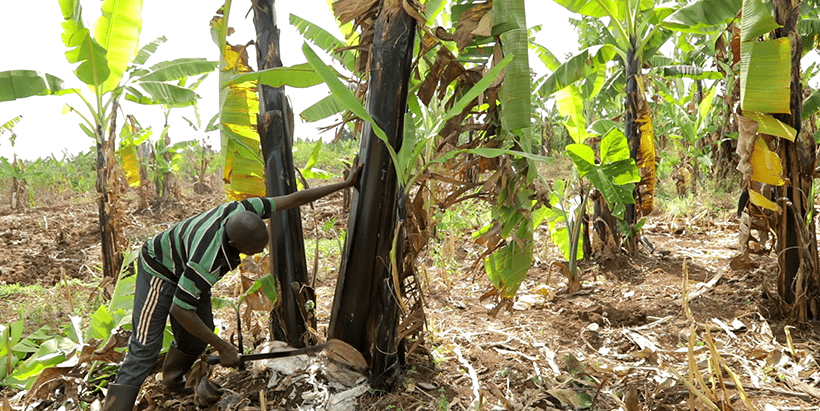
“Single Diseased Stem Removal” helps to control BXW more efficiently than “Complete Diseased Mat Uprooting”.

A novel technique to control BXW in banana, called Single Diseased Stem Removal (SDSR), developed and tested by the Alliance of Bioversity International and CIAT in neighboring countries over the past years, has recently been tested at field sites in Rwanda and showed good results.

SDSR is a disease management practice to control BXW and recover banana production rapidly. Instead of uprooting the whole sick banana mat, only the stem of a plant showing symptoms of BXW is cut at soil level. Scientists recommend supporting SDSR by sterilizing garden tools used for cutting diseased stems, either by holding the tool in fire for up to a minute or by cleaning it with soap and water or chlorine. Ideally, this work is associated with removing the male floral bud after the formation of the last cluster on the bunch, using a forked stick.

The Alliance of Bioversity International and CIAT conducted the study on the SDSR technique in Rwanda, in partnership with the Rwanda Agriculture and Animal Resources Development Board (RAB) and the International Institute of Tropical Agriculture (IITA) through the CGIAR Research Program on Roots, Tubers and Bananas (RTB) flagship project.

The trials were set in four sites located in Kayonza, Gisagara, Rulindo, and Rubavu districts. The objectives of the study were to: 1) assess the potential of both CDMU and SDSR in controlling BXW under Rwandan agroecological conditions and 2) conduct a cost-benefit analysis for both technologies, measuring the time needed and labor costs to apply the technology and banana bunch harvests/yield.

The results show that in all four sites, both SDSR and CDMU were highly effective in halting the disease: disease incidence dropped below 1% by the end of the first month. In subsequent months, during which the banana plants were regularly monitored for symptoms of BXW, incidence remained below 2% when either SDSR or CDMU was applied, respectively, on sick plants or mats. This was a marked difference from the plots with BXW where no techniques were applied to control the disease. In these plots, incidence rapidly increased in the first month at all four sites with an average of 7.5%.

Although disease incidence declines were similar for both BXW control technologies, it is important to note that in the CDMU plots, all plants in a sick banana mat were uprooted, whereas in the SDSR plots, all healthy-looking plants were left in place, leading to continued bunch production. For banana farmers, this makes an enormous difference.

Moreover, the results show that SDSR takes much less time than CDMU. The total time (cutting/uprooting, processing plant debris, and even replanting in the case of CDMU) needed for SDSR is 88% less than for CDMU, averaging 4.3 ± 0.3 minutes treatment time for removing one affected plant, compared to 36.5 ± 4.5 minutes for uprooting one affected whole mat. It logically follows that the labor costs associated with CDMU are much higher.

Scientists recommend the SDSR technique to control BXW to Rwandan banana farmers because it is easy to apply and highly effective in controlling and halting the dissemination of BXW in banana gardens.

Read the research brief here: https://www.rtb.cgiar.org/publications/a-superior-technology-to-control-banana-xanthomonas-wilt-bxw-in-rwanda/


Contributed by

Related news

No items found

Leave a Reply

Your email address will not be published. Required fields are marked *

Scroll to Top
Olaosebikan, Olamide

Olamide Deborah Nwanze is a Senior Research Associate specializing in gender mainstreaming research to inform participatory and inclusive breeding, variety development, and seed systems policies regarding root, tuber, and banana (RTB) crops in the International Institute of Tropical Agriculture Headquarters, Ibadan, Nigeria. She is a PhD candidate at the University of Ibadan and holds an MSc and B. Agric in Agricultural Extension and Rural Development. Olamide is a fellow of the African Women in Agricultural Research and Development – Gender Responsive Agricultural Systems Policy (AWARD-GRASP) and the Gender Responsive Researchers Equipped for Agricultural Transformation (GREAT). She seeks to apply her gender-mainstreaming learnings, gender-responsive research, and policy development, and review expertise to facilitate women, youth, children, and vulnerable social group’s access to and adoption of agricultural Innovations that guarantee food, nutrition, income, and livelihood security in Africa. Her current roles include mentoring research fellows, development of guides and training manuals, implementation and adaptation of gender frameworks and tools, value chain actors’ engagement as citizen science partners, policy review and redesign, data management, and analysis. Her current research explores mixed methods and participatory and interdisciplinary approaches to capture and highlight gender dynamics, needs, preferences, and challenges stakeholders face within the agricultural livelihood value chain to prioritize gender-inclusive strategies in breeding programs, policy design, and implementation.

At IITA, she contributes to the implementation of the CGIAR Accelerated Breeding Initiative and Genetic Innovation Programs; participatory and gender research within the NextGen CassavaHarvestPlusRTBFoods, and Tricot-ClimMob 1000Farms Projects; and gender knowledge communication via the G-LENS webinar series, video documentary, policy briefspublications, and blogs.


Recent publications

de Sousa, K., van Etten, J., Manners, R. Bello, A., Teeken, B., Olaosebikan, O., et al. 2024. The tricot approach: an agile framework for decentralized on-farm testing supported by citizen science. A retrospective. Agron. Sustain. Dev. 44, 8. https://doi.org/10.1007/s13593-023-00937-1

Madu, T., Onwuka, S., Nwafor, S., Onyemauwa, N., Ejechi, M., Ofoeze, M., Ukeje, B., Eluagu, C., Olaosebikan, O., Okoye, B., 2024. Gender-Inclusive Consumer Studies Improve Cassava Breeding in Nigeria in: Frontiers in Sociology, volume 9, number: 1224504, doi: 10.3389/fsoc.2024.1224504

Olaosebikan, O.; Bello, A.; Utoblo, O.; Okoye, B.; Olutegbe, N.; Garner, E.; Teeken, B.; Bryan, E.; Forsythe, L.; Cole, S.; Madu, T. 2023.  Stressors and Resilience within the Cassava Value Chain in Nigeria: Preferred Cassava Variety Traits and Response Strategies of Men and Women to Inform Breeding. Sustainability 15, 7837. https://doi.org/10.3390/su15107837

Okoye, B., Ofoeze, M., Ejechi, M., Onwuka, S., Nwafor, S., Onyemauwa, N., Ukeje, B., Eluagu, C., Obidiegwu, J.*, Olaosebikan, O., Madu, T.* 2023. Prioritizing preferred traits in the yam value chain in Nigeria: a gender situation analysis in: Frontiers in Sociology, volume 8, number: 1232626, pages 1 – 9, ISSN 2297-7775, 2023. https://www.frontiersin.org/articles/10.3389/fsoc.2023.1232626/full

Olaosebikan, O., Bello, A. A., de Sousa, K., Ndjouenkeu, R., Adesokan, M., Alamu, E. O., Agbona, A., van Etten, J., Kegah, F. N.*, Dufour, D., Bouniol, A., Teeken, B. 2023. Consumer acceptability of cassava gari-eba food products across cultural and environmental settings using the triadic comparison of technologies approach (tricot) in: Journal of the Science of Food and Agriculture,

Teeken, B., Olaosebikan, O., Bello, A. A., Madu, T.*, Cole, S. M. 2023. Qualitative assessment on the positionality and preferences of dyads in relation to cassava-related activities: working with tricot trial citizen scientists https://hdl.handle.net/10568/138326 Type: Manual

Bouniol, A., Ceballos, H., Bello, A. A., Teeken, B., Olaosebikan, O., Owoade, D., Agbona, A., Fotso Kuate, A., Madu, T.*, Okoye, B.*, Ofoeze, M.*, Nwafor, S.*, Onyemauwa, N.*, Adinsi, L.*, Forsythe, L., Dufour, D. 2023. Varietal impact on women’s labour, workload and related drudgery in processing root, tuber and banana crops: focus on cassava in sub-Saharan Africa in: Journal of the Science of Food and Agriculture, pages 1 – 25, ISSN 0022-5142,

Bello, A. A., Agbona, A., Olaosebikan, O., Edughaen, G., Dufour, D., Bouniol, A., Iluebbey, P., Ndjouenkeu, R.*, Rabbi, I. Y., Teeken, B. 2023. Genetic and environmental effects on processing productivity and food product yield: drudgery of women’s work in: Journal of the Science of Food and Agriculture, pages 1 – 32, ISSN 0022-5142, 5

Cavicchioli, M., Zimbiti, T., Teeken, B., Nwanze, D.O., Liani, M., Parkes, E. & Bello, A. 2023. IITA-Gender Responsive Breeding Training Report. Genetic Resources Center, IITA-HQ, Ibadan, 21-23 September, 2022. Ibadan, Nigeria: IITA, (34 p.).https://hdl.handle.net/10568/131368

Agbona, A. Peteti P., Teeken B., Olaosebikan O. Bello, A. A., Parkes, E., Rabbi, I. Y., Mueller, L., Egesi, C., Kulakow, P. 2022. Data Management in Multi-disciplinary African RTB Crop Breeding Programs. In: Williamson, H.F., Leonelli, S. (eds) Towards Responsible Plant Data Linkage: Data Challenges for Agricultural Research and Development. Springer, Cham. https://doi.org/10.1007/978-3-031-13276-6_5

Lora Forsythe, Pricilla Marimo, Sarah Mayanja, Olamide D. Olaosebikan, Esme Stuart, Bela Teeken, Benjamin Okoye, Tessy Madu, (2021). Cross-product Gender Analysis of RTBfoods Step 2 Gendered Food Mapping on RTB Products. Understanding the Drivers of Trait Preferences and the Development of Multi-user RTB Product Profiles, WP1. London, UK: RTBfoods Field Scientific Report, 30 p.

Teeken, B., Garner, E., Agbona, A., Balogun, I., Olaosebikan, O., Bello, A., Madu, T., Okoye, B., Egesi, C., Kulakow, P. and Tufan, H.A. 2021. Beyond “Women’s Traits”: Exploring How Gender, Social Difference, and Household Characteristics Influence Trait Preferences. Frontiers Sustainable Food Systems 5:740926. https://doi.org/10.3389/fsufs.2021.740926

Teeken, B., Agbona, A., Bello, A., Olaosebikan, O., Alamu, E., Adesokan, M., Awoyale, W., Madu, T., Okoye, B., Chijioke, U., Owoade, D., Okoro, M., Bouniol, A., Dufour, D., Hershey, C., Rabbi, I., Maziya‐Dixon, B., Egesi, C., Tufan, H. and Kulakow, P. (020. Understanding cassava varietal preferences through pairwise ranking of gari‐eba and fufu prepared by local farmer–processors. Int J Food Sci Technol. https://doi.org/10.1111/ijfs.14862

Bela Teeken, Olamide Olaosebikan, Ireti Balogun, Benjamin Okoye, Tessy Madu, Steven Cole, Abolore Bello, Elizabeth Parkes. (2020). Piloting the G+ customer and product profile tools for gender-responsive cassava breeding in Nigeria. Nigeria: International Institute of Tropical Agriculture (IITA). https://hdl.handle.net/20.500.11766/13000