
NEWS

IITA signs Aflasafe manufacturing and distribution agreement in Mozambique
June 21, 2021

Food safety took a step forward in Mozambique as IITA signed a Technology Transfer and Licensing Agreement (TTLA) with AflaLivre Moçambique S.A. (AflaLivre) to manufacture and distribute Aflasafe in the country. The renewable agreement, signed on 7 May, defines the framework of operations and responsibilities of each party.

IITA’s Aflasafe team is already providing technical assistance with the design of the Aflasafe factory and procurement of the equipment. This Aflasafe manufacturing facility in Nampula, the fifth in sub-Saharan Africa, should be operational by June 2022.
IITA signs Aflasafe manufacturing and distribution agreement in Mozambique
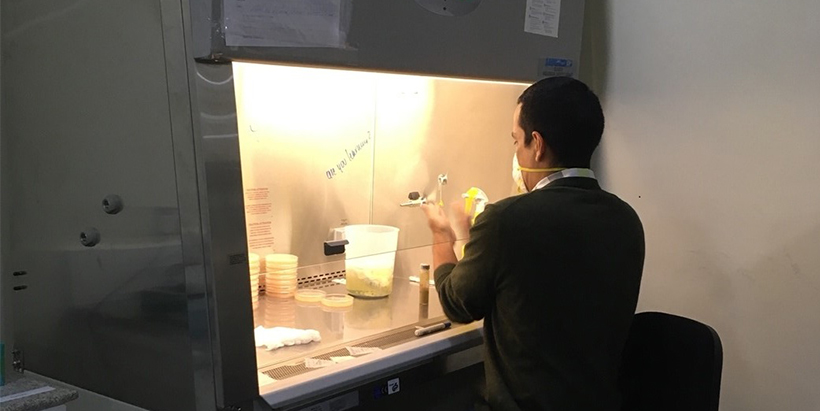
IITA Plant Pathologist Dr Alejandro Ortega-Beltran working on the inoculum to manufacture Aflasafe MZ02 in the Arusha factory.

Mozambique has the potential to contribute significantly to food security in Africa. However, only about 15% of its arable land is cultivated, mainly with staple food crops such as maize, cassava, and groundnut. Also, only about 20% of maize and groundnut produced in Mozambique enter markets; the rest is consumed at the household level. Moreover, high aflatoxin levels in these crops undermine their nutritional value and reduce access to lucrative export markets in the event of surplus production.

The country’s huge production potential and aflatoxin challenge led IITA and partners to develop and adapt the aflatoxin biocontrol technology for local use with funding from USAID. After several years, two Aflasafe products—Aflasafe MZMW01 and Aflasafe MZ02—that were developed with atoxigenic strains of Aspergillus flavus native to Mozambique and tested across the country were registered in February 2019 for commercial use by the Division of Registration and Control of Agrochemicals, in the Department of Plant Health under the National Directorate of Agriculture and Forestry in the Ministry of Agriculture and Food Safety. As a result, farmers in Mozambique now have an effective technology to address the aflatoxin menace.
IITA signs Aflasafe manufacturing and distribution agreement in Mozambique
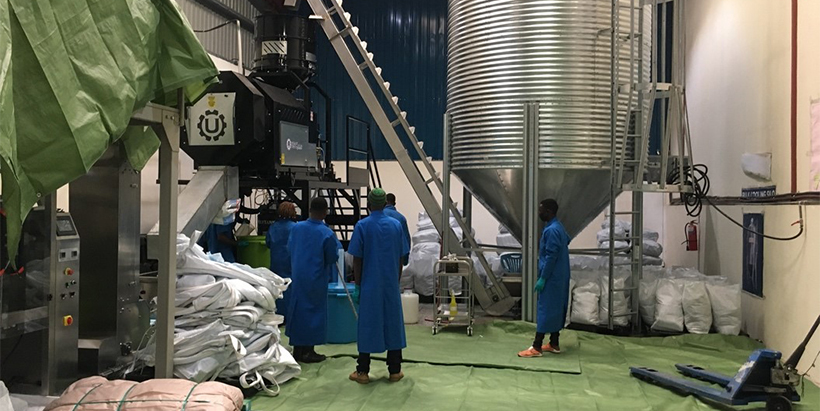
Manufacturing Aflasafe MZ02 in Arusha for Mozambican farmers’ use during the 2021 cropping season.

Groundnut growers, who had participated in the effectiveness trials of Aflasafe in Northern Mozambique, showed considerable interest in the product after seeing its tangible benefits in reducing aflatoxin accumulation. Therefore, to meet growing demand, IITA facilitated a short-term manufacturing arrangement for Aflasafe MZ02 at one of the operational licensed factories in the region.

Fifteen tons of the product were manufactured by A to Z Textiles Ltd, in Arusha (Tanzania), transported by road, and distributed by the Associação Moçambicana Para Promoção do Cooperativismo Moderno (AMPCM), a cooperative, facilitated by the Royal Norwegian Society for Development also known as Norges Vel, an international NGO.
IITA signs Aflasafe manufacturing and distribution agreement in Mozambique
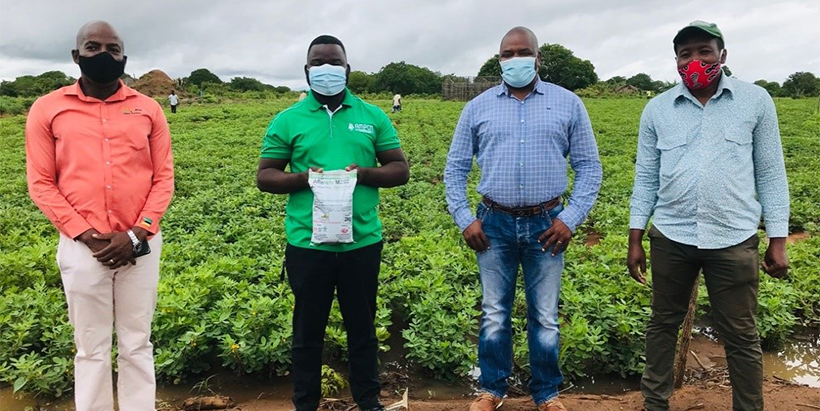
IITA Plant Pathologist and Mozambique Aflasafe Coordinator GNWG members and farmers in Mozambique in a groundnut field about to be treated with Aflasafe MZ02 produced in Arusha, late January 2021. Activities of the Aflasafe team continued despite the COVID-19 pandemic. Pictured from left to right are Rui Matos (Farmer of 23Matos company producing groundnuts), Natalino Barnete (AMPCM Manager and GNWG focal point), Joao Augusto (IITA Plant Pathologist and Mozambique Aflasafe Coordinator), and Ibraimo Chabite (Laboratory Director, University Lurio (Unilurio)).

Concurrently, discussions began with the groundnut working group to facilitate Aflasafe production in Mozambique and reduce the cost for local farmers, who have to pay more because of the import-related transactional costs, limiting widespread use. AMPCM and Norges Vel teamed up with a private company Miruku Agro Indústria (Miruku), to set up AflaLivre, a private limited liability company registered with the Legal Entities Conservatory of the Republic of Mozambique.

With Norges Vel as the majority shareholder, the core business of AflaLivre is to produce, distribute, and add value to groundnut, maize, cassava, and other agricultural products, process and manage agricultural inputs, including Aflasafe, and other agricultural-related matters.

Unlike other Aflasafe factories, this one will combine Aflasafe manufacturing and aflatoxin-safe groundnut processing in one facility. As a result, Mozambican farmers are now a step closer to having a reliable source of an aflatoxin biocontrol product at a significantly lower price than what it cost to import it from Tanzania.


Contributed by

Recent stories

No items found

Leave a Reply

Your email address will not be published. Required fields are marked *

Scroll to Top
Olaosebikan, Olamide

Olamide Deborah Nwanze is a Senior Research Associate specializing in gender mainstreaming research to inform participatory and inclusive breeding, variety development, and seed systems policies regarding root, tuber, and banana (RTB) crops in the International Institute of Tropical Agriculture Headquarters, Ibadan, Nigeria. She is a PhD candidate at the University of Ibadan and holds an MSc and B. Agric in Agricultural Extension and Rural Development. Olamide is a fellow of the African Women in Agricultural Research and Development – Gender Responsive Agricultural Systems Policy (AWARD-GRASP) and the Gender Responsive Researchers Equipped for Agricultural Transformation (GREAT). She seeks to apply her gender-mainstreaming learnings, gender-responsive research, and policy development, and review expertise to facilitate women, youth, children, and vulnerable social group’s access to and adoption of agricultural Innovations that guarantee food, nutrition, income, and livelihood security in Africa. Her current roles include mentoring research fellows, development of guides and training manuals, implementation and adaptation of gender frameworks and tools, value chain actors’ engagement as citizen science partners, policy review and redesign, data management, and analysis. Her current research explores mixed methods and participatory and interdisciplinary approaches to capture and highlight gender dynamics, needs, preferences, and challenges stakeholders face within the agricultural livelihood value chain to prioritize gender-inclusive strategies in breeding programs, policy design, and implementation.

At IITA, she contributes to the implementation of the CGIAR Accelerated Breeding Initiative and Genetic Innovation Programs; participatory and gender research within the NextGen CassavaHarvestPlusRTBFoods, and Tricot-ClimMob 1000Farms Projects; and gender knowledge communication via the G-LENS webinar series, video documentary, policy briefspublications, and blogs.


Recent publications

de Sousa, K., van Etten, J., Manners, R. Bello, A., Teeken, B., Olaosebikan, O., et al. 2024. The tricot approach: an agile framework for decentralized on-farm testing supported by citizen science. A retrospective. Agron. Sustain. Dev. 44, 8. https://doi.org/10.1007/s13593-023-00937-1

Madu, T., Onwuka, S., Nwafor, S., Onyemauwa, N., Ejechi, M., Ofoeze, M., Ukeje, B., Eluagu, C., Olaosebikan, O., Okoye, B., 2024. Gender-Inclusive Consumer Studies Improve Cassava Breeding in Nigeria in: Frontiers in Sociology, volume 9, number: 1224504, doi: 10.3389/fsoc.2024.1224504

Olaosebikan, O.; Bello, A.; Utoblo, O.; Okoye, B.; Olutegbe, N.; Garner, E.; Teeken, B.; Bryan, E.; Forsythe, L.; Cole, S.; Madu, T. 2023.  Stressors and Resilience within the Cassava Value Chain in Nigeria: Preferred Cassava Variety Traits and Response Strategies of Men and Women to Inform Breeding. Sustainability 15, 7837. https://doi.org/10.3390/su15107837

Okoye, B., Ofoeze, M., Ejechi, M., Onwuka, S., Nwafor, S., Onyemauwa, N., Ukeje, B., Eluagu, C., Obidiegwu, J.*, Olaosebikan, O., Madu, T.* 2023. Prioritizing preferred traits in the yam value chain in Nigeria: a gender situation analysis in: Frontiers in Sociology, volume 8, number: 1232626, pages 1 – 9, ISSN 2297-7775, 2023. https://www.frontiersin.org/articles/10.3389/fsoc.2023.1232626/full

Olaosebikan, O., Bello, A. A., de Sousa, K., Ndjouenkeu, R., Adesokan, M., Alamu, E. O., Agbona, A., van Etten, J., Kegah, F. N.*, Dufour, D., Bouniol, A., Teeken, B. 2023. Consumer acceptability of cassava gari-eba food products across cultural and environmental settings using the triadic comparison of technologies approach (tricot) in: Journal of the Science of Food and Agriculture,

Teeken, B., Olaosebikan, O., Bello, A. A., Madu, T.*, Cole, S. M. 2023. Qualitative assessment on the positionality and preferences of dyads in relation to cassava-related activities: working with tricot trial citizen scientists https://hdl.handle.net/10568/138326 Type: Manual

Bouniol, A., Ceballos, H., Bello, A. A., Teeken, B., Olaosebikan, O., Owoade, D., Agbona, A., Fotso Kuate, A., Madu, T.*, Okoye, B.*, Ofoeze, M.*, Nwafor, S.*, Onyemauwa, N.*, Adinsi, L.*, Forsythe, L., Dufour, D. 2023. Varietal impact on women’s labour, workload and related drudgery in processing root, tuber and banana crops: focus on cassava in sub-Saharan Africa in: Journal of the Science of Food and Agriculture, pages 1 – 25, ISSN 0022-5142,

Bello, A. A., Agbona, A., Olaosebikan, O., Edughaen, G., Dufour, D., Bouniol, A., Iluebbey, P., Ndjouenkeu, R.*, Rabbi, I. Y., Teeken, B. 2023. Genetic and environmental effects on processing productivity and food product yield: drudgery of women’s work in: Journal of the Science of Food and Agriculture, pages 1 – 32, ISSN 0022-5142, 5

Cavicchioli, M., Zimbiti, T., Teeken, B., Nwanze, D.O., Liani, M., Parkes, E. & Bello, A. 2023. IITA-Gender Responsive Breeding Training Report. Genetic Resources Center, IITA-HQ, Ibadan, 21-23 September, 2022. Ibadan, Nigeria: IITA, (34 p.).https://hdl.handle.net/10568/131368

Agbona, A. Peteti P., Teeken B., Olaosebikan O. Bello, A. A., Parkes, E., Rabbi, I. Y., Mueller, L., Egesi, C., Kulakow, P. 2022. Data Management in Multi-disciplinary African RTB Crop Breeding Programs. In: Williamson, H.F., Leonelli, S. (eds) Towards Responsible Plant Data Linkage: Data Challenges for Agricultural Research and Development. Springer, Cham. https://doi.org/10.1007/978-3-031-13276-6_5

Lora Forsythe, Pricilla Marimo, Sarah Mayanja, Olamide D. Olaosebikan, Esme Stuart, Bela Teeken, Benjamin Okoye, Tessy Madu, (2021). Cross-product Gender Analysis of RTBfoods Step 2 Gendered Food Mapping on RTB Products. Understanding the Drivers of Trait Preferences and the Development of Multi-user RTB Product Profiles, WP1. London, UK: RTBfoods Field Scientific Report, 30 p.

Teeken, B., Garner, E., Agbona, A., Balogun, I., Olaosebikan, O., Bello, A., Madu, T., Okoye, B., Egesi, C., Kulakow, P. and Tufan, H.A. 2021. Beyond “Women’s Traits”: Exploring How Gender, Social Difference, and Household Characteristics Influence Trait Preferences. Frontiers Sustainable Food Systems 5:740926. https://doi.org/10.3389/fsufs.2021.740926

Teeken, B., Agbona, A., Bello, A., Olaosebikan, O., Alamu, E., Adesokan, M., Awoyale, W., Madu, T., Okoye, B., Chijioke, U., Owoade, D., Okoro, M., Bouniol, A., Dufour, D., Hershey, C., Rabbi, I., Maziya‐Dixon, B., Egesi, C., Tufan, H. and Kulakow, P. (020. Understanding cassava varietal preferences through pairwise ranking of gari‐eba and fufu prepared by local farmer–processors. Int J Food Sci Technol. https://doi.org/10.1111/ijfs.14862

Bela Teeken, Olamide Olaosebikan, Ireti Balogun, Benjamin Okoye, Tessy Madu, Steven Cole, Abolore Bello, Elizabeth Parkes. (2020). Piloting the G+ customer and product profile tools for gender-responsive cassava breeding in Nigeria. Nigeria: International Institute of Tropical Agriculture (IITA). https://hdl.handle.net/20.500.11766/13000