
NEWS

BEST cassava project supports cassava transformation in Handeni District
October 8, 2021

With 70% of families in Handeni District, Tanga region, suffering from food insecurity and hunger for years, leading to poor performance and dropouts in schools, the leaders and agriculture department at the district level had to seek a solution for their community. Growing cassava as a food crop is an immediate option to fight hunger and malnutrition in schools because of its drought tolerance.
BEST cassava project supports cassava transformation in Handeni District
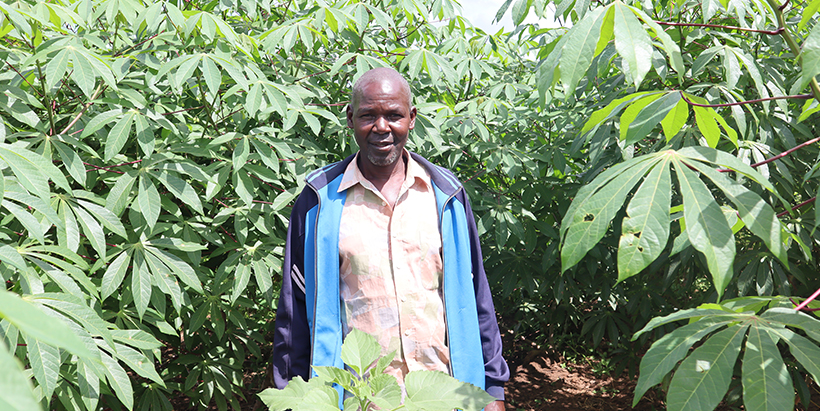
A beneficiary farmer of Handeni model, Alamin Baruti, giving a tour of his farm to show the performance of the cassava seeds distributed to him by the CSEs in Handeni district. (IITA/G.Ndibalema)

Four years after introducing cassava to the district, primary school pupils’ retention improved from 18% in 2015 to 77% in 2019, while passing performance improved from 58% in 2015 to 88% in 2020. These positive impacts increased demand for more cassava within the community, and the district leaders had to find new ways to increase availability and access to cassava seed materials for increased cassava production; thus, the beginning of the Handeni Model.

The Handeni model is a collaborative approach used by the district leadership and other stakeholders to increase food security, improve nutrition, and provide income to families through cassava production in the Handeni district.

The district leadership invited the Building an Economically Sustainable seed system for Cassava in Tanzania (BEST Cassava) project to support increasing the availability of clean seeds of improved cassava varieties. BEST Cassava is implemented by MEDA, IITA, and the Tanzania Agricultural Research Institute (TARI).
BEST cassava project supports cassava transformation in Handeni District
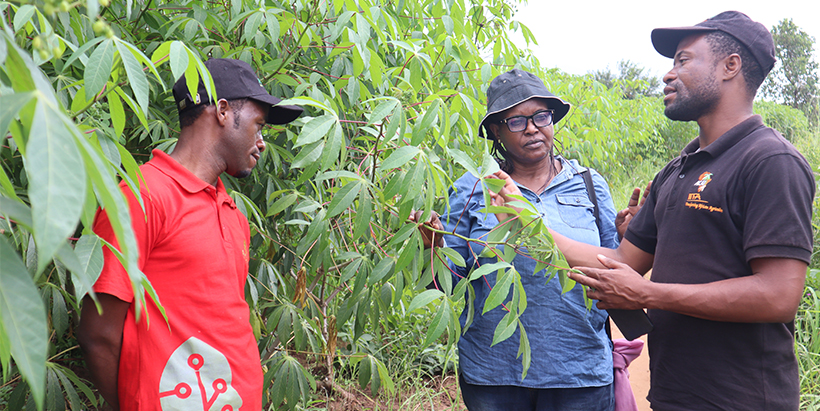
IITA researchers Ally Ng’adoa (left), Kiddo Mtunda (centre) and MEDA zonal field officer Asael John (right) touring in Alamin Baruti, a beneficiary farmer of Handeni model.

The BEST Cassava team linked the district to formal cassava seed system entrepreneurs to supply clean planting material to farmers. Moreover, the district partnered with banks and secured a bank loan worth 3 billion Tshs for Handeni farmers as capital for cassava production. They also provided a market linkage by partnering with cassava processors to purchase the cassava roots as dried chips once harvested. The district linked with markets, including cassava starch processors, who got an assured market supply for the product in and out of the country.

The stakeholders endorsed collaboration because they agreed about the underutilization of the crop in the district. The banks identified the opportunity to work with the small business sector because the district had invented a sustainable system that involved essential stakeholders along the value chain that assured minimal risks on returns from the loans they provide to farmers.

“Our initial objective was to grow cassava for food security, to save our community from hunger because the late president John Pombe Magufuli gave directives to stop providing food aid to regions affected by hunger,” said Mary Missokia, the district’s Cassava Coordinator.

“The model guarantees cassava supply from farmers for our industry; we also expect to have good quality since farmers are closely working with experts,” said Beneath Behutha, Operations Manager, Dar Canton Investment.

“Through the collective model, we are assured of a sustainable market of clean cassava seeds because the local government has offered us the tender of distributing the seeds to farmers in Handeni. This has challenged us on logistical arrangements to deliver in time and expand our seed farm sizes that will accommodate farmers’ orders,” explained Raymond Nziyajose, a member of Cassava Seed Entrepreneurs.

“On product market aspects, we are also guaranteed quality and enough cassava roots for starch processing for our export market because the district management has connected us directly with the farmers who produce cassava,” added Beneath.

“This model is a good deal for us as bankers because there is risk-sharing of investments among stakeholders. The government acts as a middleman who supervises the farmers to follow the agronomy practices to get the products expected; it also acts as a sponsor to ensure loan returns,” noted John Machunda, Manager, NMB bank.

“I am glad to have the opportunity to access a bank loan; also the access to clean seeds of improved varieties like Mkuranga,” said Alamin Baruti, a farmer from Handeni.

Mary Missokia said that by working with experienced researchers from IITA and MEDA, Handeni farmers and extension officers could learn about cassava agronomy practices. “Our district used to be a maize-growing area; many had little knowledge on cassava growing. Even our extension officers had forgotten about the practices. But through this model, farmers have learned about cassava; thus, there were misunderstandings between the farmers and seed distributors on the delay of providing seeds because farmers wanted to apply what they learned,” she proudly noted.

Handeni model stakeholders noted that despite the initiative’s good progress, some lessons are to be considered for improving the model and scaling up. The lessons include increasing availability and access of clean improved cassava seeds to farmers, increased investment in cassava seed production, intensive and proper vetting of farmers groups who are cassava agripreneurs, and increased awareness about the Handeni model and its procedures among farmers. Moreover, capacity building for farmers about agripreneur thinking in their cassava farming activities also came up.

Handeni is one among eight districts of Tanga region in the northern part of Tanzania. For many years Handeni community grew maize as their primary staple food until 2016, when maize productivity significantly dropped due to unfavorable climate conditions leading to food insecurity.  The district leaders then decided to introduce the cassava crop.


Contributed by

Recent stories

No items found

Leave a Reply

Your email address will not be published. Required fields are marked *

Scroll to Top
Olaosebikan, Olamide

Olamide Deborah Nwanze is a Senior Research Associate specializing in gender mainstreaming research to inform participatory and inclusive breeding, variety development, and seed systems policies regarding root, tuber, and banana (RTB) crops in the International Institute of Tropical Agriculture Headquarters, Ibadan, Nigeria. She is a PhD candidate at the University of Ibadan and holds an MSc and B. Agric in Agricultural Extension and Rural Development. Olamide is a fellow of the African Women in Agricultural Research and Development – Gender Responsive Agricultural Systems Policy (AWARD-GRASP) and the Gender Responsive Researchers Equipped for Agricultural Transformation (GREAT). She seeks to apply her gender-mainstreaming learnings, gender-responsive research, and policy development, and review expertise to facilitate women, youth, children, and vulnerable social group’s access to and adoption of agricultural Innovations that guarantee food, nutrition, income, and livelihood security in Africa. Her current roles include mentoring research fellows, development of guides and training manuals, implementation and adaptation of gender frameworks and tools, value chain actors’ engagement as citizen science partners, policy review and redesign, data management, and analysis. Her current research explores mixed methods and participatory and interdisciplinary approaches to capture and highlight gender dynamics, needs, preferences, and challenges stakeholders face within the agricultural livelihood value chain to prioritize gender-inclusive strategies in breeding programs, policy design, and implementation.

At IITA, she contributes to the implementation of the CGIAR Accelerated Breeding Initiative and Genetic Innovation Programs; participatory and gender research within the NextGen CassavaHarvestPlusRTBFoods, and Tricot-ClimMob 1000Farms Projects; and gender knowledge communication via the G-LENS webinar series, video documentary, policy briefspublications, and blogs.


Recent publications

de Sousa, K., van Etten, J., Manners, R. Bello, A., Teeken, B., Olaosebikan, O., et al. 2024. The tricot approach: an agile framework for decentralized on-farm testing supported by citizen science. A retrospective. Agron. Sustain. Dev. 44, 8. https://doi.org/10.1007/s13593-023-00937-1

Madu, T., Onwuka, S., Nwafor, S., Onyemauwa, N., Ejechi, M., Ofoeze, M., Ukeje, B., Eluagu, C., Olaosebikan, O., Okoye, B., 2024. Gender-Inclusive Consumer Studies Improve Cassava Breeding in Nigeria in: Frontiers in Sociology, volume 9, number: 1224504, doi: 10.3389/fsoc.2024.1224504

Olaosebikan, O.; Bello, A.; Utoblo, O.; Okoye, B.; Olutegbe, N.; Garner, E.; Teeken, B.; Bryan, E.; Forsythe, L.; Cole, S.; Madu, T. 2023.  Stressors and Resilience within the Cassava Value Chain in Nigeria: Preferred Cassava Variety Traits and Response Strategies of Men and Women to Inform Breeding. Sustainability 15, 7837. https://doi.org/10.3390/su15107837

Okoye, B., Ofoeze, M., Ejechi, M., Onwuka, S., Nwafor, S., Onyemauwa, N., Ukeje, B., Eluagu, C., Obidiegwu, J.*, Olaosebikan, O., Madu, T.* 2023. Prioritizing preferred traits in the yam value chain in Nigeria: a gender situation analysis in: Frontiers in Sociology, volume 8, number: 1232626, pages 1 – 9, ISSN 2297-7775, 2023. https://www.frontiersin.org/articles/10.3389/fsoc.2023.1232626/full

Olaosebikan, O., Bello, A. A., de Sousa, K., Ndjouenkeu, R., Adesokan, M., Alamu, E. O., Agbona, A., van Etten, J., Kegah, F. N.*, Dufour, D., Bouniol, A., Teeken, B. 2023. Consumer acceptability of cassava gari-eba food products across cultural and environmental settings using the triadic comparison of technologies approach (tricot) in: Journal of the Science of Food and Agriculture,

Teeken, B., Olaosebikan, O., Bello, A. A., Madu, T.*, Cole, S. M. 2023. Qualitative assessment on the positionality and preferences of dyads in relation to cassava-related activities: working with tricot trial citizen scientists https://hdl.handle.net/10568/138326 Type: Manual

Bouniol, A., Ceballos, H., Bello, A. A., Teeken, B., Olaosebikan, O., Owoade, D., Agbona, A., Fotso Kuate, A., Madu, T.*, Okoye, B.*, Ofoeze, M.*, Nwafor, S.*, Onyemauwa, N.*, Adinsi, L.*, Forsythe, L., Dufour, D. 2023. Varietal impact on women’s labour, workload and related drudgery in processing root, tuber and banana crops: focus on cassava in sub-Saharan Africa in: Journal of the Science of Food and Agriculture, pages 1 – 25, ISSN 0022-5142,

Bello, A. A., Agbona, A., Olaosebikan, O., Edughaen, G., Dufour, D., Bouniol, A., Iluebbey, P., Ndjouenkeu, R.*, Rabbi, I. Y., Teeken, B. 2023. Genetic and environmental effects on processing productivity and food product yield: drudgery of women’s work in: Journal of the Science of Food and Agriculture, pages 1 – 32, ISSN 0022-5142, 5

Cavicchioli, M., Zimbiti, T., Teeken, B., Nwanze, D.O., Liani, M., Parkes, E. & Bello, A. 2023. IITA-Gender Responsive Breeding Training Report. Genetic Resources Center, IITA-HQ, Ibadan, 21-23 September, 2022. Ibadan, Nigeria: IITA, (34 p.).https://hdl.handle.net/10568/131368

Agbona, A. Peteti P., Teeken B., Olaosebikan O. Bello, A. A., Parkes, E., Rabbi, I. Y., Mueller, L., Egesi, C., Kulakow, P. 2022. Data Management in Multi-disciplinary African RTB Crop Breeding Programs. In: Williamson, H.F., Leonelli, S. (eds) Towards Responsible Plant Data Linkage: Data Challenges for Agricultural Research and Development. Springer, Cham. https://doi.org/10.1007/978-3-031-13276-6_5

Lora Forsythe, Pricilla Marimo, Sarah Mayanja, Olamide D. Olaosebikan, Esme Stuart, Bela Teeken, Benjamin Okoye, Tessy Madu, (2021). Cross-product Gender Analysis of RTBfoods Step 2 Gendered Food Mapping on RTB Products. Understanding the Drivers of Trait Preferences and the Development of Multi-user RTB Product Profiles, WP1. London, UK: RTBfoods Field Scientific Report, 30 p.

Teeken, B., Garner, E., Agbona, A., Balogun, I., Olaosebikan, O., Bello, A., Madu, T., Okoye, B., Egesi, C., Kulakow, P. and Tufan, H.A. 2021. Beyond “Women’s Traits”: Exploring How Gender, Social Difference, and Household Characteristics Influence Trait Preferences. Frontiers Sustainable Food Systems 5:740926. https://doi.org/10.3389/fsufs.2021.740926

Teeken, B., Agbona, A., Bello, A., Olaosebikan, O., Alamu, E., Adesokan, M., Awoyale, W., Madu, T., Okoye, B., Chijioke, U., Owoade, D., Okoro, M., Bouniol, A., Dufour, D., Hershey, C., Rabbi, I., Maziya‐Dixon, B., Egesi, C., Tufan, H. and Kulakow, P. (020. Understanding cassava varietal preferences through pairwise ranking of gari‐eba and fufu prepared by local farmer–processors. Int J Food Sci Technol. https://doi.org/10.1111/ijfs.14862

Bela Teeken, Olamide Olaosebikan, Ireti Balogun, Benjamin Okoye, Tessy Madu, Steven Cole, Abolore Bello, Elizabeth Parkes. (2020). Piloting the G+ customer and product profile tools for gender-responsive cassava breeding in Nigeria. Nigeria: International Institute of Tropical Agriculture (IITA). https://hdl.handle.net/20.500.11766/13000