
Despite the heavy-laden coffee trees in Fred Salongo Kigongo’s coffee garden, the income from the coffee has never been enough to cater for his large family. Prolonged droughts, weather variability, and the never-ending cases of pests and diseases have affected most of Uganda’s 1.7 million smallholder farmers, resulting in the very high costs associated with proper management of the coffee farms, which most farmers cannot afford. This has led to a severe decline in coffee yields. Farmers now also experience one harvest season, yet the region previously experienced multiple harvests annually. To address this, IITA developed the Stepwise approach in collaboration with partners. Stepwise breaks down the recommended best practices that many farmers cannot afford into smaller, more affordable packages that can be implemented in phases.
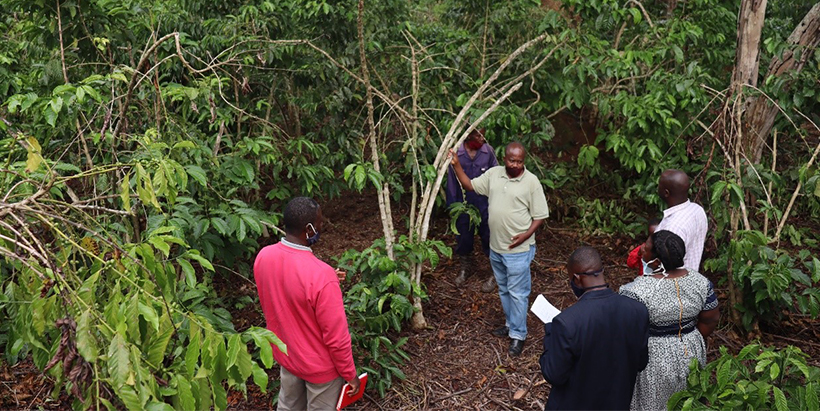
Kigongo was among the few farmers selected from Bakyabumba Farmers’ Cooperative to participate in the experiment. Because he managed the experiment well, his home has become a learning center/farmer field school where groups of 15 to 25 farmers receive regular training on good agricultural practices (GAPs). The training aligns with the cropping calendar. This approach motivates farmers to adopt the same techniques on their farms.
Kigongo admits that when IITA Research Associate David Mukasa visited his farm, he had a firewood forest, not coffee. He refers to his coffee garden as “ekibira,” translated as forest. Not anymore though, he proudly informs the participants. As the group makes their way through the steps from the control to step 4 of the demonstration, one cannot help but hear the “oohs” and “aahs” of admiration.
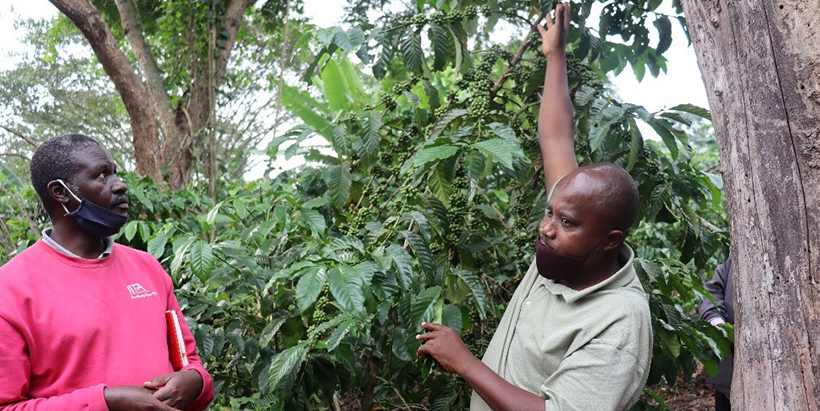
July in Luweero is the season of the fly crop. However, Kigongo admits that he has harvested more coffee during the fly crop season than he previously did during the primary season. He attributes all this to the climate-smart technologies that were introduced in his farm.
While thanking IITA and Hanns R. Neumann Stiftung – HRNS, Kigongo informs everyone that he is now referred to as “the” coffee farmer even though several other coffee farmers are in his village. Kigongo has transferred his knowledge from the demonstration and applied it to the rest of his coffee gardens. He now boasts of having two coffee harvest seasons, something almost unheard of in Luweero district due to climate change.
IITA utilized the already existing structures of depot committees and producer organizations of implementing partner HRNS within Luweero district to identify and reach farmers to test and validate the stepwise approach.
Contributed by
Recent stories