
NEWS

International, multi-stakeholder alliance continue to tackle banana bunchy top disease in Africa
November 12, 2021

Up to 16 African countries have now experienced the banana bunchy top disease (BBTD), caused by the banana bunchy top virus (BBTV), which threatens the livelihoods of 70 million vulnerable banana farmers. The virus is also endangering the diversity of banana varieties grown by these farmers. The CGIAR Research Program on Roots, Tubers and Bananas (RTB) is combating the virus through the Alliance for Banana Bunchy Top Disease Control in Africa.

The BBTD Alliance convened international, multi-stakeholder teams fostering cutting-edge research for development (R4D) to establish practical solutions so farmers can once again produce bananas for food and income. The Alliance has collaborated with national programs, building their capacity to detect, surveil, and control BBTD.
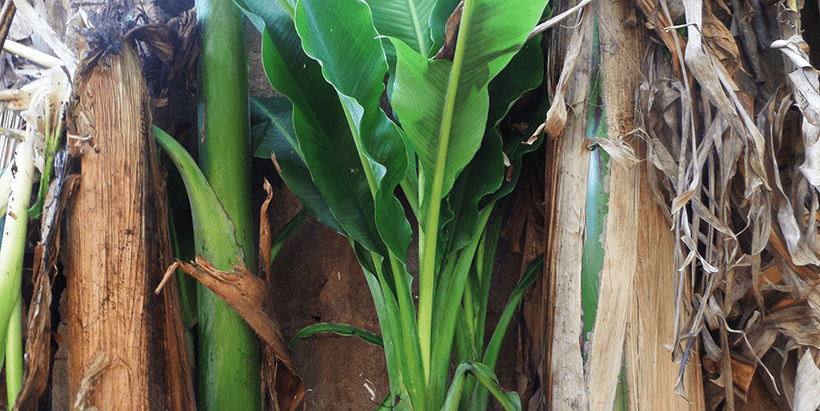
Fresh banana plants exhibiting subtle Bunchy top symptoms. (Photo: L. Kumar/IITA)

This disease stunts the plant, stopping fruit production, sometimes causing total crop loss in a single season. Farmers are advised to eliminate infected banana mats and replace them with healthy suckers. However, smallholders hesitate to destroy large parts of their banana gardens, especially if some of their plants still bear bunches.

BBTD increases the demand for clean planting material but makes it more challenging to find the seed of local landraces, threatening the diversity of well-adapted landraces. Farmers need to act collectively to prevent the disease from spreading to their community or reinfecting after replanting.

Since the disease was first reported in the Democratic Republic of Congo (DRC) in the 1960s, the virus has invaded several countries across sub-Saharan Africa, spreading through planting material and an insect vector—the banana aphid.

Because BBTD can easily cross borders, management requires international cooperation. In 2011, RTB set up the BBTD Alliance, coordinated by IITA, the Alliance of Bioversity International and CIAT, CIRAD, and national research partners in Benin, Burundi, Cameroon, Congo Brazzaville, DRC, Ghana, Malawi, Nigeria, and Zambia. Other partners include the FAO, the Inter-African Phytosanitary Council (IAPSC), and research partners from Australia (University of Queensland), Asia, Europe, India, Kenya, UK (University of Cambridge), and the USA.

The BBTD Alliance develops new knowledge and management technologies, facilitates training and information exchange, and supports national partners and farmer organizations. Seed entrepreneurs, extension agents, farmers, and plant health inspectors are learning to diagnose the disease in the field, identify rogue infected plants, and produce clean planting material. In 2020, RTB developed an online training course on disease recognition and eradication.
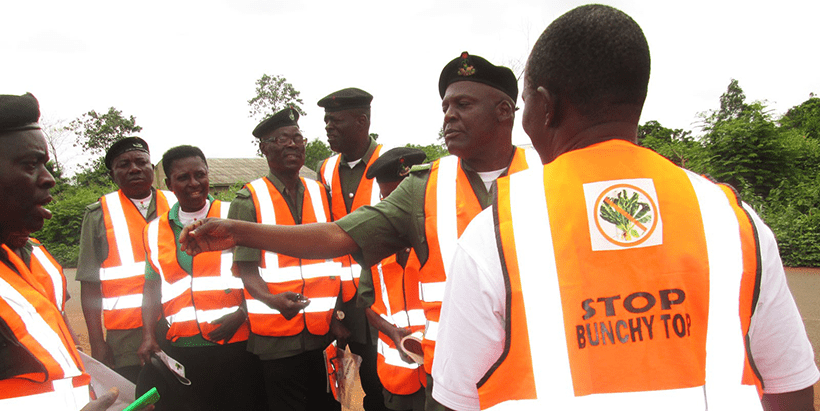
Getting ready for surveillance and eradication of BBTV infected banana plants. (Photo: L. Kumar/IITA)

Trials conducted in Benin, Burundi, and Malawi have effectively maintained BBTD levels below 1%, supporting the production of low-risk seed for expansion. Farmers learned to multiply clean seed and were linked to tissue culture and other sources of healthy planting material.

Early detection of BBTD and the virus’s eradication in Togo is the first case for halting the spread of an invasive virus in sub-Saharan Africa. Demonstrations and hands-on training helped Togolese partners eliminate the disease. Farmers, extension workers, policymakers, and donors also saw how BBTD was managed in Benin, Cameroon, Malawi, and Nigeria.

BBTD Alliance studies also examined gendered access to information and resources in Benin, Cameroon, and Nigeria. In Cameroon, men had more influence in decision-making over farm resources and information services, even when women were more involved in actual seed and site selection. Men also had greater access to clean seed than women. “Getting healthy planting material is crucial for managing bunchy top, and if women cannot access clean seed, they are at a disadvantage. Projects across Africa will have to ensure that women have equal access to healthy planting material,” said Lava Kumar, Virologist and Head of IITA’s Germplasm Health Unit.


Contributed by

Recent stories

No items found

Leave a Reply

Your email address will not be published. Required fields are marked *

Scroll to Top
Olaosebikan, Olamide

Olamide Deborah Nwanze is a Senior Research Associate specializing in gender mainstreaming research to inform participatory and inclusive breeding, variety development, and seed systems policies regarding root, tuber, and banana (RTB) crops in the International Institute of Tropical Agriculture Headquarters, Ibadan, Nigeria. She is a PhD candidate at the University of Ibadan and holds an MSc and B. Agric in Agricultural Extension and Rural Development. Olamide is a fellow of the African Women in Agricultural Research and Development – Gender Responsive Agricultural Systems Policy (AWARD-GRASP) and the Gender Responsive Researchers Equipped for Agricultural Transformation (GREAT). She seeks to apply her gender-mainstreaming learnings, gender-responsive research, and policy development, and review expertise to facilitate women, youth, children, and vulnerable social group’s access to and adoption of agricultural Innovations that guarantee food, nutrition, income, and livelihood security in Africa. Her current roles include mentoring research fellows, development of guides and training manuals, implementation and adaptation of gender frameworks and tools, value chain actors’ engagement as citizen science partners, policy review and redesign, data management, and analysis. Her current research explores mixed methods and participatory and interdisciplinary approaches to capture and highlight gender dynamics, needs, preferences, and challenges stakeholders face within the agricultural livelihood value chain to prioritize gender-inclusive strategies in breeding programs, policy design, and implementation.

At IITA, she contributes to the implementation of the CGIAR Accelerated Breeding Initiative and Genetic Innovation Programs; participatory and gender research within the NextGen CassavaHarvestPlusRTBFoods, and Tricot-ClimMob 1000Farms Projects; and gender knowledge communication via the G-LENS webinar series, video documentary, policy briefspublications, and blogs.


Recent publications

de Sousa, K., van Etten, J., Manners, R. Bello, A., Teeken, B., Olaosebikan, O., et al. 2024. The tricot approach: an agile framework for decentralized on-farm testing supported by citizen science. A retrospective. Agron. Sustain. Dev. 44, 8. https://doi.org/10.1007/s13593-023-00937-1

Madu, T., Onwuka, S., Nwafor, S., Onyemauwa, N., Ejechi, M., Ofoeze, M., Ukeje, B., Eluagu, C., Olaosebikan, O., Okoye, B., 2024. Gender-Inclusive Consumer Studies Improve Cassava Breeding in Nigeria in: Frontiers in Sociology, volume 9, number: 1224504, doi: 10.3389/fsoc.2024.1224504

Olaosebikan, O.; Bello, A.; Utoblo, O.; Okoye, B.; Olutegbe, N.; Garner, E.; Teeken, B.; Bryan, E.; Forsythe, L.; Cole, S.; Madu, T. 2023.  Stressors and Resilience within the Cassava Value Chain in Nigeria: Preferred Cassava Variety Traits and Response Strategies of Men and Women to Inform Breeding. Sustainability 15, 7837. https://doi.org/10.3390/su15107837

Okoye, B., Ofoeze, M., Ejechi, M., Onwuka, S., Nwafor, S., Onyemauwa, N., Ukeje, B., Eluagu, C., Obidiegwu, J.*, Olaosebikan, O., Madu, T.* 2023. Prioritizing preferred traits in the yam value chain in Nigeria: a gender situation analysis in: Frontiers in Sociology, volume 8, number: 1232626, pages 1 – 9, ISSN 2297-7775, 2023. https://www.frontiersin.org/articles/10.3389/fsoc.2023.1232626/full

Olaosebikan, O., Bello, A. A., de Sousa, K., Ndjouenkeu, R., Adesokan, M., Alamu, E. O., Agbona, A., van Etten, J., Kegah, F. N.*, Dufour, D., Bouniol, A., Teeken, B. 2023. Consumer acceptability of cassava gari-eba food products across cultural and environmental settings using the triadic comparison of technologies approach (tricot) in: Journal of the Science of Food and Agriculture,

Teeken, B., Olaosebikan, O., Bello, A. A., Madu, T.*, Cole, S. M. 2023. Qualitative assessment on the positionality and preferences of dyads in relation to cassava-related activities: working with tricot trial citizen scientists https://hdl.handle.net/10568/138326 Type: Manual

Bouniol, A., Ceballos, H., Bello, A. A., Teeken, B., Olaosebikan, O., Owoade, D., Agbona, A., Fotso Kuate, A., Madu, T.*, Okoye, B.*, Ofoeze, M.*, Nwafor, S.*, Onyemauwa, N.*, Adinsi, L.*, Forsythe, L., Dufour, D. 2023. Varietal impact on women’s labour, workload and related drudgery in processing root, tuber and banana crops: focus on cassava in sub-Saharan Africa in: Journal of the Science of Food and Agriculture, pages 1 – 25, ISSN 0022-5142,

Bello, A. A., Agbona, A., Olaosebikan, O., Edughaen, G., Dufour, D., Bouniol, A., Iluebbey, P., Ndjouenkeu, R.*, Rabbi, I. Y., Teeken, B. 2023. Genetic and environmental effects on processing productivity and food product yield: drudgery of women’s work in: Journal of the Science of Food and Agriculture, pages 1 – 32, ISSN 0022-5142, 5

Cavicchioli, M., Zimbiti, T., Teeken, B., Nwanze, D.O., Liani, M., Parkes, E. & Bello, A. 2023. IITA-Gender Responsive Breeding Training Report. Genetic Resources Center, IITA-HQ, Ibadan, 21-23 September, 2022. Ibadan, Nigeria: IITA, (34 p.).https://hdl.handle.net/10568/131368

Agbona, A. Peteti P., Teeken B., Olaosebikan O. Bello, A. A., Parkes, E., Rabbi, I. Y., Mueller, L., Egesi, C., Kulakow, P. 2022. Data Management in Multi-disciplinary African RTB Crop Breeding Programs. In: Williamson, H.F., Leonelli, S. (eds) Towards Responsible Plant Data Linkage: Data Challenges for Agricultural Research and Development. Springer, Cham. https://doi.org/10.1007/978-3-031-13276-6_5

Lora Forsythe, Pricilla Marimo, Sarah Mayanja, Olamide D. Olaosebikan, Esme Stuart, Bela Teeken, Benjamin Okoye, Tessy Madu, (2021). Cross-product Gender Analysis of RTBfoods Step 2 Gendered Food Mapping on RTB Products. Understanding the Drivers of Trait Preferences and the Development of Multi-user RTB Product Profiles, WP1. London, UK: RTBfoods Field Scientific Report, 30 p.

Teeken, B., Garner, E., Agbona, A., Balogun, I., Olaosebikan, O., Bello, A., Madu, T., Okoye, B., Egesi, C., Kulakow, P. and Tufan, H.A. 2021. Beyond “Women’s Traits”: Exploring How Gender, Social Difference, and Household Characteristics Influence Trait Preferences. Frontiers Sustainable Food Systems 5:740926. https://doi.org/10.3389/fsufs.2021.740926

Teeken, B., Agbona, A., Bello, A., Olaosebikan, O., Alamu, E., Adesokan, M., Awoyale, W., Madu, T., Okoye, B., Chijioke, U., Owoade, D., Okoro, M., Bouniol, A., Dufour, D., Hershey, C., Rabbi, I., Maziya‐Dixon, B., Egesi, C., Tufan, H. and Kulakow, P. (020. Understanding cassava varietal preferences through pairwise ranking of gari‐eba and fufu prepared by local farmer–processors. Int J Food Sci Technol. https://doi.org/10.1111/ijfs.14862

Bela Teeken, Olamide Olaosebikan, Ireti Balogun, Benjamin Okoye, Tessy Madu, Steven Cole, Abolore Bello, Elizabeth Parkes. (2020). Piloting the G+ customer and product profile tools for gender-responsive cassava breeding in Nigeria. Nigeria: International Institute of Tropical Agriculture (IITA). https://hdl.handle.net/20.500.11766/13000