Tricot approach: Cassava and potato trials show promising results in Rwanda
December 22, 2021
IITA and partners—the Rwanda Agriculture and Animal Resources Development Board (RAB), the International Potato Center (CIP), One Acre Fund (OAF), and the Alliance of Bioversity International and CIAT (the Alliance)—are implementing the triadic comparison of technology options (tricot) methodology to help farmers identify the most suitable crop varieties for the local conditions of their farm. This approach has been used since 2020 to identify novel varieties of potato and cassava preferred by farmers for release.
In November 2021, the tricot partners (IITA, RAB, CIP, OAF, and the Alliance) gathered in Rwanda to present and discuss the results from the two years of trials and plan potential next steps for trials and potential mainstreaming of tricot into RAB and OAF. Both RAB and OAF demonstrated interest in a stepped adoption of tricot as part of their variety selection activities.
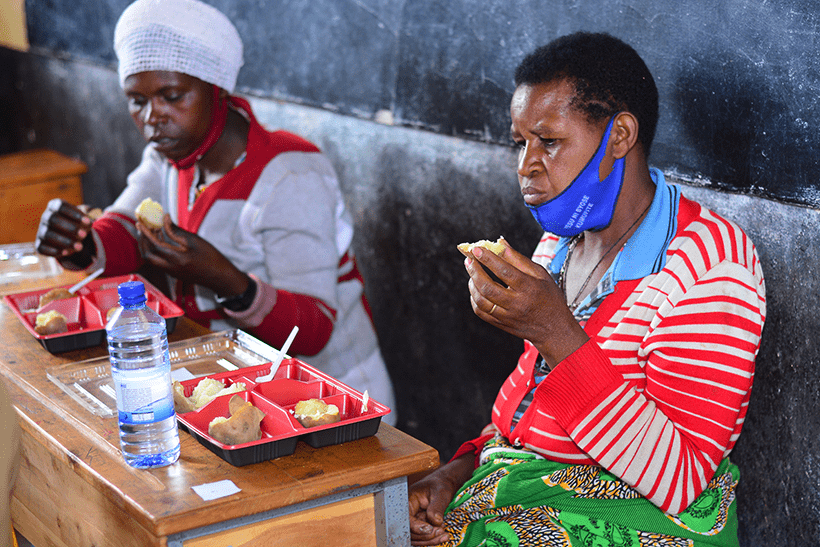
Consumer analysis for the tricot potato trials.
OAF Agricultural Research Specialist Elyse Tuyishime commented, “We have been using the Randomized Complete Block Design (RCBD) approach in our field trials, which requires all participants to have the same varieties. Alternatively, the tricot approach uses an incomplete block design, allowing participants to use different varieties. Since working on this project, I have realized that this [tricot] approach is very efficient because a researcher does not conduct the trial; farmers lead the research by planting trials under their normal practices and conditions. Moreover, for the RCBD approach, a farmer is passive; therefore, the trials inform primarily a researcher, not a farmer.”
She noted that because farmers actively conduct the trials using the tricot approach, the results inform both the farmer and researcher. Further, the tricot approach is cheaper, as field visits are not necessary, and the approach also facilitates data sharing.”
Tricot trials in Rwanda
Tricot engages farmers as “farmer researchers” in testing or validating new crop varieties and other promising technologies. Each participating farmer executes the mini-task of evaluating only three varieties, out of a range to be tested, in their fields under their actual farm conditions and usual agricultural practices. The methodology does not specify management practices, simply requesting farmers to treat the plots as they usually do their own.
The farmer ranks their preferred variety relative to a suite of traits (e.g., yield, disease resistance, taste, marketability). The methodology works on the premise of external validity to validate varieties.
During the project, RAB, OAF, IITA, CIP, and the Alliance researchers monitored the trials using digital tools. Data collected and recorded through phone-based data collection applications are analyzed in ClimMob (tricot’s analytics application). Farmers from Gicumbi, Nyabihu, and Nyamagabe participated in the potato trials and Bugesera, Kamonyi, Nyanza, and Ruhango, in the cassava trials.
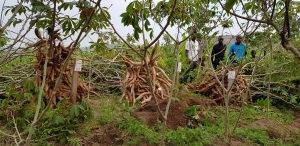
Farmers in Ruhango district, Rwanda observing cassava root yield from tricot trials.
The first season of cassava trials was recently harvested, with farmers and researchers measuring the cassava yield together, thus enabling yield comparisons across varieties and agroecological zones.
“From the yield that I am seeing right now, taking into consideration that these cassava varieties have only been in the ground for 11 months (our local cassava varieties normally mature from 12 to 15 months), these varieties are very promising. I think these varieties will increase cassava production in our area. I have already prepared land to plant these cuttings in the next agricultural season,” said Daniel Habimana, one of the participating farmers from Kigoma sector, Nyanza District, who evaluated the novel cassava varieties using the tricot approach.
The simplicity of tricot allows its use across value chains, not just by producers but also by processors and consumers. More than 100 consumers across Rwanda recently shared their preferences on potato varieties using the tricot approach. Participants were invited to rank their preferred potato varieties, identifying their favorite in terms of taste, appearance, and other characteristics. The initial results from this exercise highlighted that consumers’ preferences were notably different from producers. These results reinforce the need for a full value-chain analysis of varieties before recommending them for release.
The current phase of the project will conclude in Rwanda in December 2021. Despite this, the benefits of the tricot approach are evident by both RAB and OAF showing interest in gradually adopting it for their variety selection research. Following this, the Bill & Melinda Gates Foundation recently approved a pan-African project that will see these activities continue in Rwanda.
Olamide Deborah Nwanze is a Senior Research Associate specializing in gender mainstreaming research to inform participatory and inclusive breeding, variety development, and seed systems policies regarding root, tuber, and banana (RTB) crops in the International Institute of Tropical Agriculture Headquarters, Ibadan, Nigeria. She is a PhD candidate at the University of Ibadan and holds an MSc and B. Agric in Agricultural Extension and Rural Development. Olamide is a fellow of the African Women in Agricultural Research and Development – Gender Responsive Agricultural Systems Policy (AWARD-GRASP) and the Gender Responsive Researchers Equipped for Agricultural Transformation (GREAT). She seeks to apply her gender-mainstreaming learnings, gender-responsive research, and policy development, and review expertise to facilitate women, youth, children, and vulnerable social group’s access to and adoption of agricultural Innovations that guarantee food, nutrition, income, and livelihood security in Africa. Her current roles include mentoring research fellows, development of guides and training manuals, implementation and adaptation of gender frameworks and tools, value chain actors’ engagement as citizen science partners, policy review and redesign, data management, and analysis. Her current research explores mixed methods and participatory and interdisciplinary approaches to capture and highlight gender dynamics, needs, preferences, and challenges stakeholders face within the agricultural livelihood value chain to prioritize gender-inclusive strategies in breeding programs, policy design, and implementation.
de Sousa, K., van Etten, J., Manners, R. Bello, A., Teeken, B., Olaosebikan, O., et al. 2024. The tricot approach: an agile framework for decentralized on-farm testing supported by citizen science. A retrospective. Agron. Sustain. Dev. 44, 8. https://doi.org/10.1007/s13593-023-00937-1
Madu, T., Onwuka, S., Nwafor, S., Onyemauwa, N., Ejechi, M., Ofoeze, M., Ukeje, B., Eluagu, C., Olaosebikan, O., Okoye, B., 2024. Gender-Inclusive Consumer Studies Improve Cassava Breeding in Nigeria in: Frontiers in Sociology, volume 9, number: 1224504, doi: 10.3389/fsoc.2024.1224504
Olaosebikan, O.; Bello, A.; Utoblo, O.; Okoye, B.; Olutegbe, N.; Garner, E.; Teeken, B.; Bryan, E.; Forsythe, L.; Cole, S.; Madu, T. 2023. Stressors and Resilience within the Cassava Value Chain in Nigeria: Preferred Cassava Variety Traits and Response Strategies of Men and Women to Inform Breeding. Sustainability 15, 7837. https://doi.org/10.3390/su15107837
Okoye, B., Ofoeze, M., Ejechi, M., Onwuka, S., Nwafor, S., Onyemauwa, N., Ukeje, B., Eluagu, C., Obidiegwu, J.*, Olaosebikan, O., Madu, T.* 2023. Prioritizing preferred traits in the yam value chain in Nigeria: a gender situation analysis in: Frontiers in Sociology, volume 8, number: 1232626, pages 1 – 9, ISSN 2297-7775, 2023. https://www.frontiersin.org/articles/10.3389/fsoc.2023.1232626/full
Olaosebikan, O., Bello, A. A., de Sousa, K., Ndjouenkeu, R., Adesokan, M., Alamu, E. O., Agbona, A., van Etten, J., Kegah, F. N.*, Dufour, D., Bouniol, A., Teeken, B. 2023. Consumer acceptability of cassava gari-eba food products across cultural and environmental settings using the triadic comparison of technologies approach (tricot) in: Journal of the Science of Food and Agriculture,
Teeken, B., Olaosebikan, O., Bello, A. A., Madu, T.*, Cole, S. M. 2023. Qualitative assessment on the positionality and preferences of dyads in relation to cassava-related activities: working with tricot trial citizen scientists https://hdl.handle.net/10568/138326 Type: Manual
Bouniol, A., Ceballos, H., Bello, A. A., Teeken, B., Olaosebikan, O., Owoade, D., Agbona, A., Fotso Kuate, A., Madu, T.*, Okoye, B.*, Ofoeze, M.*, Nwafor, S.*, Onyemauwa, N.*, Adinsi, L.*, Forsythe, L., Dufour, D. 2023. Varietal impact on women’s labour, workload and related drudgery in processing root, tuber and banana crops: focus on cassava in sub-Saharan Africa in: Journal of the Science of Food and Agriculture, pages 1 – 25, ISSN 0022-5142,
Bello, A. A., Agbona, A., Olaosebikan, O., Edughaen, G., Dufour, D., Bouniol, A., Iluebbey, P., Ndjouenkeu, R.*, Rabbi, I. Y., Teeken, B. 2023. Genetic and environmental effects on processing productivity and food product yield: drudgery of women’s work in: Journal of the Science of Food and Agriculture, pages 1 – 32, ISSN 0022-5142, 5
Cavicchioli, M., Zimbiti, T., Teeken, B., Nwanze, D.O., Liani, M., Parkes, E. & Bello, A. 2023. IITA-Gender Responsive Breeding Training Report. Genetic Resources Center, IITA-HQ, Ibadan, 21-23 September, 2022. Ibadan, Nigeria: IITA, (34 p.).https://hdl.handle.net/10568/131368
Agbona, A. Peteti P., Teeken B., Olaosebikan O. Bello, A. A., Parkes, E., Rabbi, I. Y., Mueller, L., Egesi, C., Kulakow, P. 2022. Data Management in Multi-disciplinary African RTB Crop Breeding Programs. In: Williamson, H.F., Leonelli, S. (eds) Towards Responsible Plant Data Linkage: Data Challenges for Agricultural Research and Development. Springer, Cham. https://doi.org/10.1007/978-3-031-13276-6_5
Lora Forsythe, Pricilla Marimo, Sarah Mayanja, Olamide D. Olaosebikan, Esme Stuart, Bela Teeken, Benjamin Okoye, Tessy Madu, (2021). Cross-product Gender Analysis of RTBfoods Step 2 Gendered Food Mapping on RTB Products. Understanding the Drivers of Trait Preferences and the Development of Multi-user RTB Product Profiles, WP1. London, UK: RTBfoods Field Scientific Report, 30 p.
Teeken, B., Garner, E., Agbona, A., Balogun, I., Olaosebikan, O., Bello, A., Madu, T., Okoye, B., Egesi, C., Kulakow, P. and Tufan, H.A. 2021. Beyond “Women’s Traits”: Exploring How Gender, Social Difference, and Household Characteristics Influence Trait Preferences. Frontiers Sustainable Food Systems 5:740926. https://doi.org/10.3389/fsufs.2021.740926
Teeken, B., Agbona, A., Bello, A., Olaosebikan, O., Alamu, E., Adesokan, M., Awoyale, W., Madu, T., Okoye, B., Chijioke, U., Owoade, D., Okoro, M., Bouniol, A., Dufour, D., Hershey, C., Rabbi, I., Maziya‐Dixon, B., Egesi, C., Tufan, H. and Kulakow, P. (020. Understanding cassava varietal preferences through pairwise ranking of gari‐eba and fufu prepared by local farmer–processors. Int J Food Sci Technol.https://doi.org/10.1111/ijfs.14862
Bela Teeken, Olamide Olaosebikan, Ireti Balogun, Benjamin Okoye, Tessy Madu, Steven Cole, Abolore Bello, Elizabeth Parkes. (2020). Piloting the G+ customer and product profile tools for gender-responsive cassava breeding in Nigeria. Nigeria: International Institute of Tropical Agriculture (IITA). https://hdl.handle.net/20.500.11766/13000