
NEWS

Research shows material from banana waste can help fight destructive potato cyst nematodes
March 24, 2022

With potato production in East Africa under increasing threat from the invasive and highly destructive potato cyst nematode (PCN) pest, an organic technology developed from banana plant waste material may be the ultimate rescue. Known as “wrap and plant”, the solution involves enclosing potato seed in a thick absorbent paper made from the fiber of banana plants before planting. This strategy provides a protective barrier for the plants against damage by PCN.
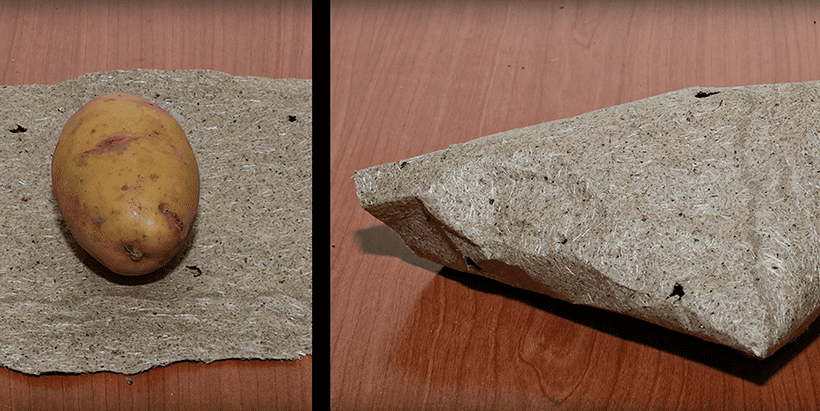
The “wrap and plant” or W&P technology involves enclosing potato seed in a thick absorbent paper made from banana fiber before planting.

These research findings led by the International Centre of Insect Physiology and Ecology (icipe), IITA, and North Carolina State University, USA, working with various partners, have been published recently in Nature Sustainability (https://rdcu.be/cHVSg; article in Science; short video).

“Initially, we aimed to understand whether the “wrap and plant” technology could improve the delivery and effectiveness of nematicides, the chemical agents used to control parasitic worms that damage crops, such as nematodes,” notes Juliet Ochola (Kenya). She was involved in the research as part of her MSc studies that she completed at Kenyatta University, Kenya, in 2021, co-supervised by icipe and IITA.

She adds: “We established that when loaded with ultra-low dosages of nematicides, the banana paper enables the chemicals to be released in a slow and sustained manner and in very low but effective concentrations. The paper also facilitates the nematicides to be conveyed specifically to the root zone of the potato plants; the infection site of the nematodes, thus preventing contamination to non-target areas and organisms.”

As Prof. Baldwyn Torto, Head, Behavioural and Chemical Ecology Unit, icipe, explains, the most significant discovery of this study was that, even without the nematicides, the “wrap and plant” technology protects potato from PCN damage. “We established that the banana-fiber has unique sponge-like properties. Thus, through a process known scientifically as ‘hydrogen bonding’, the ‘wrap and plant’ paper can soak and physically bind the critical chemical signals released by potato crops that allow the PCN to hatch, find, and infect the plant’s roots. We confirmed this to be the case, as we recovered these chemicals from the paper,” he states.

The banana-fiber characteristics make the “wrap and plant” paper dense, rigid, and sturdy, such that it remains intact in the soil while also allowing the plant’s roots to germinate and thrive. Although the paper is durable, it is also biodegradable and eventually decomposes.
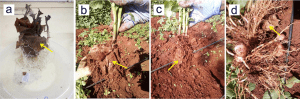
Root penetration through the banana waste based material and its gradual decomposition after 2 weeks (a), 4 weeks (b), 6 weeks (c), and 8 weeks (d) of potato growth.

First detected in Kenya in 2015, the PCN pest has now widely spread across major potato growing regions and in Rwanda and Uganda. “Our estimates show that PCNs are causing potato production declines of more than 60 percent, with projectionsndicating an even worse scenario,” notes Prof. Danny Coyne, IITA Soil Health Scientist. “The current study demonstrates that the ‘wrap and plant’ paper, whether containing nematicides or not, and depending on the practices of individual farmers, can increase potato yield by up to five times. This is by preventing the damage by PCNs and other nematode species.”

The “wrap and plant” technology is a promising boost for food and nutrition security and household incomes, as it will help safeguard the production of potato, East Africa’s second most important staple crop. It also contributes to the vision of a circular economy by transforming banana-fiber, often regarded as agricultural waste and a nuisance for farmers, into raw material for a pest control innovation. This could create opportunities for entrepreneurs and farmers.

Besides reducing overuse or misuse of chemical pesticides, the “wrap and plant” technology supports environmental protection by curtailing the growing trend where farmers are compelled to clear forests unsustainably to create productive fields free of PCNs and other pests. Overall, this breakthrough in PCN control demonstrates an environmentally-friendly way to counter disruptions in sustainable food systems.
Contributed by Liz Ng’ang’a (ngangaen@gmail.com)


Contributed by

Recent stories

No items found

Leave a Reply

Your email address will not be published. Required fields are marked *

Scroll to Top
Olaosebikan, Olamide

Olamide Deborah Nwanze is a Senior Research Associate specializing in gender mainstreaming research to inform participatory and inclusive breeding, variety development, and seed systems policies regarding root, tuber, and banana (RTB) crops in the International Institute of Tropical Agriculture Headquarters, Ibadan, Nigeria. She is a PhD candidate at the University of Ibadan and holds an MSc and B. Agric in Agricultural Extension and Rural Development. Olamide is a fellow of the African Women in Agricultural Research and Development – Gender Responsive Agricultural Systems Policy (AWARD-GRASP) and the Gender Responsive Researchers Equipped for Agricultural Transformation (GREAT). She seeks to apply her gender-mainstreaming learnings, gender-responsive research, and policy development, and review expertise to facilitate women, youth, children, and vulnerable social group’s access to and adoption of agricultural Innovations that guarantee food, nutrition, income, and livelihood security in Africa. Her current roles include mentoring research fellows, development of guides and training manuals, implementation and adaptation of gender frameworks and tools, value chain actors’ engagement as citizen science partners, policy review and redesign, data management, and analysis. Her current research explores mixed methods and participatory and interdisciplinary approaches to capture and highlight gender dynamics, needs, preferences, and challenges stakeholders face within the agricultural livelihood value chain to prioritize gender-inclusive strategies in breeding programs, policy design, and implementation.

At IITA, she contributes to the implementation of the CGIAR Accelerated Breeding Initiative and Genetic Innovation Programs; participatory and gender research within the NextGen CassavaHarvestPlusRTBFoods, and Tricot-ClimMob 1000Farms Projects; and gender knowledge communication via the G-LENS webinar series, video documentary, policy briefspublications, and blogs.


Recent publications

de Sousa, K., van Etten, J., Manners, R. Bello, A., Teeken, B., Olaosebikan, O., et al. 2024. The tricot approach: an agile framework for decentralized on-farm testing supported by citizen science. A retrospective. Agron. Sustain. Dev. 44, 8. https://doi.org/10.1007/s13593-023-00937-1

Madu, T., Onwuka, S., Nwafor, S., Onyemauwa, N., Ejechi, M., Ofoeze, M., Ukeje, B., Eluagu, C., Olaosebikan, O., Okoye, B., 2024. Gender-Inclusive Consumer Studies Improve Cassava Breeding in Nigeria in: Frontiers in Sociology, volume 9, number: 1224504, doi: 10.3389/fsoc.2024.1224504

Olaosebikan, O.; Bello, A.; Utoblo, O.; Okoye, B.; Olutegbe, N.; Garner, E.; Teeken, B.; Bryan, E.; Forsythe, L.; Cole, S.; Madu, T. 2023.  Stressors and Resilience within the Cassava Value Chain in Nigeria: Preferred Cassava Variety Traits and Response Strategies of Men and Women to Inform Breeding. Sustainability 15, 7837. https://doi.org/10.3390/su15107837

Okoye, B., Ofoeze, M., Ejechi, M., Onwuka, S., Nwafor, S., Onyemauwa, N., Ukeje, B., Eluagu, C., Obidiegwu, J.*, Olaosebikan, O., Madu, T.* 2023. Prioritizing preferred traits in the yam value chain in Nigeria: a gender situation analysis in: Frontiers in Sociology, volume 8, number: 1232626, pages 1 – 9, ISSN 2297-7775, 2023. https://www.frontiersin.org/articles/10.3389/fsoc.2023.1232626/full

Olaosebikan, O., Bello, A. A., de Sousa, K., Ndjouenkeu, R., Adesokan, M., Alamu, E. O., Agbona, A., van Etten, J., Kegah, F. N.*, Dufour, D., Bouniol, A., Teeken, B. 2023. Consumer acceptability of cassava gari-eba food products across cultural and environmental settings using the triadic comparison of technologies approach (tricot) in: Journal of the Science of Food and Agriculture,

Teeken, B., Olaosebikan, O., Bello, A. A., Madu, T.*, Cole, S. M. 2023. Qualitative assessment on the positionality and preferences of dyads in relation to cassava-related activities: working with tricot trial citizen scientists https://hdl.handle.net/10568/138326 Type: Manual

Bouniol, A., Ceballos, H., Bello, A. A., Teeken, B., Olaosebikan, O., Owoade, D., Agbona, A., Fotso Kuate, A., Madu, T.*, Okoye, B.*, Ofoeze, M.*, Nwafor, S.*, Onyemauwa, N.*, Adinsi, L.*, Forsythe, L., Dufour, D. 2023. Varietal impact on women’s labour, workload and related drudgery in processing root, tuber and banana crops: focus on cassava in sub-Saharan Africa in: Journal of the Science of Food and Agriculture, pages 1 – 25, ISSN 0022-5142,

Bello, A. A., Agbona, A., Olaosebikan, O., Edughaen, G., Dufour, D., Bouniol, A., Iluebbey, P., Ndjouenkeu, R.*, Rabbi, I. Y., Teeken, B. 2023. Genetic and environmental effects on processing productivity and food product yield: drudgery of women’s work in: Journal of the Science of Food and Agriculture, pages 1 – 32, ISSN 0022-5142, 5

Cavicchioli, M., Zimbiti, T., Teeken, B., Nwanze, D.O., Liani, M., Parkes, E. & Bello, A. 2023. IITA-Gender Responsive Breeding Training Report. Genetic Resources Center, IITA-HQ, Ibadan, 21-23 September, 2022. Ibadan, Nigeria: IITA, (34 p.).https://hdl.handle.net/10568/131368

Agbona, A. Peteti P., Teeken B., Olaosebikan O. Bello, A. A., Parkes, E., Rabbi, I. Y., Mueller, L., Egesi, C., Kulakow, P. 2022. Data Management in Multi-disciplinary African RTB Crop Breeding Programs. In: Williamson, H.F., Leonelli, S. (eds) Towards Responsible Plant Data Linkage: Data Challenges for Agricultural Research and Development. Springer, Cham. https://doi.org/10.1007/978-3-031-13276-6_5

Lora Forsythe, Pricilla Marimo, Sarah Mayanja, Olamide D. Olaosebikan, Esme Stuart, Bela Teeken, Benjamin Okoye, Tessy Madu, (2021). Cross-product Gender Analysis of RTBfoods Step 2 Gendered Food Mapping on RTB Products. Understanding the Drivers of Trait Preferences and the Development of Multi-user RTB Product Profiles, WP1. London, UK: RTBfoods Field Scientific Report, 30 p.

Teeken, B., Garner, E., Agbona, A., Balogun, I., Olaosebikan, O., Bello, A., Madu, T., Okoye, B., Egesi, C., Kulakow, P. and Tufan, H.A. 2021. Beyond “Women’s Traits”: Exploring How Gender, Social Difference, and Household Characteristics Influence Trait Preferences. Frontiers Sustainable Food Systems 5:740926. https://doi.org/10.3389/fsufs.2021.740926

Teeken, B., Agbona, A., Bello, A., Olaosebikan, O., Alamu, E., Adesokan, M., Awoyale, W., Madu, T., Okoye, B., Chijioke, U., Owoade, D., Okoro, M., Bouniol, A., Dufour, D., Hershey, C., Rabbi, I., Maziya‐Dixon, B., Egesi, C., Tufan, H. and Kulakow, P. (020. Understanding cassava varietal preferences through pairwise ranking of gari‐eba and fufu prepared by local farmer–processors. Int J Food Sci Technol. https://doi.org/10.1111/ijfs.14862

Bela Teeken, Olamide Olaosebikan, Ireti Balogun, Benjamin Okoye, Tessy Madu, Steven Cole, Abolore Bello, Elizabeth Parkes. (2020). Piloting the G+ customer and product profile tools for gender-responsive cassava breeding in Nigeria. Nigeria: International Institute of Tropical Agriculture (IITA). https://hdl.handle.net/20.500.11766/13000