
IITA NEWS

Partner organizations benefit from IITA-PDAU capacity-building activities
August 12, 2022

The IITACGIAR Project Development and Administration Unit (PDAU) organized a 3-day workshop on “Effective Proposal Budgeting, Grants Management, and Administration” at the Institute’s headquarters from 18 to 20 July 2022. The workshop aimed to develop capacity and close the knowledge gap of participating institutions to enhance effective service delivery in managing grants from IITA and other international development organizations.
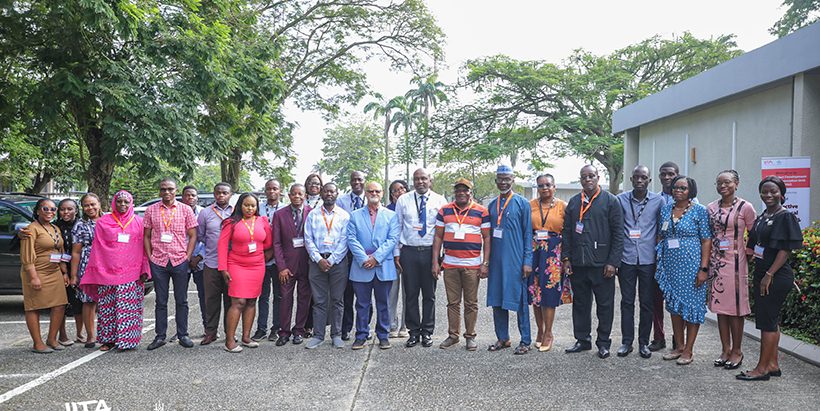
Workshop participants with the facilitators.

In attendance were scientists and administrative staff from Afe Babalola University, Ado-Ekiti (ABUAD); Crops Research Institute (CSIR), Ghana; Sasakawa Africa Association; Bayero University, Kano (BUK), and IITA.

Kayode Awobajo, Head, IITA-PDAU, graciously welcomed and encouraged participants to take advantage of the training to exchange experiences freely, share lessons learned, and network with colleagues during the sessions. In his opening remarks, the IITA Deputy Director General, Partnerships for Delivery, Kenton Dashiell, explained the importance of the capacity development activity in promoting partnership among IITA’s collaborators. He encouraged participants to maximize the opportunity to exchange knowledge to enhance productivity, especially in resource mobilization and better implementation of projects.

The facilitators were from the PDAU team. Moruff Kareem gave a presentation on “Fundamentals of grants proposal budgeting,” and Ovegho Okome took a session on “Understanding contract financial management.” Seun Oladeji facilitated the session on “Stakeholders and time management in grants administration”, and Samuel Olowoyeye from IITA Finance Directorate spoke on “Partners’ financial reporting, invoicing justification, and fund disbursement.”
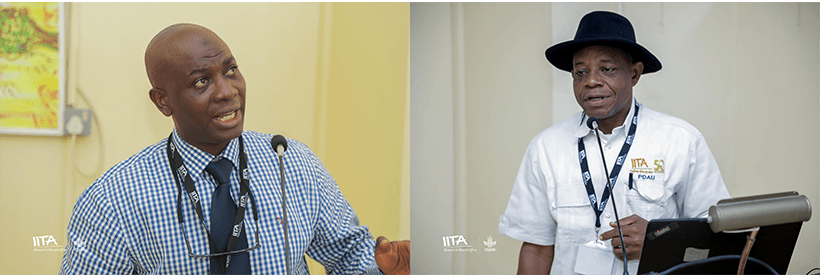
Moruff Kareem and Ovegho Okome during the training presentation.

Activities during the interactive workshop included case studies, practical sessions, and ice-breakers while participants took a tour of IITA facilities on the workshop’s final day.

In his closing remarks, Awobajo appreciated the participants for their brilliant contributions during the sessions and acknowledged the tremendous efforts put into the planning by his PDAU colleagues while expressing excitement for the positive feedback from the participants.

During the wrap-up session, Prof Emmanuel Otoo, on behalf of CSIR-CRI, Ghana, expressed delight at IITA’s excellent delivery during the training and committed to attend future training with his team.

Abdul Abdulrasheed from Sasakawa appreciated the PDAU team’s professional delivery during the training while assuring that the quality experience gained will open further collaborative opportunities and engagements between the two institutions.

Dr Amina Mustapha from BUK appreciated IITA for sustaining a long-standing partnership between both institutions. She said she looks forward to more collaboration and attending such training in the future.

Prof Abiodun Ojo from ABUAD, said the training experience was an eye-opener for him and his colleagues while extending goodwill wishes from Aare Afe Babalola, the founder of ABUAD. Prof Ojo added that the training would strengthen the positive collaboration between IITA and ABUAD.

The feedback from participants reinforced the necessity of further engaging the PDAU team to establish and build the capacity of similar Central Grants Office in their various institutions.

According to CDA, BUK group feedback, “We came aspiring to learn from IITA-PDAU’s wealth of experience and exposure, and our expectations were met. Our anticipations were also met and the hospitality was top-notch. The ice-breaker sessions also helped establish bonds among participants, which was worth all the time spent. We are indeed grateful to the workshop organizers, and their effort is appreciated.”
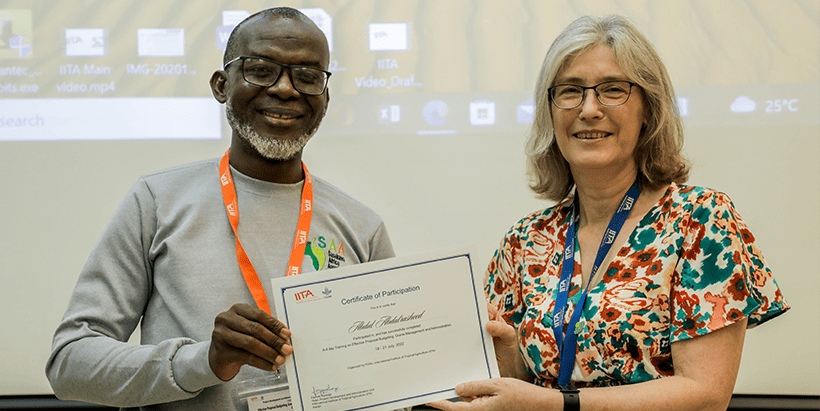
Hilde Koper presenting one of the participants with a certificate.

Wrapping up the workshop, Hilde Koper-Limbourg, IITA’s Deputy Director General, Corporate Services, presented certificates to participants while acknowledging the strategic role of the PDAU team in IITA. She appreciated the active interaction by participants and encouraged further collaborations between participating institutions and the IITA-PDAU team.

Contributed by Anita Akinyomade


Contributed by

Recent stories

No items found

Leave a Reply

Your email address will not be published. Required fields are marked *

Scroll to Top
Olaosebikan, Olamide

Olamide Deborah Nwanze is a Senior Research Associate specializing in gender mainstreaming research to inform participatory and inclusive breeding, variety development, and seed systems policies regarding root, tuber, and banana (RTB) crops in the International Institute of Tropical Agriculture Headquarters, Ibadan, Nigeria. She is a PhD candidate at the University of Ibadan and holds an MSc and B. Agric in Agricultural Extension and Rural Development. Olamide is a fellow of the African Women in Agricultural Research and Development – Gender Responsive Agricultural Systems Policy (AWARD-GRASP) and the Gender Responsive Researchers Equipped for Agricultural Transformation (GREAT). She seeks to apply her gender-mainstreaming learnings, gender-responsive research, and policy development, and review expertise to facilitate women, youth, children, and vulnerable social group’s access to and adoption of agricultural Innovations that guarantee food, nutrition, income, and livelihood security in Africa. Her current roles include mentoring research fellows, development of guides and training manuals, implementation and adaptation of gender frameworks and tools, value chain actors’ engagement as citizen science partners, policy review and redesign, data management, and analysis. Her current research explores mixed methods and participatory and interdisciplinary approaches to capture and highlight gender dynamics, needs, preferences, and challenges stakeholders face within the agricultural livelihood value chain to prioritize gender-inclusive strategies in breeding programs, policy design, and implementation.

At IITA, she contributes to the implementation of the CGIAR Accelerated Breeding Initiative and Genetic Innovation Programs; participatory and gender research within the NextGen CassavaHarvestPlusRTBFoods, and Tricot-ClimMob 1000Farms Projects; and gender knowledge communication via the G-LENS webinar series, video documentary, policy briefspublications, and blogs.


Recent publications

de Sousa, K., van Etten, J., Manners, R. Bello, A., Teeken, B., Olaosebikan, O., et al. 2024. The tricot approach: an agile framework for decentralized on-farm testing supported by citizen science. A retrospective. Agron. Sustain. Dev. 44, 8. https://doi.org/10.1007/s13593-023-00937-1

Madu, T., Onwuka, S., Nwafor, S., Onyemauwa, N., Ejechi, M., Ofoeze, M., Ukeje, B., Eluagu, C., Olaosebikan, O., Okoye, B., 2024. Gender-Inclusive Consumer Studies Improve Cassava Breeding in Nigeria in: Frontiers in Sociology, volume 9, number: 1224504, doi: 10.3389/fsoc.2024.1224504

Olaosebikan, O.; Bello, A.; Utoblo, O.; Okoye, B.; Olutegbe, N.; Garner, E.; Teeken, B.; Bryan, E.; Forsythe, L.; Cole, S.; Madu, T. 2023.  Stressors and Resilience within the Cassava Value Chain in Nigeria: Preferred Cassava Variety Traits and Response Strategies of Men and Women to Inform Breeding. Sustainability 15, 7837. https://doi.org/10.3390/su15107837

Okoye, B., Ofoeze, M., Ejechi, M., Onwuka, S., Nwafor, S., Onyemauwa, N., Ukeje, B., Eluagu, C., Obidiegwu, J.*, Olaosebikan, O., Madu, T.* 2023. Prioritizing preferred traits in the yam value chain in Nigeria: a gender situation analysis in: Frontiers in Sociology, volume 8, number: 1232626, pages 1 – 9, ISSN 2297-7775, 2023. https://www.frontiersin.org/articles/10.3389/fsoc.2023.1232626/full

Olaosebikan, O., Bello, A. A., de Sousa, K., Ndjouenkeu, R., Adesokan, M., Alamu, E. O., Agbona, A., van Etten, J., Kegah, F. N.*, Dufour, D., Bouniol, A., Teeken, B. 2023. Consumer acceptability of cassava gari-eba food products across cultural and environmental settings using the triadic comparison of technologies approach (tricot) in: Journal of the Science of Food and Agriculture,

Teeken, B., Olaosebikan, O., Bello, A. A., Madu, T.*, Cole, S. M. 2023. Qualitative assessment on the positionality and preferences of dyads in relation to cassava-related activities: working with tricot trial citizen scientists https://hdl.handle.net/10568/138326 Type: Manual

Bouniol, A., Ceballos, H., Bello, A. A., Teeken, B., Olaosebikan, O., Owoade, D., Agbona, A., Fotso Kuate, A., Madu, T.*, Okoye, B.*, Ofoeze, M.*, Nwafor, S.*, Onyemauwa, N.*, Adinsi, L.*, Forsythe, L., Dufour, D. 2023. Varietal impact on women’s labour, workload and related drudgery in processing root, tuber and banana crops: focus on cassava in sub-Saharan Africa in: Journal of the Science of Food and Agriculture, pages 1 – 25, ISSN 0022-5142,

Bello, A. A., Agbona, A., Olaosebikan, O., Edughaen, G., Dufour, D., Bouniol, A., Iluebbey, P., Ndjouenkeu, R.*, Rabbi, I. Y., Teeken, B. 2023. Genetic and environmental effects on processing productivity and food product yield: drudgery of women’s work in: Journal of the Science of Food and Agriculture, pages 1 – 32, ISSN 0022-5142, 5

Cavicchioli, M., Zimbiti, T., Teeken, B., Nwanze, D.O., Liani, M., Parkes, E. & Bello, A. 2023. IITA-Gender Responsive Breeding Training Report. Genetic Resources Center, IITA-HQ, Ibadan, 21-23 September, 2022. Ibadan, Nigeria: IITA, (34 p.).https://hdl.handle.net/10568/131368

Agbona, A. Peteti P., Teeken B., Olaosebikan O. Bello, A. A., Parkes, E., Rabbi, I. Y., Mueller, L., Egesi, C., Kulakow, P. 2022. Data Management in Multi-disciplinary African RTB Crop Breeding Programs. In: Williamson, H.F., Leonelli, S. (eds) Towards Responsible Plant Data Linkage: Data Challenges for Agricultural Research and Development. Springer, Cham. https://doi.org/10.1007/978-3-031-13276-6_5

Lora Forsythe, Pricilla Marimo, Sarah Mayanja, Olamide D. Olaosebikan, Esme Stuart, Bela Teeken, Benjamin Okoye, Tessy Madu, (2021). Cross-product Gender Analysis of RTBfoods Step 2 Gendered Food Mapping on RTB Products. Understanding the Drivers of Trait Preferences and the Development of Multi-user RTB Product Profiles, WP1. London, UK: RTBfoods Field Scientific Report, 30 p.

Teeken, B., Garner, E., Agbona, A., Balogun, I., Olaosebikan, O., Bello, A., Madu, T., Okoye, B., Egesi, C., Kulakow, P. and Tufan, H.A. 2021. Beyond “Women’s Traits”: Exploring How Gender, Social Difference, and Household Characteristics Influence Trait Preferences. Frontiers Sustainable Food Systems 5:740926. https://doi.org/10.3389/fsufs.2021.740926

Teeken, B., Agbona, A., Bello, A., Olaosebikan, O., Alamu, E., Adesokan, M., Awoyale, W., Madu, T., Okoye, B., Chijioke, U., Owoade, D., Okoro, M., Bouniol, A., Dufour, D., Hershey, C., Rabbi, I., Maziya‐Dixon, B., Egesi, C., Tufan, H. and Kulakow, P. (020. Understanding cassava varietal preferences through pairwise ranking of gari‐eba and fufu prepared by local farmer–processors. Int J Food Sci Technol. https://doi.org/10.1111/ijfs.14862

Bela Teeken, Olamide Olaosebikan, Ireti Balogun, Benjamin Okoye, Tessy Madu, Steven Cole, Abolore Bello, Elizabeth Parkes. (2020). Piloting the G+ customer and product profile tools for gender-responsive cassava breeding in Nigeria. Nigeria: International Institute of Tropical Agriculture (IITA). https://hdl.handle.net/20.500.11766/13000