
On 22 July, IITA–CGIAR signed a Memorandum of Understanding (MoU) with the first Waste Museum in Africa, situated in Ibadan, in line with IITA’s mandate to conserve natural resources. The partnership will harness various wastes in a circular economy and drive advocacy and outreach programs on waste management and environmental sustainability.
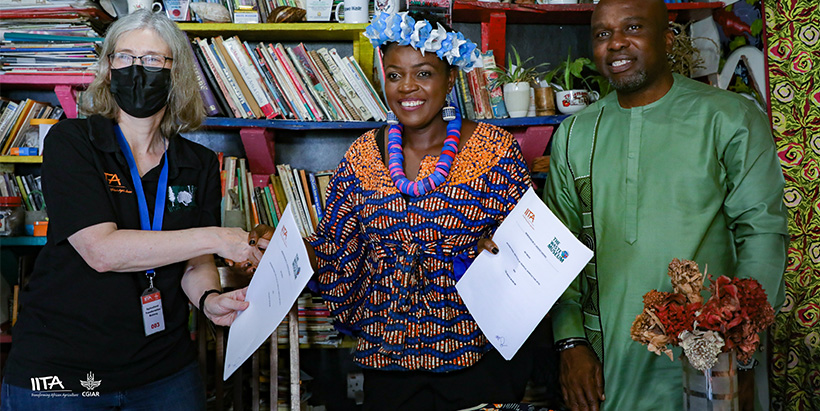
The Creative Director of the Waste Museum, Jumoke Olowookere, and her team were delighted to receive the IITA team at her fully maximized piece of land, hosting the Waste Museum. IITA Deputy Director General, Corporate Services, Hilde Koper, led the IITA delegation comprising Head of Project Development and Administration Unit (PDAU), Kayode Awobajo; Legal officer PDAU, Precious Adebanjo; Risk Management personnel, Rasheed Fagbenro; IITA Forest Center personnel, Adewale Awoyemi and Olukunle Olasupo; and Y-SWEP representatives. Olowookere’s mentor and Founder of EZ37 Solutions, Adaora Ayoade, also graced the occasion.
In a brief tour of the facility, both teams viewed the different species of indigenous plants raised in the museum – ornamentals, air purifiers, spices, and herbs. Dorcas Ibukun, a member of the team, noted that “the plant section of the museum has 155 species of indigenous plants in four different categories: ornamentals to beautify the environment, air purifiers to sanitize the environment, spices for foods, and herbs, which we use as medicines.” The museum explored waste materials from broken plates, bottles, tires, and bamboo to construct different sections of its walkway using upcycling techniques for waste conversion to wealth.
Their protein for animal feed and plant fertilizer is from waste recycled using the Black Soldier Fly (BSF) technology, one of the waste recycling technologies in which IITA is experienced. IITA has explored projects in waste management over the years, such as the BSF technology and biogas generation from biodegradable wastes, through the Youth in Sustainable Waste Eco-Recycling Program, Y-SWEP.
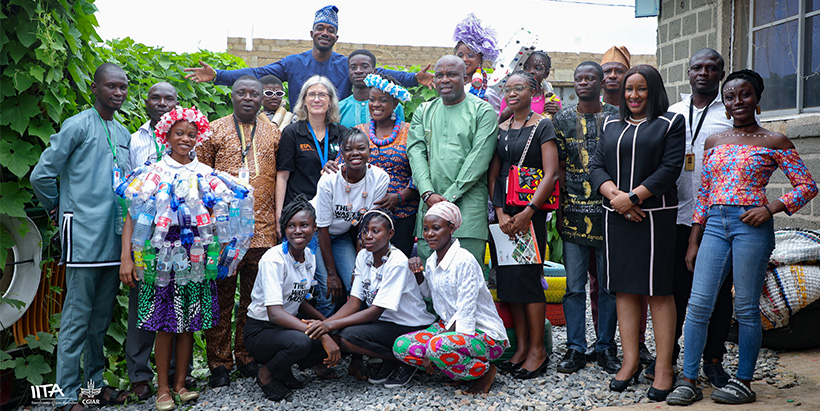
Koper said, “This museum is unique. It has a lot going on all at once. We have gained considerable ground in natural resource and environmental conservation in about 11 to 12 years since the Forest project started. The youth are also doing a lot to make IITA greener. Waste management and conservation are everyone’s business, and we should do all we can to save our environment. Our collaboration will go a long way to bring that about.”
Olowookere said her love for gardening was birthed in IITA during a widow-empowerment training for sustainable livelihoods. She added, “The waste itself inspires how it should be used. Tailors’ waste can be repurposed as door mats, tires for walkways, corn husks as mirror frames, and plastic bottles and abandoned tires as stools. Styrofoam, nylon, and bottle covers could be used as jewelry and artwork.
She highlighted a no-weed-pulling culture that had preserved an unidentified plant. IITA Forest Center Supervisor, Olasupo, identified the plant as the rare Bombax silk tree. The day witnessed the first dividend of collaboration as the Waste Museum donated the rare Bombax silk tree to the Forest Center, where it would have enough space to grow and contribute to biodiversity conservation.
Contributed by Folake Oduntan
Contributed by
Recent stories