
IITA NEWS

Remote-sensing models to enhance Banana bunchy top virus (BBTV) surveillance in Africa
January 13, 2023

The IITACGIAR team has published a method using drones and satellite imager-based remote sensing approaches for mapping banana farms to guide surveillance for the detection and mapping of the banana bunchy top virus (BBTV) spread and support data-informed decision-making on BBTV containment strategies in sub-Saharan Africa. The study, Banana Mapping in Heterogenous Smallholder Farming Systems Using High-Resolution Remote Sensing Imagery and Machine Learning Models with Implications for Banana Bunchy Top Disease Surveillance, was published in the peer-reviewed, open access Remote Sensing journal.
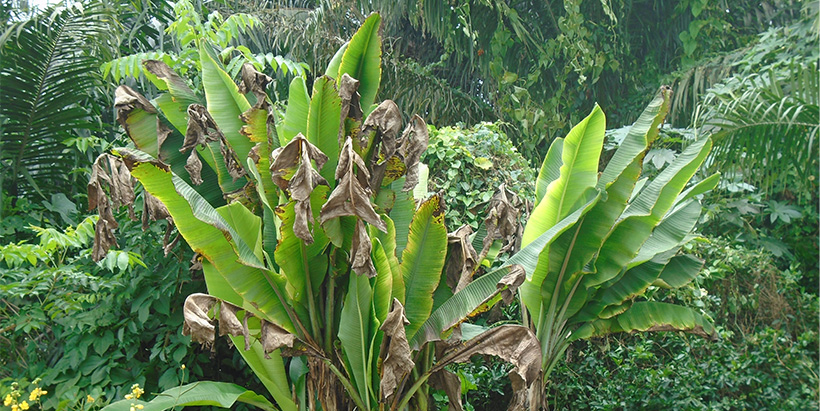
Bunchy top disease-affected banana plant in Ipokia LGA in Ogun State of Nigeria. Photo: IITA/L. Kumar

BBTV has emerged as a major threat to banana production in sub-Saharan Africa (SSA). The virus infection results in severe dwarfing (bunching) of the shoots and cessation of fruit production, denting the food and income security of smallholder farmers.

BBTV is an introduced virus in Africa, first reported in the 1960s in the Democratic Republic of Congo (DRC). The transboundary spread of the virus is unabated, as the single introduction event has spread to 15 countries in SSA, assisted by the ubiquitous banana aphid (Pentalonia nigronervosa) and vegetative propagation and distribution of virus-infected planting materials.
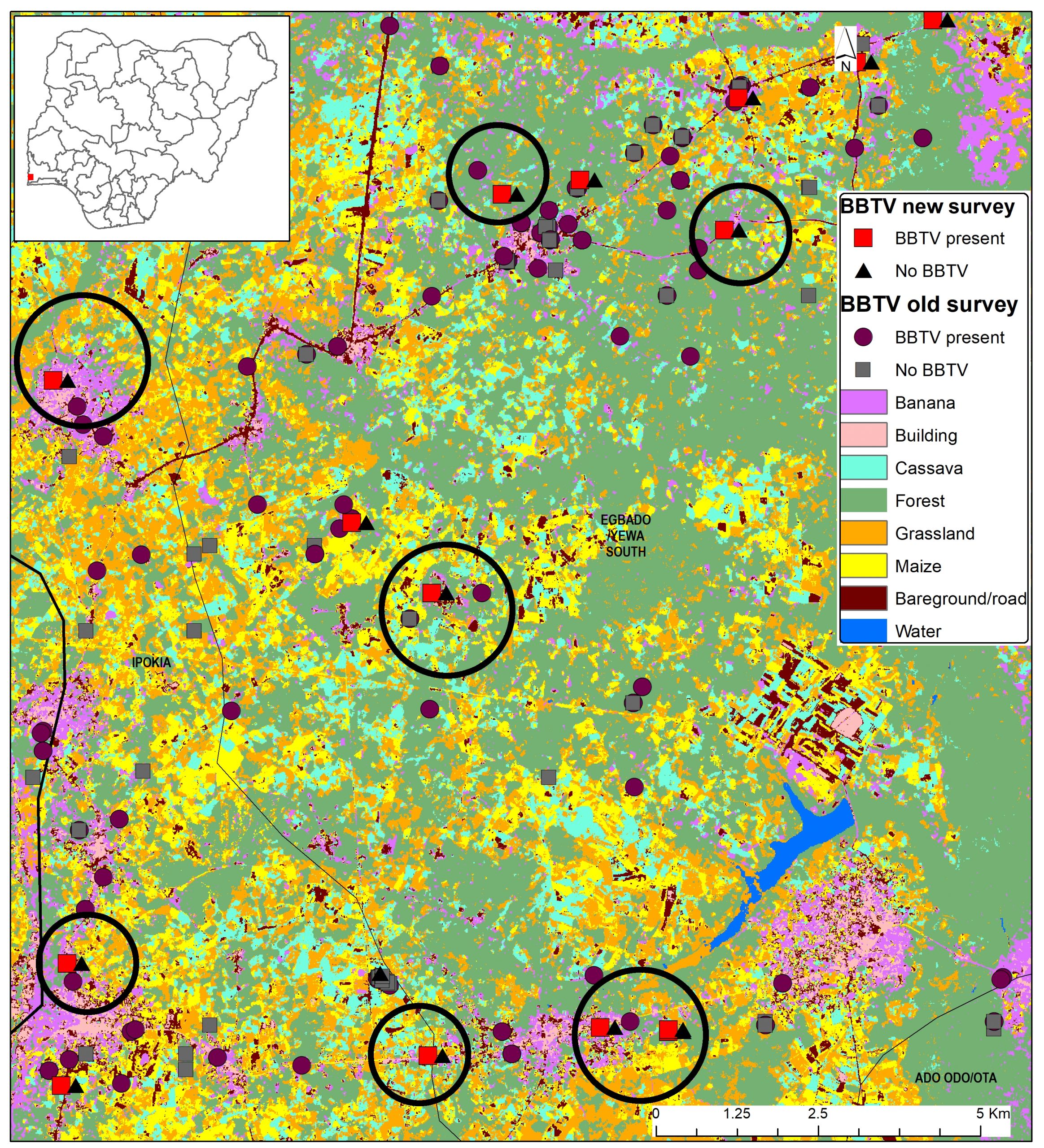
Prediction of bananas and identification of bunch top-affected fields in mixed cropping systems in Idologun region in Nigeria. Image: IITA/T. Alabi

“Since 2010, the new spread of BBTV was confirmed in seven countries, including Benin, Nigeria, and Togo in West Africa, and Tanzania and Uganda in East Africa, and Mozambique and South Africa in Southern Africa,” said IITA Virologist and Head of Germplasm Health Unit, Lava Kumar, who is leading the ALLIANCE for controlling BBTV spread and recover banana production in the region, and co-author of the study.

Surveillance by scouting across large areas is a critical requirement for the early detection of BBTV occurrence in farms, mapping the extent of its geographic spread, and deploying control measures. However, it is laborious and requires surveyors to visit banana fields looking for infected plants. This task has been challenging and requires local individuals to guide the survey teams to the banana fields and is often marked by the unintentional omission of several banana farms from the assessment.
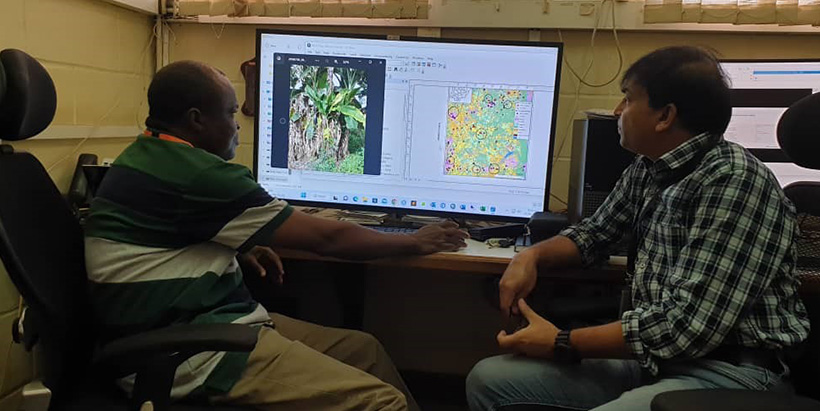
The IITA team using machine learning models for detecting bananas in the mixed cropping systems in Nigeria. Photo: IITA/L. Kumar

Remote sensing and machine learning (ML) models provide a wealth of data from a particular geographical location, including detecting and monitoring the physical characteristics of a geographical area, mapping vegetation and crop types on the local and regional scales without making physical contact.

IITA researchers have combined high-resolution imagery from unmanned aerial vehicles (UAV) and medium-resolution Synthetic Aperture Radar (SAR), Sentinel 2 imagery with Random Forest (RF), and Support Vector Machine (SVM) analytics for identifying infected banana plants and fields for targeted BBTV surveillance.

IITA-GIS Support Services Manager and lead author, Alabi Tunrayo, revealed that ML performed relatively better in classifying the land cover, achieving means overall accuracy (OA) of about 93% and a Kappa coefficient (KC) of 0.89 for the UAV data. Applying fused SAR and Sentinel 2A data, the model gave an OA of 90% and a KC of 0.86. IITA Geospatial Data Scientist and co-author, Julius Adewopo, said that the findings confirm the model’s usefulness for predicting infection in banana and other crops in SSA’s heterogeneous smallholder farming systems.

As part of verifying the accuracy of the high spatial resolution cropland maps generated by the models, the researchers have done ground truthing and detected 17 new farms with BBTV with the developed models in Ogun State, which were missed during the conventional surveys.

The study recommends the adoption of the model for other crops in heterogeneous smallholder farming systems to increase their productivity.

For more information about this work, contact: Lava Kumar (l.kumar@cgiar.org) and Tunrayo Alabi (t.alabi@cgiar.org).

Contributed by Lava Kumar and Anita Akinyomade


Contributed by

Recent stories

No items found

Leave a Reply

Your email address will not be published. Required fields are marked *

Scroll to Top
Olaosebikan, Olamide

Olamide Deborah Nwanze is a Senior Research Associate specializing in gender mainstreaming research to inform participatory and inclusive breeding, variety development, and seed systems policies regarding root, tuber, and banana (RTB) crops in the International Institute of Tropical Agriculture Headquarters, Ibadan, Nigeria. She is a PhD candidate at the University of Ibadan and holds an MSc and B. Agric in Agricultural Extension and Rural Development. Olamide is a fellow of the African Women in Agricultural Research and Development – Gender Responsive Agricultural Systems Policy (AWARD-GRASP) and the Gender Responsive Researchers Equipped for Agricultural Transformation (GREAT). She seeks to apply her gender-mainstreaming learnings, gender-responsive research, and policy development, and review expertise to facilitate women, youth, children, and vulnerable social group’s access to and adoption of agricultural Innovations that guarantee food, nutrition, income, and livelihood security in Africa. Her current roles include mentoring research fellows, development of guides and training manuals, implementation and adaptation of gender frameworks and tools, value chain actors’ engagement as citizen science partners, policy review and redesign, data management, and analysis. Her current research explores mixed methods and participatory and interdisciplinary approaches to capture and highlight gender dynamics, needs, preferences, and challenges stakeholders face within the agricultural livelihood value chain to prioritize gender-inclusive strategies in breeding programs, policy design, and implementation.

At IITA, she contributes to the implementation of the CGIAR Accelerated Breeding Initiative and Genetic Innovation Programs; participatory and gender research within the NextGen CassavaHarvestPlusRTBFoods, and Tricot-ClimMob 1000Farms Projects; and gender knowledge communication via the G-LENS webinar series, video documentary, policy briefspublications, and blogs.


Recent publications

de Sousa, K., van Etten, J., Manners, R. Bello, A., Teeken, B., Olaosebikan, O., et al. 2024. The tricot approach: an agile framework for decentralized on-farm testing supported by citizen science. A retrospective. Agron. Sustain. Dev. 44, 8. https://doi.org/10.1007/s13593-023-00937-1

Madu, T., Onwuka, S., Nwafor, S., Onyemauwa, N., Ejechi, M., Ofoeze, M., Ukeje, B., Eluagu, C., Olaosebikan, O., Okoye, B., 2024. Gender-Inclusive Consumer Studies Improve Cassava Breeding in Nigeria in: Frontiers in Sociology, volume 9, number: 1224504, doi: 10.3389/fsoc.2024.1224504

Olaosebikan, O.; Bello, A.; Utoblo, O.; Okoye, B.; Olutegbe, N.; Garner, E.; Teeken, B.; Bryan, E.; Forsythe, L.; Cole, S.; Madu, T. 2023.  Stressors and Resilience within the Cassava Value Chain in Nigeria: Preferred Cassava Variety Traits and Response Strategies of Men and Women to Inform Breeding. Sustainability 15, 7837. https://doi.org/10.3390/su15107837

Okoye, B., Ofoeze, M., Ejechi, M., Onwuka, S., Nwafor, S., Onyemauwa, N., Ukeje, B., Eluagu, C., Obidiegwu, J.*, Olaosebikan, O., Madu, T.* 2023. Prioritizing preferred traits in the yam value chain in Nigeria: a gender situation analysis in: Frontiers in Sociology, volume 8, number: 1232626, pages 1 – 9, ISSN 2297-7775, 2023. https://www.frontiersin.org/articles/10.3389/fsoc.2023.1232626/full

Olaosebikan, O., Bello, A. A., de Sousa, K., Ndjouenkeu, R., Adesokan, M., Alamu, E. O., Agbona, A., van Etten, J., Kegah, F. N.*, Dufour, D., Bouniol, A., Teeken, B. 2023. Consumer acceptability of cassava gari-eba food products across cultural and environmental settings using the triadic comparison of technologies approach (tricot) in: Journal of the Science of Food and Agriculture,

Teeken, B., Olaosebikan, O., Bello, A. A., Madu, T.*, Cole, S. M. 2023. Qualitative assessment on the positionality and preferences of dyads in relation to cassava-related activities: working with tricot trial citizen scientists https://hdl.handle.net/10568/138326 Type: Manual

Bouniol, A., Ceballos, H., Bello, A. A., Teeken, B., Olaosebikan, O., Owoade, D., Agbona, A., Fotso Kuate, A., Madu, T.*, Okoye, B.*, Ofoeze, M.*, Nwafor, S.*, Onyemauwa, N.*, Adinsi, L.*, Forsythe, L., Dufour, D. 2023. Varietal impact on women’s labour, workload and related drudgery in processing root, tuber and banana crops: focus on cassava in sub-Saharan Africa in: Journal of the Science of Food and Agriculture, pages 1 – 25, ISSN 0022-5142,

Bello, A. A., Agbona, A., Olaosebikan, O., Edughaen, G., Dufour, D., Bouniol, A., Iluebbey, P., Ndjouenkeu, R.*, Rabbi, I. Y., Teeken, B. 2023. Genetic and environmental effects on processing productivity and food product yield: drudgery of women’s work in: Journal of the Science of Food and Agriculture, pages 1 – 32, ISSN 0022-5142, 5

Cavicchioli, M., Zimbiti, T., Teeken, B., Nwanze, D.O., Liani, M., Parkes, E. & Bello, A. 2023. IITA-Gender Responsive Breeding Training Report. Genetic Resources Center, IITA-HQ, Ibadan, 21-23 September, 2022. Ibadan, Nigeria: IITA, (34 p.).https://hdl.handle.net/10568/131368

Agbona, A. Peteti P., Teeken B., Olaosebikan O. Bello, A. A., Parkes, E., Rabbi, I. Y., Mueller, L., Egesi, C., Kulakow, P. 2022. Data Management in Multi-disciplinary African RTB Crop Breeding Programs. In: Williamson, H.F., Leonelli, S. (eds) Towards Responsible Plant Data Linkage: Data Challenges for Agricultural Research and Development. Springer, Cham. https://doi.org/10.1007/978-3-031-13276-6_5

Lora Forsythe, Pricilla Marimo, Sarah Mayanja, Olamide D. Olaosebikan, Esme Stuart, Bela Teeken, Benjamin Okoye, Tessy Madu, (2021). Cross-product Gender Analysis of RTBfoods Step 2 Gendered Food Mapping on RTB Products. Understanding the Drivers of Trait Preferences and the Development of Multi-user RTB Product Profiles, WP1. London, UK: RTBfoods Field Scientific Report, 30 p.

Teeken, B., Garner, E., Agbona, A., Balogun, I., Olaosebikan, O., Bello, A., Madu, T., Okoye, B., Egesi, C., Kulakow, P. and Tufan, H.A. 2021. Beyond “Women’s Traits”: Exploring How Gender, Social Difference, and Household Characteristics Influence Trait Preferences. Frontiers Sustainable Food Systems 5:740926. https://doi.org/10.3389/fsufs.2021.740926

Teeken, B., Agbona, A., Bello, A., Olaosebikan, O., Alamu, E., Adesokan, M., Awoyale, W., Madu, T., Okoye, B., Chijioke, U., Owoade, D., Okoro, M., Bouniol, A., Dufour, D., Hershey, C., Rabbi, I., Maziya‐Dixon, B., Egesi, C., Tufan, H. and Kulakow, P. (020. Understanding cassava varietal preferences through pairwise ranking of gari‐eba and fufu prepared by local farmer–processors. Int J Food Sci Technol. https://doi.org/10.1111/ijfs.14862

Bela Teeken, Olamide Olaosebikan, Ireti Balogun, Benjamin Okoye, Tessy Madu, Steven Cole, Abolore Bello, Elizabeth Parkes. (2020). Piloting the G+ customer and product profile tools for gender-responsive cassava breeding in Nigeria. Nigeria: International Institute of Tropical Agriculture (IITA). https://hdl.handle.net/20.500.11766/13000