CGIAR officially launches Portfolio of Research Initiatives in Zambia
May 19, 2023
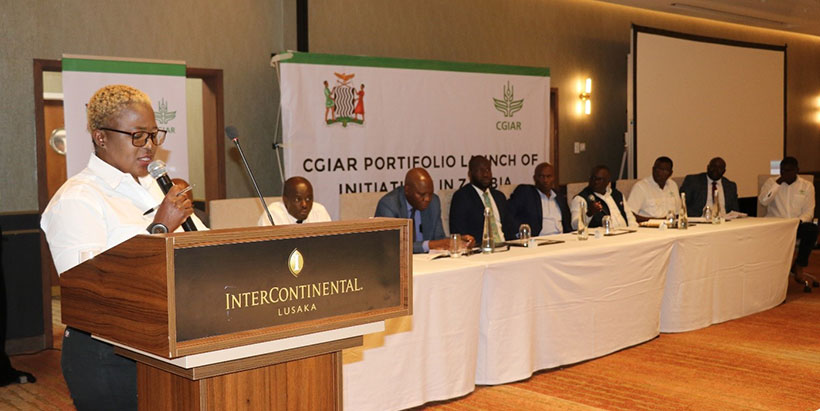
The CGIAR Portfolio of Research Initiatives was launched in Zambia on 26 April at a high-level event hosted by Vice President Mrs Mutale W. K. Nalumango MP.
Hon. Reuben Phiri, Minister of Agriculture, with Dr David Chikoye, CGIAR Country Convener, Zambia, after the official launch of the CGIAR Portfolio of Research Initiatives. Photo: Agricomm Media
The event celebrated CGIAR’s long history of partnership and work in Zambia and its focus on further collaboration in transforming food, land, and water systems in a climate crisis. It highlighted up-and-coming collaborative achievements of CGIAR and partners building on more than 40 years of engagement in Zambia.
In a speech read on her behalf by Minister of Agriculture Reuben Phiri, the Vice President said, “To optimally develop the agriculture sector, the government is investing in increasing agriculture productivity at small-scale farm level through strengthened partnerships and collaboration.”
She said this was key in attaining efficient input and output markets.
“These new opportunities created by government and the private sector have the potential to contribute immensely towards the agriculture sector’s development.
“Government wants to relegate to the past hunger and malnutrition in rural areas where the highest burden is experienced by women and youths. We intend to make agriculture the key driver of gender equality in Zambia by addressing gender gaps in productivity, wages, and entrepreneurial opportunities,” she added.
The Portfolio of Initiatives is designed to put CGIAR’s 2030 Research and Innovation Strategy into action. Thirty-three Initiatives make up the Portfolio, addressing the world’s biggest global development challenges. Of these, nine are operating in Zambia, the most of any country in Southern Africa.
CGIAR Managing Director for Resilient Agrifood Systems, Martin Kropff, thanked the government and the Vice President for hosting the auspicious event. In his remarks, he stated that the extended partnership has made it natural for so many of CGIAR’s new Initiatives to flourish in the country.
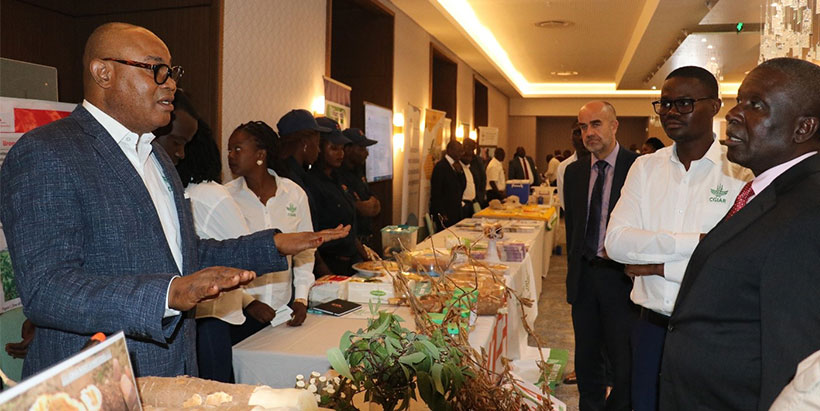
Minister of Agriculture Hon. Reuben Phiri touring exhibition stands. Photo: WorldFish/Agness Chileya
“The Portfolio is very exciting, firstly because of the timing—there is an urgent need to transform our food, land, and water systems in this climate crisis. Rising temperatures, droughts, and floods are threatening food security and livelihoods, and we need adaptation and innovation to ensure we are building climate-friendly food systems. Secondly is the approach: we envision it to be partnership-focused and demand-driven to focus on co-development and co-creation of scaling-ready tools, technologies, and approaches needed to address our global challenges,” Kropff stated.
CGIAR has enjoyed strong regional and national engagement because of its collaboration with policymakers, farmers, and other sector partners engaged in the work of the various CGIAR Centers. With that strong foundation, Research Initiatives on Accelerated Breeding, Aquatic Foods, Breeding Resources, Climate Resilience, Diversification in East and Southern Africa, Excellence in Agronomy, Foresight, Market Intelligence, and Plant Health are now being implemented by researchers and partners across Zambia.
CGIAR Country Convener in Zambia, David Chikoye, pointed out that CGIAR leadership recognizes the roles of the various stakeholders who have worked with CGIAR Centers and continue that work now through the different Initiatives to transform agrifood systems. He added that CGIAR would continue to work to establish strong partnerships with the government, agribusinesses, civil society organizations (CSOs), and development partners.
“In a series of national consultations, we intend to introduce and get feedback on the CGIAR 2030 Research and Innovation Strategy and the Initiative design and implementation process from a range of key partners and stakeholders,” Chikoye explained.
The event was attended by representatives from research organizations, policymakers, government ministries, non-governmental organizations (NGOs), and associations for smallholders, seed traders, insurers, and bankers. An exhibition by CGIAR Centers about work in Zambia showcased key accomplishments and highlighted future opportunities.
Lizzy Muzungaire of WorldFish facilitating a panel discussion. Photo: WorldFish/Agness Chileya
Strengthened partnership and collaboration
Following the exhibit, which profiled work from CGIAR Centers WorldFish, International Maize and Wheat Improvement Center (CIMMYT), Alliance-Biodiversity CIAT, International Water Management Institute (IWMI), and IITA and the official launch ceremony, the afternoon session featured panel discussions with different researchers and stakeholders highlighting their work with the new CGIAR Initiatives and giving recommendations on how the collaboration could be enhanced.
“We are working with most of the CGIAR Initiatives here; the empowerment in capacity building and the new technologies are commendable. We hope this collaboration continues and empowers even more people as we face the climate crisis together,” said Edson Nkonde, Director of Zambia Meteorological Department at the Ministry of Green Economy and Environment.
CGIAR, in its four decades in Zambia, has worked with a network of national partners, including the Zambia Agricultural Research Institute (ZARI), Aquaculture Skills Training Centre (ASTC), Seed Control and Certification Institute (SCCI), universities, NGOs, and the private sector. With these partners, CGIAR Centers have co-developed several technologies, tools, methodologies, practices, and policy options that have contributed to resolving challenges undermining agricultural transformation in Zambia. The new Portfolio of Research Initiatives provides opportunities for that collaboration to continue and grow.
Contributed by Agnes Chileya
Olamide Deborah Nwanze is a Senior Research Associate specializing in gender mainstreaming research to inform participatory and inclusive breeding, variety development, and seed systems policies regarding root, tuber, and banana (RTB) crops in the International Institute of Tropical Agriculture Headquarters, Ibadan, Nigeria. She is a PhD candidate at the University of Ibadan and holds an MSc and B. Agric in Agricultural Extension and Rural Development. Olamide is a fellow of the African Women in Agricultural Research and Development – Gender Responsive Agricultural Systems Policy (AWARD-GRASP) and the Gender Responsive Researchers Equipped for Agricultural Transformation (GREAT). She seeks to apply her gender-mainstreaming learnings, gender-responsive research, and policy development, and review expertise to facilitate women, youth, children, and vulnerable social group’s access to and adoption of agricultural Innovations that guarantee food, nutrition, income, and livelihood security in Africa. Her current roles include mentoring research fellows, development of guides and training manuals, implementation and adaptation of gender frameworks and tools, value chain actors’ engagement as citizen science partners, policy review and redesign, data management, and analysis. Her current research explores mixed methods and participatory and interdisciplinary approaches to capture and highlight gender dynamics, needs, preferences, and challenges stakeholders face within the agricultural livelihood value chain to prioritize gender-inclusive strategies in breeding programs, policy design, and implementation.
de Sousa, K., van Etten, J., Manners, R. Bello, A., Teeken, B., Olaosebikan, O., et al. 2024. The tricot approach: an agile framework for decentralized on-farm testing supported by citizen science. A retrospective. Agron. Sustain. Dev. 44, 8. https://doi.org/10.1007/s13593-023-00937-1
Madu, T., Onwuka, S., Nwafor, S., Onyemauwa, N., Ejechi, M., Ofoeze, M., Ukeje, B., Eluagu, C., Olaosebikan, O., Okoye, B., 2024. Gender-Inclusive Consumer Studies Improve Cassava Breeding in Nigeria in: Frontiers in Sociology, volume 9, number: 1224504, doi: 10.3389/fsoc.2024.1224504
Olaosebikan, O.; Bello, A.; Utoblo, O.; Okoye, B.; Olutegbe, N.; Garner, E.; Teeken, B.; Bryan, E.; Forsythe, L.; Cole, S.; Madu, T. 2023. Stressors and Resilience within the Cassava Value Chain in Nigeria: Preferred Cassava Variety Traits and Response Strategies of Men and Women to Inform Breeding. Sustainability 15, 7837. https://doi.org/10.3390/su15107837
Okoye, B., Ofoeze, M., Ejechi, M., Onwuka, S., Nwafor, S., Onyemauwa, N., Ukeje, B., Eluagu, C., Obidiegwu, J.*, Olaosebikan, O., Madu, T.* 2023. Prioritizing preferred traits in the yam value chain in Nigeria: a gender situation analysis in: Frontiers in Sociology, volume 8, number: 1232626, pages 1 – 9, ISSN 2297-7775, 2023. https://www.frontiersin.org/articles/10.3389/fsoc.2023.1232626/full
Olaosebikan, O., Bello, A. A., de Sousa, K., Ndjouenkeu, R., Adesokan, M., Alamu, E. O., Agbona, A., van Etten, J., Kegah, F. N.*, Dufour, D., Bouniol, A., Teeken, B. 2023. Consumer acceptability of cassava gari-eba food products across cultural and environmental settings using the triadic comparison of technologies approach (tricot) in: Journal of the Science of Food and Agriculture,
Teeken, B., Olaosebikan, O., Bello, A. A., Madu, T.*, Cole, S. M. 2023. Qualitative assessment on the positionality and preferences of dyads in relation to cassava-related activities: working with tricot trial citizen scientists https://hdl.handle.net/10568/138326 Type: Manual
Bouniol, A., Ceballos, H., Bello, A. A., Teeken, B., Olaosebikan, O., Owoade, D., Agbona, A., Fotso Kuate, A., Madu, T.*, Okoye, B.*, Ofoeze, M.*, Nwafor, S.*, Onyemauwa, N.*, Adinsi, L.*, Forsythe, L., Dufour, D. 2023. Varietal impact on women’s labour, workload and related drudgery in processing root, tuber and banana crops: focus on cassava in sub-Saharan Africa in: Journal of the Science of Food and Agriculture, pages 1 – 25, ISSN 0022-5142,
Bello, A. A., Agbona, A., Olaosebikan, O., Edughaen, G., Dufour, D., Bouniol, A., Iluebbey, P., Ndjouenkeu, R.*, Rabbi, I. Y., Teeken, B. 2023. Genetic and environmental effects on processing productivity and food product yield: drudgery of women’s work in: Journal of the Science of Food and Agriculture, pages 1 – 32, ISSN 0022-5142, 5
Cavicchioli, M., Zimbiti, T., Teeken, B., Nwanze, D.O., Liani, M., Parkes, E. & Bello, A. 2023. IITA-Gender Responsive Breeding Training Report. Genetic Resources Center, IITA-HQ, Ibadan, 21-23 September, 2022. Ibadan, Nigeria: IITA, (34 p.).https://hdl.handle.net/10568/131368
Agbona, A. Peteti P., Teeken B., Olaosebikan O. Bello, A. A., Parkes, E., Rabbi, I. Y., Mueller, L., Egesi, C., Kulakow, P. 2022. Data Management in Multi-disciplinary African RTB Crop Breeding Programs. In: Williamson, H.F., Leonelli, S. (eds) Towards Responsible Plant Data Linkage: Data Challenges for Agricultural Research and Development. Springer, Cham. https://doi.org/10.1007/978-3-031-13276-6_5
Lora Forsythe, Pricilla Marimo, Sarah Mayanja, Olamide D. Olaosebikan, Esme Stuart, Bela Teeken, Benjamin Okoye, Tessy Madu, (2021). Cross-product Gender Analysis of RTBfoods Step 2 Gendered Food Mapping on RTB Products. Understanding the Drivers of Trait Preferences and the Development of Multi-user RTB Product Profiles, WP1. London, UK: RTBfoods Field Scientific Report, 30 p.
Teeken, B., Garner, E., Agbona, A., Balogun, I., Olaosebikan, O., Bello, A., Madu, T., Okoye, B., Egesi, C., Kulakow, P. and Tufan, H.A. 2021. Beyond “Women’s Traits”: Exploring How Gender, Social Difference, and Household Characteristics Influence Trait Preferences. Frontiers Sustainable Food Systems 5:740926. https://doi.org/10.3389/fsufs.2021.740926
Teeken, B., Agbona, A., Bello, A., Olaosebikan, O., Alamu, E., Adesokan, M., Awoyale, W., Madu, T., Okoye, B., Chijioke, U., Owoade, D., Okoro, M., Bouniol, A., Dufour, D., Hershey, C., Rabbi, I., Maziya‐Dixon, B., Egesi, C., Tufan, H. and Kulakow, P. (020. Understanding cassava varietal preferences through pairwise ranking of gari‐eba and fufu prepared by local farmer–processors. Int J Food Sci Technol.https://doi.org/10.1111/ijfs.14862
Bela Teeken, Olamide Olaosebikan, Ireti Balogun, Benjamin Okoye, Tessy Madu, Steven Cole, Abolore Bello, Elizabeth Parkes. (2020). Piloting the G+ customer and product profile tools for gender-responsive cassava breeding in Nigeria. Nigeria: International Institute of Tropical Agriculture (IITA). https://hdl.handle.net/20.500.11766/13000