
NEWS

Small-scale processors and farmers in Tanzania boosted by new machine donations
May 5, 2023

Value addition of agriculture products is crucial to the sector’s development in Tanzania and improving the livelihood of the country’s smallholder farmers. To contribute to agricultural transformation, IITA-Tanzania and the Alliance of Bioversity International and CIAT (ABC), through the Supporting and Strengthening Community Resilience in Tanzania (SSUCORETA) project purchased 14 processing machines for smallholder farmers and processors groups to increase processing efficiency in value addition of their products.
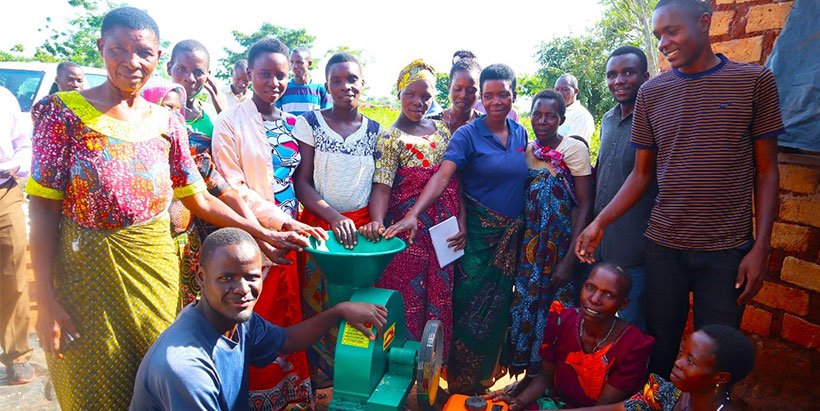
 Excited small-scale processor group members with a sunflower oil press.
Excited small-scale processor group members with a sunflower oil press.

SSUCORETA handed over eight cassava milling machines and six sunflower oil presses to farmers and processors in six regions—Dodoma, Geita, Kagera, Manyara, Morogoro, and Mwanza. Production from the new machines will increase the value of agricultural commodities, boosting revenue and income for smallholder farmers and processors.

During the installation, the beneficiaries also received hands-on training on properly operating the machines. Speaking at the hand-over of cassava slicing machines to the Kolping Society of Tanzania group in the Kagera region, the project coordinator from IITA, Lembris Laizer, noted that the SSUCORETA project empowers farmers to add value to their crops, particularly cassava, sunflower, and beans.

“By its appearance, the machine seems too small, but once it starts processing, you will see how efficient it is. This machine can process cassava, sorghum, and carrots,” Lembris noted.

Lestuta Deogratius, a treasurer of the Kolping Society group from the Kagera region, applauded the new machines’ efficiency, noting that while their previous machines would take a day to process, the new machines take a few hours. They are also more efficient and less expensive to operate, yet process high-quality cassava flour. “Thanks to SSUCORETA, we will manage to get a good market for our cassava flour,” Deogratius said.

She added that the group plans to expand their production in cassava farms to increase cassava flour production and enhance their income.
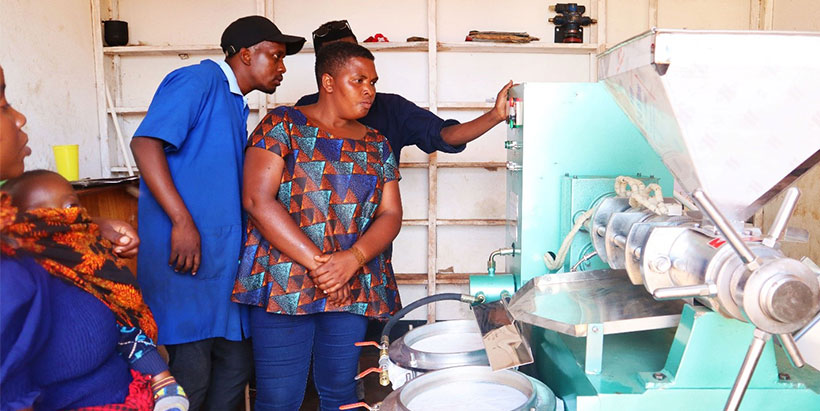
Processors learning how to use one of the cassava milling machines.

Gabriel Matemu, a cassava value chain off-taker and Production Manager of Kipipa Millers LTD from the Mwanza region, noted that the company used to get poor quality cassava chips from the aggregated farmers due to poor post-harvest handling and considerable delays in producing enough quantity. But the new machines will improve the farmers’ chips quality.

“The new cassava slicing machine can process at least ten metric tons per day and boost cassava flour production because I will get quality cassava chips in large quantities. My advice to youths is to ensure a consistent supply of quality cassava chips, and our company will offer them competitive prices, form cooperatives, and engage in cassava and other crops farming to have decent employment and earn income,” Matemu said.

Kinyakala youth group leader Pendo Petro Mahiga, a farmer and processor from Rubeho village in Gairo District, grows cassava, sunflower, and maize. Unfortunately, their old machine was damaged, and they could not repair it because of the financial constraints caused by COVID-19. “We are happy with the new machine because it saves the group from the oil loss that used to happen while processing sunflowers. The new machine saves us from losing three liters for every 70 kg bag of sunflower grain of oil from leakage. It does both splitting and filtering of the oil at the same time, compared to the old machine,” she explained.

SSUCORETA is a two-year project (2022- 2023) funded by the International Fund for Agricultural Development (IFAD) with a major goal of restoring and increasing the productivity and profitability of key food and oilseed crops and enhancing market access for rural women and young farmers in Tanzania to mitigate the negative impact of COVID-19 and enhance resilience. The project is implemented in collaboration with Tanzania Agricultural Research Institute (TARI) and the Local Government Authorities (LGAs).

Contributed by Hadi Rashid


Contributed by

Recent stories

No items found

Leave a Reply

Your email address will not be published. Required fields are marked *

Scroll to Top
Olaosebikan, Olamide

Olamide Deborah Nwanze is a Senior Research Associate specializing in gender mainstreaming research to inform participatory and inclusive breeding, variety development, and seed systems policies regarding root, tuber, and banana (RTB) crops in the International Institute of Tropical Agriculture Headquarters, Ibadan, Nigeria. She is a PhD candidate at the University of Ibadan and holds an MSc and B. Agric in Agricultural Extension and Rural Development. Olamide is a fellow of the African Women in Agricultural Research and Development – Gender Responsive Agricultural Systems Policy (AWARD-GRASP) and the Gender Responsive Researchers Equipped for Agricultural Transformation (GREAT). She seeks to apply her gender-mainstreaming learnings, gender-responsive research, and policy development, and review expertise to facilitate women, youth, children, and vulnerable social group’s access to and adoption of agricultural Innovations that guarantee food, nutrition, income, and livelihood security in Africa. Her current roles include mentoring research fellows, development of guides and training manuals, implementation and adaptation of gender frameworks and tools, value chain actors’ engagement as citizen science partners, policy review and redesign, data management, and analysis. Her current research explores mixed methods and participatory and interdisciplinary approaches to capture and highlight gender dynamics, needs, preferences, and challenges stakeholders face within the agricultural livelihood value chain to prioritize gender-inclusive strategies in breeding programs, policy design, and implementation.

At IITA, she contributes to the implementation of the CGIAR Accelerated Breeding Initiative and Genetic Innovation Programs; participatory and gender research within the NextGen CassavaHarvestPlusRTBFoods, and Tricot-ClimMob 1000Farms Projects; and gender knowledge communication via the G-LENS webinar series, video documentary, policy briefspublications, and blogs.


Recent publications

de Sousa, K., van Etten, J., Manners, R. Bello, A., Teeken, B., Olaosebikan, O., et al. 2024. The tricot approach: an agile framework for decentralized on-farm testing supported by citizen science. A retrospective. Agron. Sustain. Dev. 44, 8. https://doi.org/10.1007/s13593-023-00937-1

Madu, T., Onwuka, S., Nwafor, S., Onyemauwa, N., Ejechi, M., Ofoeze, M., Ukeje, B., Eluagu, C., Olaosebikan, O., Okoye, B., 2024. Gender-Inclusive Consumer Studies Improve Cassava Breeding in Nigeria in: Frontiers in Sociology, volume 9, number: 1224504, doi: 10.3389/fsoc.2024.1224504

Olaosebikan, O.; Bello, A.; Utoblo, O.; Okoye, B.; Olutegbe, N.; Garner, E.; Teeken, B.; Bryan, E.; Forsythe, L.; Cole, S.; Madu, T. 2023.  Stressors and Resilience within the Cassava Value Chain in Nigeria: Preferred Cassava Variety Traits and Response Strategies of Men and Women to Inform Breeding. Sustainability 15, 7837. https://doi.org/10.3390/su15107837

Okoye, B., Ofoeze, M., Ejechi, M., Onwuka, S., Nwafor, S., Onyemauwa, N., Ukeje, B., Eluagu, C., Obidiegwu, J.*, Olaosebikan, O., Madu, T.* 2023. Prioritizing preferred traits in the yam value chain in Nigeria: a gender situation analysis in: Frontiers in Sociology, volume 8, number: 1232626, pages 1 – 9, ISSN 2297-7775, 2023. https://www.frontiersin.org/articles/10.3389/fsoc.2023.1232626/full

Olaosebikan, O., Bello, A. A., de Sousa, K., Ndjouenkeu, R., Adesokan, M., Alamu, E. O., Agbona, A., van Etten, J., Kegah, F. N.*, Dufour, D., Bouniol, A., Teeken, B. 2023. Consumer acceptability of cassava gari-eba food products across cultural and environmental settings using the triadic comparison of technologies approach (tricot) in: Journal of the Science of Food and Agriculture,

Teeken, B., Olaosebikan, O., Bello, A. A., Madu, T.*, Cole, S. M. 2023. Qualitative assessment on the positionality and preferences of dyads in relation to cassava-related activities: working with tricot trial citizen scientists https://hdl.handle.net/10568/138326 Type: Manual

Bouniol, A., Ceballos, H., Bello, A. A., Teeken, B., Olaosebikan, O., Owoade, D., Agbona, A., Fotso Kuate, A., Madu, T.*, Okoye, B.*, Ofoeze, M.*, Nwafor, S.*, Onyemauwa, N.*, Adinsi, L.*, Forsythe, L., Dufour, D. 2023. Varietal impact on women’s labour, workload and related drudgery in processing root, tuber and banana crops: focus on cassava in sub-Saharan Africa in: Journal of the Science of Food and Agriculture, pages 1 – 25, ISSN 0022-5142,

Bello, A. A., Agbona, A., Olaosebikan, O., Edughaen, G., Dufour, D., Bouniol, A., Iluebbey, P., Ndjouenkeu, R.*, Rabbi, I. Y., Teeken, B. 2023. Genetic and environmental effects on processing productivity and food product yield: drudgery of women’s work in: Journal of the Science of Food and Agriculture, pages 1 – 32, ISSN 0022-5142, 5

Cavicchioli, M., Zimbiti, T., Teeken, B., Nwanze, D.O., Liani, M., Parkes, E. & Bello, A. 2023. IITA-Gender Responsive Breeding Training Report. Genetic Resources Center, IITA-HQ, Ibadan, 21-23 September, 2022. Ibadan, Nigeria: IITA, (34 p.).https://hdl.handle.net/10568/131368

Agbona, A. Peteti P., Teeken B., Olaosebikan O. Bello, A. A., Parkes, E., Rabbi, I. Y., Mueller, L., Egesi, C., Kulakow, P. 2022. Data Management in Multi-disciplinary African RTB Crop Breeding Programs. In: Williamson, H.F., Leonelli, S. (eds) Towards Responsible Plant Data Linkage: Data Challenges for Agricultural Research and Development. Springer, Cham. https://doi.org/10.1007/978-3-031-13276-6_5

Lora Forsythe, Pricilla Marimo, Sarah Mayanja, Olamide D. Olaosebikan, Esme Stuart, Bela Teeken, Benjamin Okoye, Tessy Madu, (2021). Cross-product Gender Analysis of RTBfoods Step 2 Gendered Food Mapping on RTB Products. Understanding the Drivers of Trait Preferences and the Development of Multi-user RTB Product Profiles, WP1. London, UK: RTBfoods Field Scientific Report, 30 p.

Teeken, B., Garner, E., Agbona, A., Balogun, I., Olaosebikan, O., Bello, A., Madu, T., Okoye, B., Egesi, C., Kulakow, P. and Tufan, H.A. 2021. Beyond “Women’s Traits”: Exploring How Gender, Social Difference, and Household Characteristics Influence Trait Preferences. Frontiers Sustainable Food Systems 5:740926. https://doi.org/10.3389/fsufs.2021.740926

Teeken, B., Agbona, A., Bello, A., Olaosebikan, O., Alamu, E., Adesokan, M., Awoyale, W., Madu, T., Okoye, B., Chijioke, U., Owoade, D., Okoro, M., Bouniol, A., Dufour, D., Hershey, C., Rabbi, I., Maziya‐Dixon, B., Egesi, C., Tufan, H. and Kulakow, P. (020. Understanding cassava varietal preferences through pairwise ranking of gari‐eba and fufu prepared by local farmer–processors. Int J Food Sci Technol. https://doi.org/10.1111/ijfs.14862

Bela Teeken, Olamide Olaosebikan, Ireti Balogun, Benjamin Okoye, Tessy Madu, Steven Cole, Abolore Bello, Elizabeth Parkes. (2020). Piloting the G+ customer and product profile tools for gender-responsive cassava breeding in Nigeria. Nigeria: International Institute of Tropical Agriculture (IITA). https://hdl.handle.net/20.500.11766/13000