
The IITA–CGIAR-led BSF for Bio Circular Economy and Environmental Sustainability (BBEST) project, in partnership with the Biotechnology and Nuclear Agriculture Research Institute (BNARI), has trained selected poultry, pig, and fish farmers on the Black soldier fly (BSF) technology in Accra, Ghana.
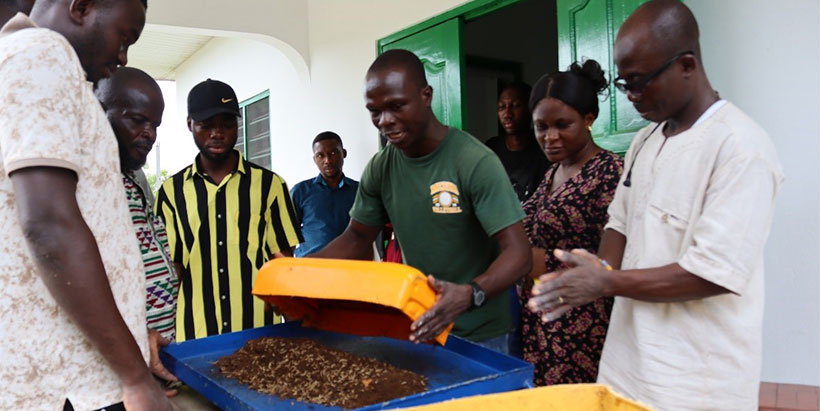
As part of activities to build capacity and BSF technology know-how of youth agripreneurs and other stakeholders, the project has started training farmers on the BSF feed production for poultry, fish, and pig to give them the necessary skills to start their own feed production.
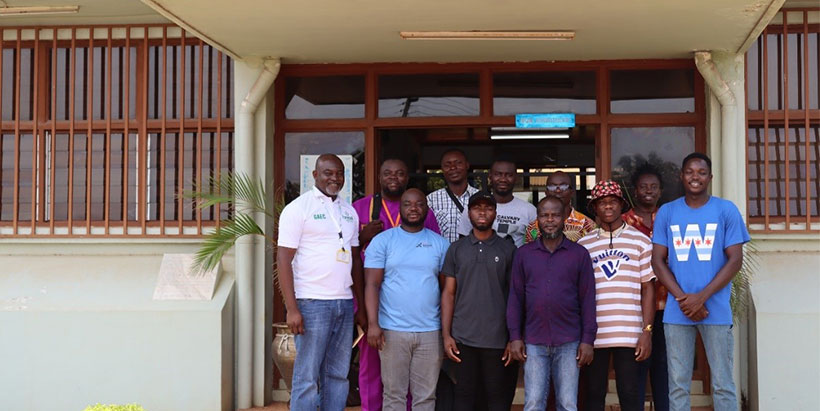
The training was held from 17 to 21 April after the BSF decentralized units were installed. BNARI hosted the training program, which began with theoretical learning followed by practical sessions. During the theoretical session, facilitators led participants through topics such as the biology and benefits of the black soldier fly, the mass-rearing process of the black soldier fly, housing and farm management practices of the black soldier fly, and the post-processing of black soldier fly larvae, residue, and compost production.
In the practice sessions, the facilitator, Dr Selorm Ofori, and his team of experts coached the farmers on feedstock preparation, feeding the larvae with feedstock, and harvesting the larvae at the appropriate instar growth stage. The practical sessions also gave some hands-on skill training to farmers on the post-processing of the larvae for feed and frass/biofertilizer production.
Funded by the Norwegian Agency for Development Cooperation (Norad), the IITA BBEST project’s objective is to improve the livelihoods of smallholder chicken, fish, pig, and vegetable producers and other value chain actors. The project also aims to contribute to improved urban sanitation and climate change mitigation.
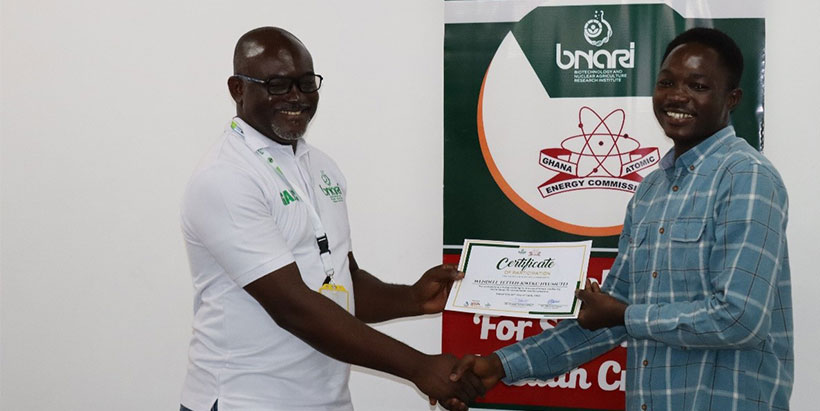
At the end of the training, participants thanked IITA and BNARI for the opportunity to learn about the BSF technology, especially as conventional animal feeds are becoming more expensive. BNARI Director Dr Michael Osae encouraged the farmers to contact the institute when they need support. He also urged them to apply what they had learned during the training before presenting them with certificates for participation.
Contributed by Francisca Ocloo
Contributed by
Recent stories