NEWS

Female scientists seek enabling environment in the CGIAR
February 3, 2021

Female scientists play an essential role at the forefront of CGIARs mission to deliver science and innovation that advance the transformation of food, land, and water systems in a climate crisis. Female scientists, representing 29% of the CGIAR workforce, power its innovation but still require more support to thrive. This led to the creation of Women in Research and Science (WIRES), a new employee-led resource group (ERG) that aims to build an enabling environment to empower women scientists across CGIAR. 

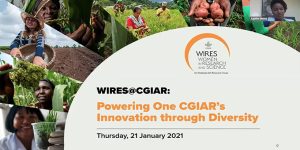
On 21 January, the WIRES platform was launched in a virtual seminar themed “Powering One CGIARs innovation through diversity.” The discussion featured five expert speakers focused on empowering women in research and science at CGIAR workplaces worldwide 

Head of Regional Information and Smart Food Coordinator at ICRISAT, Agathe Diama (top right), anchoring the WIRES launch webinar.

WIRES is one of three new ERGs established under CGIAR’s gender, diversity, and inclusion (GDI) Framework. The ERG was founded by women scientists from across the CGIAR centers, including IITA scientists Elizabeth ParkesHarvestPlus Cassava Breeder, and Gundula Fischer, Social Scientist and Gender Expert. 

The group is dedicated to championing and supporting women. The group is open to any employee who is ready to support an increase in visibility for women research and science professionals by ensuring that their voices are heard, and contributions are recognized. WIRES aims to connect and inspire its members by providing tools and shared knowledge that supports professional development. This will be done by organizing and sponsoring events and activities that build workplace relationships and strengthening networks and alliances across CGIAR. 

Agathe Diama, Head of Regional Information and Smart Food Coordinator at ICRISAT, facilitated the session. Excited about the launch and plans for the network, she stated that men are also encouraged to be part of the group, as it is not open to women alone. 
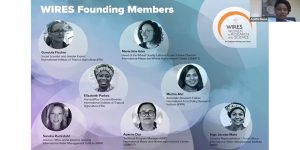
WIRES is an employee-led resource group founded by female staff from the CGIAR centers.

Fiona Bourdin, CGIAR Senior Adviser on Gender, Diversity, and Inclusion, gave an overview of ERGs. Bourdin stated that their role is to promote a diverse and inclusive workplace, one of WIRES’s goals. “ERGS encourage great staff engagement, which leads to improved motivation, morale, and innovation in the workplace,” she said. 

Technical Program Manager of the Global Maize Program at CYMMYT and one of the founding members of this ERG, Aparna Dashighlighted the mission and goal of WIRES. Das said that WIRES promotes women’s interests and enhances communication, research collaboration, and career mentoring among all members. “Our members will be expected to promote inclusiveness in the workplace, motivate colleagues through wider information about women in research and science, contribute to the mission of WIRES, and help people access ideas that inspire change and benefit individuals, families, and communities. 

In a panel discussion anchored by South Africa Country Representative of IWMI and a WIRES member Inga Jacobs-Mata, she asked speakers to share their journey and lessons learned as women scientists. Alice Ruhweza, Africa Region Director for the World Wide Fund for Nature (WWF), stated that over the years, she has learned to put her values first in everything and then explore how to bring those values to the workplace. “Be visible, accept the vulnerability that comes with being visible, and be optimistic,” she added. Another speaker, Chin Yee Chan, Research Fellow at WorldFishstated that she learned never to give up but to keep learning to extend the research horizon by exploring research options. “There are always challenges, but if we take it step by step and never give up, it will be a rewarding journey,” she added. 

The speakers also highlighted the challenges facing women in R4D and their hope for CGIAR in the future. Claudia SadoffConvener, and Managing Director of Research Delivery and Impact, for the One CGIAR Executive Management Team, mentioned her hope for CGIAR to become a space where women gain recognition, not only in research and science but generally. In the same light, Safaa KumariHead of Seed Health Lab/Plant Virologist at ICARDA, advised the CGIAR leadership to create a comprehensive workplace for women scientists and researchers. 

Concluding the seminar, Das encouraged both men and women to be part of the group. “We welcome and encourage all of you to join WIRES; let’s build this team together,” she said. 


Contributed by

Recent stories

No items found

Leave a Reply

Your email address will not be published. Required fields are marked *

Scroll to Top
Olaosebikan, Olamide

Olamide Deborah Nwanze is a Senior Research Associate specializing in gender mainstreaming research to inform participatory and inclusive breeding, variety development, and seed systems policies regarding root, tuber, and banana (RTB) crops in the International Institute of Tropical Agriculture Headquarters, Ibadan, Nigeria. She is a PhD candidate at the University of Ibadan and holds an MSc and B. Agric in Agricultural Extension and Rural Development. Olamide is a fellow of the African Women in Agricultural Research and Development – Gender Responsive Agricultural Systems Policy (AWARD-GRASP) and the Gender Responsive Researchers Equipped for Agricultural Transformation (GREAT). She seeks to apply her gender-mainstreaming learnings, gender-responsive research, and policy development, and review expertise to facilitate women, youth, children, and vulnerable social group’s access to and adoption of agricultural Innovations that guarantee food, nutrition, income, and livelihood security in Africa. Her current roles include mentoring research fellows, development of guides and training manuals, implementation and adaptation of gender frameworks and tools, value chain actors’ engagement as citizen science partners, policy review and redesign, data management, and analysis. Her current research explores mixed methods and participatory and interdisciplinary approaches to capture and highlight gender dynamics, needs, preferences, and challenges stakeholders face within the agricultural livelihood value chain to prioritize gender-inclusive strategies in breeding programs, policy design, and implementation.

At IITA, she contributes to the implementation of the CGIAR Accelerated Breeding Initiative and Genetic Innovation Programs; participatory and gender research within the NextGen CassavaHarvestPlusRTBFoods, and Tricot-ClimMob 1000Farms Projects; and gender knowledge communication via the G-LENS webinar series, video documentary, policy briefspublications, and blogs.


Recent publications

de Sousa, K., van Etten, J., Manners, R. Bello, A., Teeken, B., Olaosebikan, O., et al. 2024. The tricot approach: an agile framework for decentralized on-farm testing supported by citizen science. A retrospective. Agron. Sustain. Dev. 44, 8. https://doi.org/10.1007/s13593-023-00937-1

Madu, T., Onwuka, S., Nwafor, S., Onyemauwa, N., Ejechi, M., Ofoeze, M., Ukeje, B., Eluagu, C., Olaosebikan, O., Okoye, B., 2024. Gender-Inclusive Consumer Studies Improve Cassava Breeding in Nigeria in: Frontiers in Sociology, volume 9, number: 1224504, doi: 10.3389/fsoc.2024.1224504

Olaosebikan, O.; Bello, A.; Utoblo, O.; Okoye, B.; Olutegbe, N.; Garner, E.; Teeken, B.; Bryan, E.; Forsythe, L.; Cole, S.; Madu, T. 2023.  Stressors and Resilience within the Cassava Value Chain in Nigeria: Preferred Cassava Variety Traits and Response Strategies of Men and Women to Inform Breeding. Sustainability 15, 7837. https://doi.org/10.3390/su15107837

Okoye, B., Ofoeze, M., Ejechi, M., Onwuka, S., Nwafor, S., Onyemauwa, N., Ukeje, B., Eluagu, C., Obidiegwu, J.*, Olaosebikan, O., Madu, T.* 2023. Prioritizing preferred traits in the yam value chain in Nigeria: a gender situation analysis in: Frontiers in Sociology, volume 8, number: 1232626, pages 1 – 9, ISSN 2297-7775, 2023. https://www.frontiersin.org/articles/10.3389/fsoc.2023.1232626/full

Olaosebikan, O., Bello, A. A., de Sousa, K., Ndjouenkeu, R., Adesokan, M., Alamu, E. O., Agbona, A., van Etten, J., Kegah, F. N.*, Dufour, D., Bouniol, A., Teeken, B. 2023. Consumer acceptability of cassava gari-eba food products across cultural and environmental settings using the triadic comparison of technologies approach (tricot) in: Journal of the Science of Food and Agriculture,

Teeken, B., Olaosebikan, O., Bello, A. A., Madu, T.*, Cole, S. M. 2023. Qualitative assessment on the positionality and preferences of dyads in relation to cassava-related activities: working with tricot trial citizen scientists https://hdl.handle.net/10568/138326 Type: Manual

Bouniol, A., Ceballos, H., Bello, A. A., Teeken, B., Olaosebikan, O., Owoade, D., Agbona, A., Fotso Kuate, A., Madu, T.*, Okoye, B.*, Ofoeze, M.*, Nwafor, S.*, Onyemauwa, N.*, Adinsi, L.*, Forsythe, L., Dufour, D. 2023. Varietal impact on women’s labour, workload and related drudgery in processing root, tuber and banana crops: focus on cassava in sub-Saharan Africa in: Journal of the Science of Food and Agriculture, pages 1 – 25, ISSN 0022-5142,

Bello, A. A., Agbona, A., Olaosebikan, O., Edughaen, G., Dufour, D., Bouniol, A., Iluebbey, P., Ndjouenkeu, R.*, Rabbi, I. Y., Teeken, B. 2023. Genetic and environmental effects on processing productivity and food product yield: drudgery of women’s work in: Journal of the Science of Food and Agriculture, pages 1 – 32, ISSN 0022-5142, 5

Cavicchioli, M., Zimbiti, T., Teeken, B., Nwanze, D.O., Liani, M., Parkes, E. & Bello, A. 2023. IITA-Gender Responsive Breeding Training Report. Genetic Resources Center, IITA-HQ, Ibadan, 21-23 September, 2022. Ibadan, Nigeria: IITA, (34 p.).https://hdl.handle.net/10568/131368

Agbona, A. Peteti P., Teeken B., Olaosebikan O. Bello, A. A., Parkes, E., Rabbi, I. Y., Mueller, L., Egesi, C., Kulakow, P. 2022. Data Management in Multi-disciplinary African RTB Crop Breeding Programs. In: Williamson, H.F., Leonelli, S. (eds) Towards Responsible Plant Data Linkage: Data Challenges for Agricultural Research and Development. Springer, Cham. https://doi.org/10.1007/978-3-031-13276-6_5

Lora Forsythe, Pricilla Marimo, Sarah Mayanja, Olamide D. Olaosebikan, Esme Stuart, Bela Teeken, Benjamin Okoye, Tessy Madu, (2021). Cross-product Gender Analysis of RTBfoods Step 2 Gendered Food Mapping on RTB Products. Understanding the Drivers of Trait Preferences and the Development of Multi-user RTB Product Profiles, WP1. London, UK: RTBfoods Field Scientific Report, 30 p.

Teeken, B., Garner, E., Agbona, A., Balogun, I., Olaosebikan, O., Bello, A., Madu, T., Okoye, B., Egesi, C., Kulakow, P. and Tufan, H.A. 2021. Beyond “Women’s Traits”: Exploring How Gender, Social Difference, and Household Characteristics Influence Trait Preferences. Frontiers Sustainable Food Systems 5:740926. https://doi.org/10.3389/fsufs.2021.740926

Teeken, B., Agbona, A., Bello, A., Olaosebikan, O., Alamu, E., Adesokan, M., Awoyale, W., Madu, T., Okoye, B., Chijioke, U., Owoade, D., Okoro, M., Bouniol, A., Dufour, D., Hershey, C., Rabbi, I., Maziya‐Dixon, B., Egesi, C., Tufan, H. and Kulakow, P. (020. Understanding cassava varietal preferences through pairwise ranking of gari‐eba and fufu prepared by local farmer–processors. Int J Food Sci Technol. https://doi.org/10.1111/ijfs.14862

Bela Teeken, Olamide Olaosebikan, Ireti Balogun, Benjamin Okoye, Tessy Madu, Steven Cole, Abolore Bello, Elizabeth Parkes. (2020). Piloting the G+ customer and product profile tools for gender-responsive cassava breeding in Nigeria. Nigeria: International Institute of Tropical Agriculture (IITA). https://hdl.handle.net/20.500.11766/13000