
TETFund seeks partnership with IITA for impactful agricultural research
A 3-member delegation from Nigeria’s Tertiary Education Trust Fund (TETFund) Standing Committee on Research and Development Agriculture visited IITA-Ibadan on 20 November, as part of a new initiative to ensure that research impacts society. The team set out to find existing programs delivering on research for development in the agricultural sector and looked forward to building partnerships with IITA to achieve the Committee’s role.
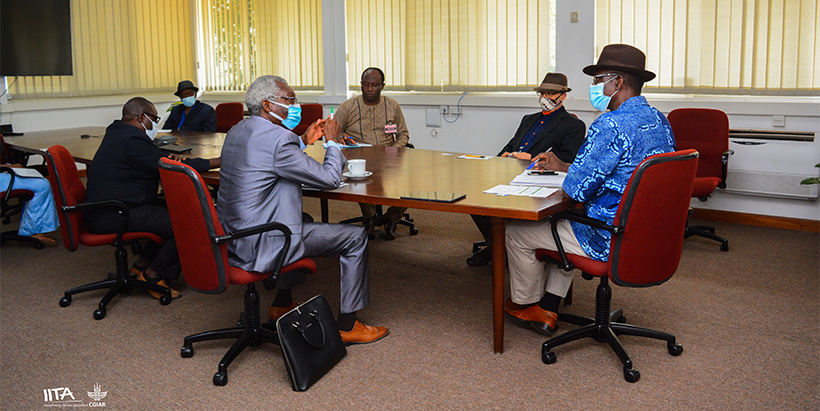 The Deputy Coordinator of the TETFund Agricultural thematic group, Prof Charles Aworh, said Nigeria devotes less than 0.1% of its GDP to research generally, which is way too low to fund research for development. He said there needs to be a National Research Foundation enacted by law that will not be subject to government change. Recognizing IITA’s impact on developing research outputs for development, it was only logical that their mission led them to IITA.
IITA Deputy Director General, Partnerships for Delivery, Kenton Dashiell and the Director Advocacy and Country Alignment Function Kwesi Atta-Krah, received the TETFund team along with the Director for Development and Delivery, Alfred Dixon. The group visited IITA Youth Agripreneurs (IYA), Aflasafe under the Business Incubation Platform (BIP), YIIFSWA hydroponics, and Genetic Resources Center (GRC) to learn about relevant resources.
The Institute’s research and delivery programs excited the delegates, especially the IYA’s gains and successes so far. They commended the Aflasafe innovation and its reach in solving aflatoxin issues in crops, and the yam hydroponics for addressing yam seed problems. Aworh said IYA had targeted the main constraint to agricultural development, which is the impression that agriculture is for the old and uneducated. He commended the leadership of IITA for bringing on IYA because engaging and training our youth is one of the best ways to steer our nation’s economy. The visitors agreed that all their visit points agree with the Committee’s goal.
Dashiell and Atta-Krah assured the delegates that IITA is open to partnerships and collaboration to drive research for sustainable development, especially those involving universities, industries, the government, and research institutes. They assured the team that donors know IITA to deliver and that the Institute has stayed true to this reputation over the years. “IITA will be very keen to partner with TETFund as a whole, especially with regards to working with the Federal and State governments in delivering technological innovations on agriculture to the nation,” Dashiell said.
The delegates said they look forward to partnerships and collaborations with IITA in running a National Research Foundation, which is one of the outputs the Committee seeks to deliver.
The Deputy Coordinator of the TETFund Agricultural thematic group, Prof Charles Aworh, said Nigeria devotes less than 0.1% of its GDP to research generally, which is way too low to fund research for development. He said there needs to be a National Research Foundation enacted by law that will not be subject to government change. Recognizing IITA’s impact on developing research outputs for development, it was only logical that their mission led them to IITA.
IITA Deputy Director General, Partnerships for Delivery, Kenton Dashiell and the Director Advocacy and Country Alignment Function Kwesi Atta-Krah, received the TETFund team along with the Director for Development and Delivery, Alfred Dixon. The group visited IITA Youth Agripreneurs (IYA), Aflasafe under the Business Incubation Platform (BIP), YIIFSWA hydroponics, and Genetic Resources Center (GRC) to learn about relevant resources.
The Institute’s research and delivery programs excited the delegates, especially the IYA’s gains and successes so far. They commended the Aflasafe innovation and its reach in solving aflatoxin issues in crops, and the yam hydroponics for addressing yam seed problems. Aworh said IYA had targeted the main constraint to agricultural development, which is the impression that agriculture is for the old and uneducated. He commended the leadership of IITA for bringing on IYA because engaging and training our youth is one of the best ways to steer our nation’s economy. The visitors agreed that all their visit points agree with the Committee’s goal.
Dashiell and Atta-Krah assured the delegates that IITA is open to partnerships and collaboration to drive research for sustainable development, especially those involving universities, industries, the government, and research institutes. They assured the team that donors know IITA to deliver and that the Institute has stayed true to this reputation over the years. “IITA will be very keen to partner with TETFund as a whole, especially with regards to working with the Federal and State governments in delivering technological innovations on agriculture to the nation,” Dashiell said.
The delegates said they look forward to partnerships and collaborations with IITA in running a National Research Foundation, which is one of the outputs the Committee seeks to deliver.
The TETFUND team meeting with IITA staff in the conference room.
IITA Senior Management staff with the TETFUND delegation.
 Alejandro Ortega-Beltran (left) explaining the Aflasafe technology to the delegation.
Contributed by
Recent stories
No items found