
Private sector engagement: Way forward for African Agriculture
November 20, 2020
A webinar was organized on 5 November to connect partners and deliberate on ways to increase private sector engagement in African agriculture.
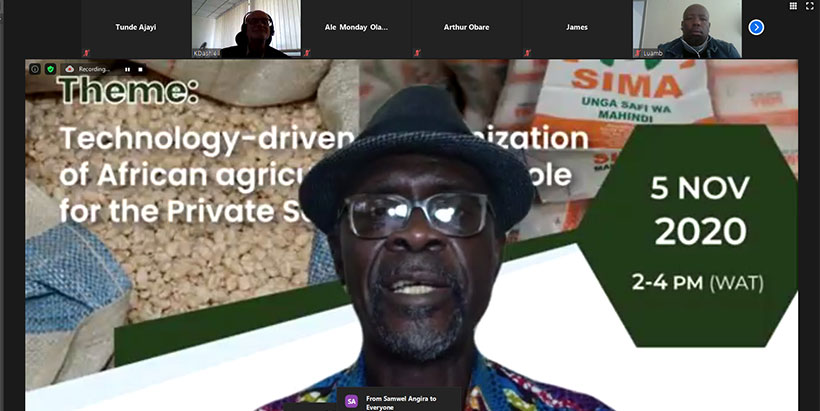
The webinar, a collaborative activity of the African Union Development Agency (AUDA-NEPAD) with Grow Africa, IITA, and Technologies for African Agricultural Transformation (TAAT), was moderated by Kwesi Atta-Krah, IITA Director for Country and Regional Engagement and Senior Programme Engagement Specialist for TAAT.
 In his opening remarks, Kenton Dashiell, IITA DDG Partnerships for Delivery, highlighted the private sector’s importance and role in the entire agriculture value chain. He noted that when the private sector is fully engaged in African agriculture, smallholder farmers will have easy access to technologies to enhance production and profit. He encouraged participants to envision a productive agricultural environment that is driven and powered by the private sector.
Ibrahim Gourouza-Magaji, Chief Operations Officer, Grow Africa (AUDA-NEPAD) expressed that since June 2017, African Institutions, under the leadership of the African Union Commission (AUC) and NEPAD, have adopted a framework which facilitates private sector investment in agriculture in Africa called the Country Agribusiness Partnership Framework (CAP-F). Gourouza- Magaji explained that CAP-F conducts policy changes, mobilizes private sector investors and FDI investment, sets up coordination mechanisms in countries, and provides a mutual accountability framework. “The model has been tested, and it has been able to mobilize half a million dollars investment in various value chains in six African countries,” he said.
“Technology is the pivot,” Wanbo Yandjeu, NEPAD Rural Development Specialist, said. He explained that digital technology is changing farming in Africa by providing an increasing number of precision services. He explained that new breeds of crops and animals being released by research help manage climate stresses better while increasing yields.
“With reduced economic activities, disruption in global supply chains, and increases in the price of commodities due to the COVID-19 pandemic, it is expedient for the private sector to be brought on board massively to effect a significant change,” said Dr Martin Fregene, Director, Agriculture and Agro-Industries, African Development Bank (AfDB). Fregene explained that 80% of all food consumed in Africa passes through small and medium enterprises. Since the private sector invests up to $16 billion in agriculture already, it is important to harness more input from it.
Putting the private sector at the center of transformation to ensure sustainability, building stronger linkages between research institutions and SMEs to ensure the affordability and availability of food on the African continent is of high importance and should be developed into a policy.
In his opening remarks, Kenton Dashiell, IITA DDG Partnerships for Delivery, highlighted the private sector’s importance and role in the entire agriculture value chain. He noted that when the private sector is fully engaged in African agriculture, smallholder farmers will have easy access to technologies to enhance production and profit. He encouraged participants to envision a productive agricultural environment that is driven and powered by the private sector.
Ibrahim Gourouza-Magaji, Chief Operations Officer, Grow Africa (AUDA-NEPAD) expressed that since June 2017, African Institutions, under the leadership of the African Union Commission (AUC) and NEPAD, have adopted a framework which facilitates private sector investment in agriculture in Africa called the Country Agribusiness Partnership Framework (CAP-F). Gourouza- Magaji explained that CAP-F conducts policy changes, mobilizes private sector investors and FDI investment, sets up coordination mechanisms in countries, and provides a mutual accountability framework. “The model has been tested, and it has been able to mobilize half a million dollars investment in various value chains in six African countries,” he said.
“Technology is the pivot,” Wanbo Yandjeu, NEPAD Rural Development Specialist, said. He explained that digital technology is changing farming in Africa by providing an increasing number of precision services. He explained that new breeds of crops and animals being released by research help manage climate stresses better while increasing yields.
“With reduced economic activities, disruption in global supply chains, and increases in the price of commodities due to the COVID-19 pandemic, it is expedient for the private sector to be brought on board massively to effect a significant change,” said Dr Martin Fregene, Director, Agriculture and Agro-Industries, African Development Bank (AfDB). Fregene explained that 80% of all food consumed in Africa passes through small and medium enterprises. Since the private sector invests up to $16 billion in agriculture already, it is important to harness more input from it.
Putting the private sector at the center of transformation to ensure sustainability, building stronger linkages between research institutions and SMEs to ensure the affordability and availability of food on the African continent is of high importance and should be developed into a policy.
Dr Kwesi Atta-Krah, moderating the webinar.
 Some of the webinar attendees.
Contributed by
Recent stories
No items found