
IITA NEWS

Teamwork delivers results in addressing cassava virus diseases!
October 23, 2020

“If you want to go quickly, go alone, if you want to go far, go together.”
The meaning of this African proverb is well manifested by the Virus Vector Ecology Group (VVEG) team at IITA’s Eastern Africa Hub as James Legg, IITA Plant Health Scientist and team lead, shared on its progress and successes towards addressing the viral disease challenge facing cassava in Africa and even Asia.
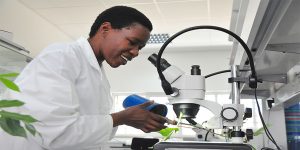
Eveline Wosula of the VVEG counting whitefly eggs on cassava leaves in the laboratory

The VVEG team is divided into several subteams working on different angles to find innovative solutions to control the spread of the two major virus diseases, cassava mosaic disease (CMD) and cassava brown streak disease (CBSD), to improve cassava productivity in Africa and Asia. Legg highlighted some of the notable outcomes of the teams at a virtual seminar titled “Teams, Whiteflies, Viruses, and More​​“, held at IITA Eastern Africa Hub, Dar es Salaam, Tanzania, on 17 September.

NuruAI app scanning leaves of a cassava plant to detect diseases and pests.

The whitefly team

Cassava whitefly, Bemisia tabaci, is the vector that transmits the viruses that cause CMD and CBSD. Efforts to control the diseases start with proper identification of the vector. The Whitefly team is therefore working on developing simpler but sensitive diagnostic tools geared towards identifying the various subgroups of the cassava whitefly and their distribution in the region. One such technology is the use of Kompetitive Allele-Specific PCR (KASP). Using this in-house technology, the team identified and characterized the whitefly population in Eastern and Central Africa and found evidence for hybridization between genotypes of cassava Bemisia tabaci in Eastern Democratic Republic of Congo (DRC).

The team is also working on innovations to effectively control the whitefly pest, including the use of essential botanical oils, soft chemistry pesticides, and entomopathogenic fungi. Legg particularly noted that excellent results have been obtained from the lab trials on the effectiveness of some essential oils such as Patchouli in reducing whitefly populations and also Flupyradifurone, a soft chemistry pesticide developed by Bayer which was found to be significantly more effective than Imidacloprid—the currently most-widely used pesticide. Flupyradifurone also had fewer nontarget effects.

Cassava virus team

The virus team is working on under­s­tan­ding developing diagnostics to detect viruses in cassava plants. This is important as part of efforts to control the disease spread by ensuring clean and disease-free seed. The team has developed a modified Loop Mediated Isothermal Amplification (LAMP) protocol for detecting cassava brown streak viruses. This method can be cheaper, quicker, and more portable than the currently used real-time polymerase chain reaction-based method. The new LAMP technique will be extremely useful to the Tanzania Official Seed Certification Institute (TOSCI) for certification testing that needs to be done in the cassava as well as other seed systems.

The team is also conducting surveillance to monitor the spread of CBSD to new areas. Recent surveys implemented together with national research systems in Tanzania, eastern DRC, and Zambia have revealed that the disease is spreading eastwards and southwards through south-eastern DRC, northern Zambia as well as the western part of Tanzania along the shores of Lake Tanganyika.

Cassava Seed systems team

Previously farmers replanted their old cassava stock or borrowed from neighbors because of a lack of cassava seed systems, contributing to the spread of both CMD and CBSD.

The cassava seed team is working together with TOSCITARIMEDA, and other partners in Tanzania to modernize cassava seed systems. This includes putting in place protocols and systems of quality assurance for disease-free seed. The quality control certification guidelines have been developed and adopted as law in Tanzania, Rwanda, and Burundi to guide production and supply of cassava quality seed. The team has also rolled out the use of SeedTracker, an ICT system facilitating real-time e-certification of clean seed in Tanzania; currently, more than 100 seed producers are registered on the platform.

Nuru team

To tackle the challenge of diagnosing plants affected by the viral diseases, IITA and Pennsylvania State University, USA, have collaborated to launch Nuru (Swahili for light), an artificial intelligence, phone-based disease diagnostic application. It recognizes leaves damaged by CMD and CBSD but also damage by green and red mites.

The team has made many improvements in the performance and accuracy of NuruAI in detecting diseases and pests. In this regard, NuruAI has been found to outperform trained extension officers in diagnosing cassava diseases. NuruAI has been used to monitor cassava diseases in 19 African countries with Tanzania, Kenya, and Ivory Coast as use hotspots.

“Life is what happens to us while we are making other plans,” says another saying. All the outcomes have boosted the team’s morale to take on new challenges. The plans for the next three years (2020/2023) shared by Legg include continuing to control the spread of the cassava viruses through clean seed systems and the development of better, faster, cheaper, and more effective diagnostics. With good collaboration, the team is excited to embark on a new journey of R4D and P4D adventures.


Contributed by

Recent stories

No items found

Leave a Reply

Your email address will not be published. Required fields are marked *

Scroll to Top
Olaosebikan, Olamide

Olamide Deborah Nwanze is a Senior Research Associate specializing in gender mainstreaming research to inform participatory and inclusive breeding, variety development, and seed systems policies regarding root, tuber, and banana (RTB) crops in the International Institute of Tropical Agriculture Headquarters, Ibadan, Nigeria. She is a PhD candidate at the University of Ibadan and holds an MSc and B. Agric in Agricultural Extension and Rural Development. Olamide is a fellow of the African Women in Agricultural Research and Development – Gender Responsive Agricultural Systems Policy (AWARD-GRASP) and the Gender Responsive Researchers Equipped for Agricultural Transformation (GREAT). She seeks to apply her gender-mainstreaming learnings, gender-responsive research, and policy development, and review expertise to facilitate women, youth, children, and vulnerable social group’s access to and adoption of agricultural Innovations that guarantee food, nutrition, income, and livelihood security in Africa. Her current roles include mentoring research fellows, development of guides and training manuals, implementation and adaptation of gender frameworks and tools, value chain actors’ engagement as citizen science partners, policy review and redesign, data management, and analysis. Her current research explores mixed methods and participatory and interdisciplinary approaches to capture and highlight gender dynamics, needs, preferences, and challenges stakeholders face within the agricultural livelihood value chain to prioritize gender-inclusive strategies in breeding programs, policy design, and implementation.

At IITA, she contributes to the implementation of the CGIAR Accelerated Breeding Initiative and Genetic Innovation Programs; participatory and gender research within the NextGen CassavaHarvestPlusRTBFoods, and Tricot-ClimMob 1000Farms Projects; and gender knowledge communication via the G-LENS webinar series, video documentary, policy briefspublications, and blogs.


Recent publications

de Sousa, K., van Etten, J., Manners, R. Bello, A., Teeken, B., Olaosebikan, O., et al. 2024. The tricot approach: an agile framework for decentralized on-farm testing supported by citizen science. A retrospective. Agron. Sustain. Dev. 44, 8. https://doi.org/10.1007/s13593-023-00937-1

Madu, T., Onwuka, S., Nwafor, S., Onyemauwa, N., Ejechi, M., Ofoeze, M., Ukeje, B., Eluagu, C., Olaosebikan, O., Okoye, B., 2024. Gender-Inclusive Consumer Studies Improve Cassava Breeding in Nigeria in: Frontiers in Sociology, volume 9, number: 1224504, doi: 10.3389/fsoc.2024.1224504

Olaosebikan, O.; Bello, A.; Utoblo, O.; Okoye, B.; Olutegbe, N.; Garner, E.; Teeken, B.; Bryan, E.; Forsythe, L.; Cole, S.; Madu, T. 2023.  Stressors and Resilience within the Cassava Value Chain in Nigeria: Preferred Cassava Variety Traits and Response Strategies of Men and Women to Inform Breeding. Sustainability 15, 7837. https://doi.org/10.3390/su15107837

Okoye, B., Ofoeze, M., Ejechi, M., Onwuka, S., Nwafor, S., Onyemauwa, N., Ukeje, B., Eluagu, C., Obidiegwu, J.*, Olaosebikan, O., Madu, T.* 2023. Prioritizing preferred traits in the yam value chain in Nigeria: a gender situation analysis in: Frontiers in Sociology, volume 8, number: 1232626, pages 1 – 9, ISSN 2297-7775, 2023. https://www.frontiersin.org/articles/10.3389/fsoc.2023.1232626/full

Olaosebikan, O., Bello, A. A., de Sousa, K., Ndjouenkeu, R., Adesokan, M., Alamu, E. O., Agbona, A., van Etten, J., Kegah, F. N.*, Dufour, D., Bouniol, A., Teeken, B. 2023. Consumer acceptability of cassava gari-eba food products across cultural and environmental settings using the triadic comparison of technologies approach (tricot) in: Journal of the Science of Food and Agriculture,

Teeken, B., Olaosebikan, O., Bello, A. A., Madu, T.*, Cole, S. M. 2023. Qualitative assessment on the positionality and preferences of dyads in relation to cassava-related activities: working with tricot trial citizen scientists https://hdl.handle.net/10568/138326 Type: Manual

Bouniol, A., Ceballos, H., Bello, A. A., Teeken, B., Olaosebikan, O., Owoade, D., Agbona, A., Fotso Kuate, A., Madu, T.*, Okoye, B.*, Ofoeze, M.*, Nwafor, S.*, Onyemauwa, N.*, Adinsi, L.*, Forsythe, L., Dufour, D. 2023. Varietal impact on women’s labour, workload and related drudgery in processing root, tuber and banana crops: focus on cassava in sub-Saharan Africa in: Journal of the Science of Food and Agriculture, pages 1 – 25, ISSN 0022-5142,

Bello, A. A., Agbona, A., Olaosebikan, O., Edughaen, G., Dufour, D., Bouniol, A., Iluebbey, P., Ndjouenkeu, R.*, Rabbi, I. Y., Teeken, B. 2023. Genetic and environmental effects on processing productivity and food product yield: drudgery of women’s work in: Journal of the Science of Food and Agriculture, pages 1 – 32, ISSN 0022-5142, 5

Cavicchioli, M., Zimbiti, T., Teeken, B., Nwanze, D.O., Liani, M., Parkes, E. & Bello, A. 2023. IITA-Gender Responsive Breeding Training Report. Genetic Resources Center, IITA-HQ, Ibadan, 21-23 September, 2022. Ibadan, Nigeria: IITA, (34 p.).https://hdl.handle.net/10568/131368

Agbona, A. Peteti P., Teeken B., Olaosebikan O. Bello, A. A., Parkes, E., Rabbi, I. Y., Mueller, L., Egesi, C., Kulakow, P. 2022. Data Management in Multi-disciplinary African RTB Crop Breeding Programs. In: Williamson, H.F., Leonelli, S. (eds) Towards Responsible Plant Data Linkage: Data Challenges for Agricultural Research and Development. Springer, Cham. https://doi.org/10.1007/978-3-031-13276-6_5

Lora Forsythe, Pricilla Marimo, Sarah Mayanja, Olamide D. Olaosebikan, Esme Stuart, Bela Teeken, Benjamin Okoye, Tessy Madu, (2021). Cross-product Gender Analysis of RTBfoods Step 2 Gendered Food Mapping on RTB Products. Understanding the Drivers of Trait Preferences and the Development of Multi-user RTB Product Profiles, WP1. London, UK: RTBfoods Field Scientific Report, 30 p.

Teeken, B., Garner, E., Agbona, A., Balogun, I., Olaosebikan, O., Bello, A., Madu, T., Okoye, B., Egesi, C., Kulakow, P. and Tufan, H.A. 2021. Beyond “Women’s Traits”: Exploring How Gender, Social Difference, and Household Characteristics Influence Trait Preferences. Frontiers Sustainable Food Systems 5:740926. https://doi.org/10.3389/fsufs.2021.740926

Teeken, B., Agbona, A., Bello, A., Olaosebikan, O., Alamu, E., Adesokan, M., Awoyale, W., Madu, T., Okoye, B., Chijioke, U., Owoade, D., Okoro, M., Bouniol, A., Dufour, D., Hershey, C., Rabbi, I., Maziya‐Dixon, B., Egesi, C., Tufan, H. and Kulakow, P. (020. Understanding cassava varietal preferences through pairwise ranking of gari‐eba and fufu prepared by local farmer–processors. Int J Food Sci Technol. https://doi.org/10.1111/ijfs.14862

Bela Teeken, Olamide Olaosebikan, Ireti Balogun, Benjamin Okoye, Tessy Madu, Steven Cole, Abolore Bello, Elizabeth Parkes. (2020). Piloting the G+ customer and product profile tools for gender-responsive cassava breeding in Nigeria. Nigeria: International Institute of Tropical Agriculture (IITA). https://hdl.handle.net/20.500.11766/13000