
Creating awareness on reporting climate smart agriculture and nutrition
November 21, 2019
IITA-Tanzania organized a media awareness session on “Climate Smart Agriculture (CSA) and nutrition” in commemoration of World Food Day 2019. It aimed at increasing the knowledge and understanding of the media on issues around climate change and its impact on agriculture and rural communities. In addition, it focused on understanding the concepts, principles, and approaches of CSA, and gender and nutrition; and to deliberate on the role of media in Tanzania in creating awareness and advocacy on issues around gender and nutrition-sensitive CSA.
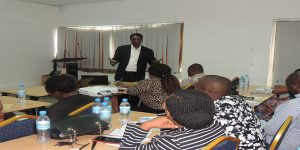 The session took place on 18 October at IITA-Tanzania offices in Dar es Salaam. Thirty-three journalists from 17 media houses attended. Also present were government officials from the Ministry of Agriculture (MoA), the Tanzania Food and Nutrition Centre (TFNC), and the World Agroforestry Centre (ICRAF) who participated and presented different topics on CSA and nutrition.
During the session, journalists were taken through the causes of climate change and its impact on agriculture, principles of climate smart agriculture, policy issues around CSA in Tanzania, Nutrition and CSA, examples of CSAs, and lessons from the Building Capacity for Resilient Food Security Project.
While giving an introduction to the CSA concept, Frederick Baijukya, a Senior Scientist at IITA said, “CSA has three pillars—sustainable increase of agricultural productivity and incomes, adaptation and resilience to climate change, and reducing or removing greenhouse gasses to mitigate climate change.”
During her presentation on policy issues around CSA in Tanzania, Evelyn Kagoma from the Environmental Management Unit in the Ministry of Agriculture (MoA) noted that agriculture is the mainstay of Tanzania’s economy employing 77.5 percent of the country’s population and contributes about 95 percent of national food requirements.
“In its efforts to address climate change in the agricultural sector, MoA has developed policies and guidelines on climate change including the Agriculture Climate Resilience Plan (2014–2019); the National Climate-Smart Agriculture Program (2015–2025), and Climate-Smart Agriculture Guidelines to guide the country’s strategic interventions. In addition, environmental and climate change issues have been incorporated into the Agricultural Sector Development Program Phase Two (ASDP II) under component 1 (Sustainable water and Land Use Management),” she said.
Despite all these efforts, the sector still faces challenges in implementing CSA practices and technologies. Kagoma said one of the major challenges is inadequate education and awareness among farmers on issues related to climate change.
During his presentation on Nutrition and CSA, Dr Francis Modaha, Senior Scientist from the Tanzania Food and Nutrition Centre (TFNC), said that climate change affects nutrition because of occurrences such as increased drought, leading to reduced agricultural yields of crops, livestock, and fish, thus diminishing food security.
He added that climate change could also diminish water supply through changes in temperature and rainfall patterns, thus resulting in reduced income among people involved in the value chain (farmers, traders, processors, etc.) as well as diminished agricultural yields that led to decreased government revenues to finance nutrition.
The session took place on 18 October at IITA-Tanzania offices in Dar es Salaam. Thirty-three journalists from 17 media houses attended. Also present were government officials from the Ministry of Agriculture (MoA), the Tanzania Food and Nutrition Centre (TFNC), and the World Agroforestry Centre (ICRAF) who participated and presented different topics on CSA and nutrition.
During the session, journalists were taken through the causes of climate change and its impact on agriculture, principles of climate smart agriculture, policy issues around CSA in Tanzania, Nutrition and CSA, examples of CSAs, and lessons from the Building Capacity for Resilient Food Security Project.
While giving an introduction to the CSA concept, Frederick Baijukya, a Senior Scientist at IITA said, “CSA has three pillars—sustainable increase of agricultural productivity and incomes, adaptation and resilience to climate change, and reducing or removing greenhouse gasses to mitigate climate change.”
During her presentation on policy issues around CSA in Tanzania, Evelyn Kagoma from the Environmental Management Unit in the Ministry of Agriculture (MoA) noted that agriculture is the mainstay of Tanzania’s economy employing 77.5 percent of the country’s population and contributes about 95 percent of national food requirements.
“In its efforts to address climate change in the agricultural sector, MoA has developed policies and guidelines on climate change including the Agriculture Climate Resilience Plan (2014–2019); the National Climate-Smart Agriculture Program (2015–2025), and Climate-Smart Agriculture Guidelines to guide the country’s strategic interventions. In addition, environmental and climate change issues have been incorporated into the Agricultural Sector Development Program Phase Two (ASDP II) under component 1 (Sustainable water and Land Use Management),” she said.
Despite all these efforts, the sector still faces challenges in implementing CSA practices and technologies. Kagoma said one of the major challenges is inadequate education and awareness among farmers on issues related to climate change.
During his presentation on Nutrition and CSA, Dr Francis Modaha, Senior Scientist from the Tanzania Food and Nutrition Centre (TFNC), said that climate change affects nutrition because of occurrences such as increased drought, leading to reduced agricultural yields of crops, livestock, and fish, thus diminishing food security.
He added that climate change could also diminish water supply through changes in temperature and rainfall patterns, thus resulting in reduced income among people involved in the value chain (farmers, traders, processors, etc.) as well as diminished agricultural yields that led to decreased government revenues to finance nutrition.
 Modaha suggested steps to reduce the impact of climate change on nutrition including integrating nutrition into agricultural investment plans and other sector policies, strategies, and programs, as well as strengthening production, preservation, and consumption of locally produced crops.
The participants also had the opportunity to learn about Agroforestry and CSA especially the benefits of agroforestry from Emmanuel Temu of ICRAF. Temu also presented on agroforestry technologies implemented by the project which include shelterbelts, contours, woodlots, and tie ridges.
Senior Reporter from the Guardian Newspaper, Gerald Kitabu highlighted the role of media in communicating CSA. “As journalists we know our role in providing education helps leaders and the public to decide what can be done about climate change. Let us contribute to improve food security in the country by passing information on climate change and CSA to farmers and the public at large,” he said.
Ashura Kazinja, a Reporter from Mtanzania Newspaper based in Morogoro Region, said the awareness session on climate smart agriculture and nutrition was important to her as an agriculture and science reporter.
“Through this session, I have learned a lot about climate smart agriculture and nutrition. I believe that I will be a good teacher to the public to educate them on climate smart agriculture, which can also increase their productivity and income,” she added.
The event was organized by the Building Capacity for Resilient Food Security in Tanzania project, an initiative of the Government of Tanzania in partnership with United States Department of Agriculture (USDA), funded by USAID-Tanzania. It aims at building the country’s capacity to effectively respond to the challenges climate change poses to the agriculture sector.
In this project, IITA, ICRAF, and FAO are working with the Government to enhance various identified capacities geared towards building agricultural resilience and food security.
Modaha suggested steps to reduce the impact of climate change on nutrition including integrating nutrition into agricultural investment plans and other sector policies, strategies, and programs, as well as strengthening production, preservation, and consumption of locally produced crops.
The participants also had the opportunity to learn about Agroforestry and CSA especially the benefits of agroforestry from Emmanuel Temu of ICRAF. Temu also presented on agroforestry technologies implemented by the project which include shelterbelts, contours, woodlots, and tie ridges.
Senior Reporter from the Guardian Newspaper, Gerald Kitabu highlighted the role of media in communicating CSA. “As journalists we know our role in providing education helps leaders and the public to decide what can be done about climate change. Let us contribute to improve food security in the country by passing information on climate change and CSA to farmers and the public at large,” he said.
Ashura Kazinja, a Reporter from Mtanzania Newspaper based in Morogoro Region, said the awareness session on climate smart agriculture and nutrition was important to her as an agriculture and science reporter.
“Through this session, I have learned a lot about climate smart agriculture and nutrition. I believe that I will be a good teacher to the public to educate them on climate smart agriculture, which can also increase their productivity and income,” she added.
The event was organized by the Building Capacity for Resilient Food Security in Tanzania project, an initiative of the Government of Tanzania in partnership with United States Department of Agriculture (USDA), funded by USAID-Tanzania. It aims at building the country’s capacity to effectively respond to the challenges climate change poses to the agriculture sector.
In this project, IITA, ICRAF, and FAO are working with the Government to enhance various identified capacities geared towards building agricultural resilience and food security.
Dr Francis Modaha making his presentation during the media awareness session.
Participants in a group photo.
Contributed by
Recent stories
No items found