
IITA and other CGIAR centers participate in PfRR learning event in South Sudan
December 10, 2018
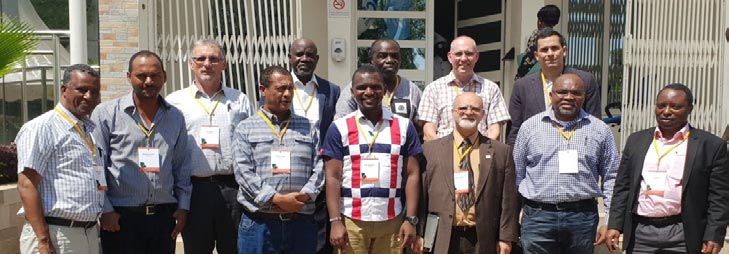
A delegation of several CGIAR scientists led by IITA Deputy Director General, Partnerships for Delivery (DDG-P4D) Kenton Dashiell took part in the Partnership for Recovery and Resilience’s (PfRR) Accountability and Learning Event, 13-15 November, in Juba, South Sudan. Participants included development partners, NGOs, local stakeholders, community leaders, United Nations entities, and representatives of regional and global centers of excellence.
 The team representing IITA included the Director of the Development and Delivery Office Alfred Dixon, Head of TAAT Clearing House Mpoko Bokanga, Postharvest Specialist Abass Adebayo, Agricultural Impact Economist Shiferaw Feleke, Food Safety Scientist Alejandro Ortega-Beltran; and Youth Agripreneur Specialist, Noel Mulinganya.
South Sudan has been ravaged by wars during the past two decades. Although a peace agreement was signed in September 2018, the prolonged years of conflict have resulted in food insecurity affecting over 80% of the population. Malnutrition is prevalent and severe across the country. Annually, South Sudan receives almost US$2 billion in humanitarian assistance, however, there is a need to accompany humanitarian efforts with development efforts.
The three-day PfRR event focused on multiple objectives including unravelling the evidence and status of vulnerability and resilience in South Sudan, learning the effective and ineffective methods for reducing vulnerability and enhancing coping capacity, as well as establishing a set of shared commitments for 2019 that partners and local communities can rally around to stop the growing trend of vulnerability and increase the coping capacity of individuals, households, and communities.
Dashiell gave a presentation on restoring productive capacities in which he focused on “The role and options of science and technology for crop and livestock production, incomes and nutrition.” He laid out key approaches that CGIAR centers have implemented for building productive capacity and economic opportunities including the use of improved sorghum, maize, and rice hybrids, improved livestock enterprises, use of cassava innovations, linking smallholder farmers to markets, use of aflatoxin management strategies centered on Aflasafe, seed systems development, appropriate selection of intervention locations, better water management technologies, empowering youth and women, use of evidence-based decision-making processes, and use of digital tools in agriculture. He noted that all these approaches can aid farmers in South Sudan to gradually shift from subsistence to commercial agriculture.
The event allowed CGIAR scientists to better understand the realities on the ground in South Sudan. Potential partners and opportunities were identified for collaborations, which will focus on maximizing synergies between activities, agencies, operations, and mandates from different institutions.
The PfRR event concluded with Dashiell leading team discussions with the United States Agency for International Development (USAID), the Food and Agriculture Organization (FAO), and the Ministry of Agriculture of South Sudan. It was agreed to jointly advocate and mobilize additional resources for activities to be conducted in the short term for the benefit of populations in South Sudan. It is expected that the participating CGIAR centers will start activities in South Sudan in 2019 by merging with existing projects of other organizations.
The PfRR was attended by representatives from the United Nations, FAO, African Development Bank (AfDB), World Bank, European Union, Governments of Canada, Germany, Japan, the Netherlands, Norway, Sweden, Switzerland, the United Kingdom, and USA, as well as local participants from South Sudan. The CGIAR centers represented included IITA, ILRI, IWMI, International Food Policy Research Institute (IFPRI), International Crops Research Institute for the Semi-Arid Tropics (ICRISAT), the International Potato Center (CIP), and the International Center for Tropical Agriculture (CIAT).
The team representing IITA included the Director of the Development and Delivery Office Alfred Dixon, Head of TAAT Clearing House Mpoko Bokanga, Postharvest Specialist Abass Adebayo, Agricultural Impact Economist Shiferaw Feleke, Food Safety Scientist Alejandro Ortega-Beltran; and Youth Agripreneur Specialist, Noel Mulinganya.
South Sudan has been ravaged by wars during the past two decades. Although a peace agreement was signed in September 2018, the prolonged years of conflict have resulted in food insecurity affecting over 80% of the population. Malnutrition is prevalent and severe across the country. Annually, South Sudan receives almost US$2 billion in humanitarian assistance, however, there is a need to accompany humanitarian efforts with development efforts.
The three-day PfRR event focused on multiple objectives including unravelling the evidence and status of vulnerability and resilience in South Sudan, learning the effective and ineffective methods for reducing vulnerability and enhancing coping capacity, as well as establishing a set of shared commitments for 2019 that partners and local communities can rally around to stop the growing trend of vulnerability and increase the coping capacity of individuals, households, and communities.
Dashiell gave a presentation on restoring productive capacities in which he focused on “The role and options of science and technology for crop and livestock production, incomes and nutrition.” He laid out key approaches that CGIAR centers have implemented for building productive capacity and economic opportunities including the use of improved sorghum, maize, and rice hybrids, improved livestock enterprises, use of cassava innovations, linking smallholder farmers to markets, use of aflatoxin management strategies centered on Aflasafe, seed systems development, appropriate selection of intervention locations, better water management technologies, empowering youth and women, use of evidence-based decision-making processes, and use of digital tools in agriculture. He noted that all these approaches can aid farmers in South Sudan to gradually shift from subsistence to commercial agriculture.
The event allowed CGIAR scientists to better understand the realities on the ground in South Sudan. Potential partners and opportunities were identified for collaborations, which will focus on maximizing synergies between activities, agencies, operations, and mandates from different institutions.
The PfRR event concluded with Dashiell leading team discussions with the United States Agency for International Development (USAID), the Food and Agriculture Organization (FAO), and the Ministry of Agriculture of South Sudan. It was agreed to jointly advocate and mobilize additional resources for activities to be conducted in the short term for the benefit of populations in South Sudan. It is expected that the participating CGIAR centers will start activities in South Sudan in 2019 by merging with existing projects of other organizations.
The PfRR was attended by representatives from the United Nations, FAO, African Development Bank (AfDB), World Bank, European Union, Governments of Canada, Germany, Japan, the Netherlands, Norway, Sweden, Switzerland, the United Kingdom, and USA, as well as local participants from South Sudan. The CGIAR centers represented included IITA, ILRI, IWMI, International Food Policy Research Institute (IFPRI), International Crops Research Institute for the Semi-Arid Tropics (ICRISAT), the International Potato Center (CIP), and the International Center for Tropical Agriculture (CIAT).
Team of CGIAR scientists with IITA DDG-P4D, Kenton Dashiell (front row, 3rd from right). Photo by Paul DemoCIP.
Contributed by
Recent stories
No items found