
IITA clinches 2018 Africa Food Prize!
October 1, 2018
For its creative work in generating solutions on and off the farm, innovative solutions that have improved the lives of millions in the face of climate change, and rampaging crop pests and disease, IITA has been named winner of the 2018 African Food Prize.
 IITA is the first institution to receive the distinguished Africa Food Prize as announced on 7 September at the African Green Revolution Forum (AGRF) in Kigali, Rwanda. It was presented with the iconic Africa Food Prize trophy that was hand made by the Norwegian glass artist Cathrine Maske with its green color references to the African Green Revolution.
[su_quote]The independent Africa Food Prize Committee, chaired by HE Olusegun Obasanjo, former President of Nigeria, selected IITA for its “deep commitment over many decades to producing a steady stream of innovations that have boosted the nutrition and incomes of millions of people across Africa.”[/su_quote]
In recent years, that work also has included a critical focus on connecting crop science to creating employment for Africa’s youth, and ensuring African farmers can adapt to the stress of climate change and the growing threat for an array of crop pests and plant diseases.
“IITA stood out to us for its steadfast and inspiring commitment to a research agenda that aligns with both our African traditions as well as the evolving needs of African farmers and consumers for the latest advances in food production,” said Obasanjo.
[su_quote]“From the cassava we’re still eating today, to the valuable and nutritious soybean we now grow in our fields, to maize varieties that can withstand drought and deadly toxins—our diets and our agriculture businesses would be much poorer today without IITA’s leadership, and its willingness to forge powerful bonds with African farmers and African communities.”[/su_quote]
Speaking as he received the Prize on behalf of the institution, Dr Nteranya Sanginga, IITA’s Director General, stated that “a great deal of IITA’s success rests on its ability to develop relationships and collaborations that allow the fruits of its research to be scaled up and made available to millions of farmers.
[su_quote]“I’m extremely honored to be receiving this prize on behalf of IITA and proud to be part of a group of researchers dedicated to building lasting and relevant solutions for the continent,” said Sanginga.[/su_quote]
“But it would be remiss of me if I didn’t acknowledge the important role of our various partners, from other research centers to governments to the private sector, without whom our research might never have seen the light of day.
IITA is the first institution to receive the distinguished Africa Food Prize as announced on 7 September at the African Green Revolution Forum (AGRF) in Kigali, Rwanda. It was presented with the iconic Africa Food Prize trophy that was hand made by the Norwegian glass artist Cathrine Maske with its green color references to the African Green Revolution.
[su_quote]The independent Africa Food Prize Committee, chaired by HE Olusegun Obasanjo, former President of Nigeria, selected IITA for its “deep commitment over many decades to producing a steady stream of innovations that have boosted the nutrition and incomes of millions of people across Africa.”[/su_quote]
In recent years, that work also has included a critical focus on connecting crop science to creating employment for Africa’s youth, and ensuring African farmers can adapt to the stress of climate change and the growing threat for an array of crop pests and plant diseases.
“IITA stood out to us for its steadfast and inspiring commitment to a research agenda that aligns with both our African traditions as well as the evolving needs of African farmers and consumers for the latest advances in food production,” said Obasanjo.
[su_quote]“From the cassava we’re still eating today, to the valuable and nutritious soybean we now grow in our fields, to maize varieties that can withstand drought and deadly toxins—our diets and our agriculture businesses would be much poorer today without IITA’s leadership, and its willingness to forge powerful bonds with African farmers and African communities.”[/su_quote]
Speaking as he received the Prize on behalf of the institution, Dr Nteranya Sanginga, IITA’s Director General, stated that “a great deal of IITA’s success rests on its ability to develop relationships and collaborations that allow the fruits of its research to be scaled up and made available to millions of farmers.
[su_quote]“I’m extremely honored to be receiving this prize on behalf of IITA and proud to be part of a group of researchers dedicated to building lasting and relevant solutions for the continent,” said Sanginga.[/su_quote]
“But it would be remiss of me if I didn’t acknowledge the important role of our various partners, from other research centers to governments to the private sector, without whom our research might never have seen the light of day.
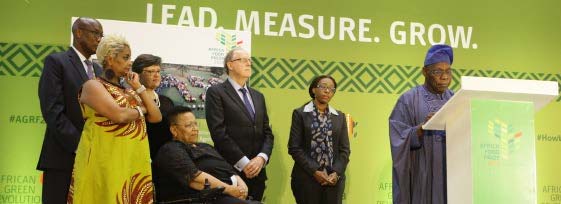
Pres Olusegun Obasanjo reading the citation for IITA during the awarding of the 2018 Africa Food Prize.
Contributed by
Recent stories
No items found