Joint comprehensive strategies to combat banana bunchy top outbreak in East Africa
April 19, 2024
The invasion of banana bunchy top virus (BBTV), the causal agent of the lethal bunchy top disease of banana and plantain, threatens Africa’s most crucial banana production region in East Africa. The virus spread, confirmed in the 2020s in Tanzania and Uganda, is expanding fast. For instance, the delimitation survey undertaken with the support of the USAID and CGIAR Plant Health Initiative in 2023 revealed BBTV occurrence in seven of Tanzania’s ten major banana production regions.
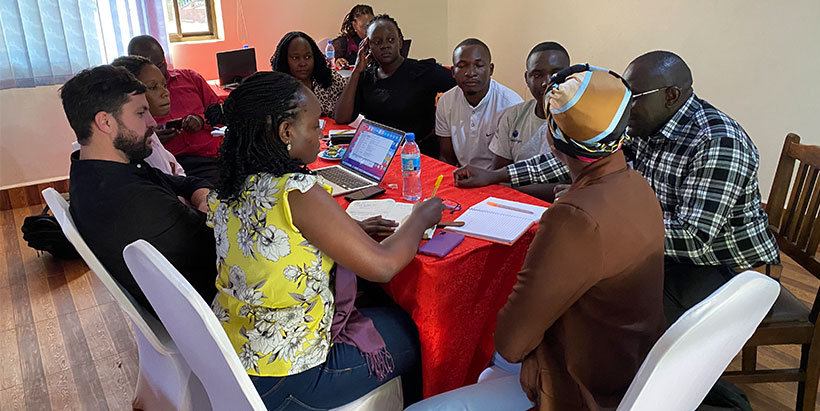
Participants in a break out discussion during the BBTV project launching meeting. (Photo by G.Mahuku – IITA)Crop cultural practices, mainly the exchange of planting materials within the region, contribute to the virus’s rapid spread. In addition, the ubiquitous banana aphid, Pentalonia nigronervosa, is also contributing to the spread of the virus. There is a concern that without strong counteraction, the virus would spread widely in East Africa, home to about 40% of the total banana and plantain production and a vital source of food, income, and jobs.
To address this pressing issue, a regional project titled “Combating banana bunchy top virus in East Africa” led by IITA with the support of the United States Department of Agriculture – Foreign Agricultural Services (USDA-FAS) and the USAID Regional Mission in East Africa was commissioned. The project aims to develop a harmonized regional strategy for combating BBTV, support a regional BBTV technical working group, create stakeholders’ awareness, organize delimitation surveys, and strengthen BBTV detection and disease control capacity.
IITA Pathologist and Project Lead George Mahuku noted that diseases do not respect borders, and a regional approach is crucial for transboundary disease control. “Our borders are porous; people have families in different countries; they move freely, often carry planting material with them.” He added that such actions lead to the inoculum being introduced into new locations for diseases like BBTV.
“The project reflects a recognition of the urgent need for a collective approach to combatting BBTV,” noted Dr Robooni Tumuhimbise, a participant from the National Agricultural Research Organization (NARO), Uganda. “I was shocked to see over 80% of the bananas wiped out by this disease. We urgently need to increase awareness along the value chain to curb the spread of the disease.”
The emergence of BBTV in Uganda and Tanzania in 2021 has had a devastating impact on banana production. The virus causes 70-90% yield loss in the first season; subsequent seasons produce no bananas. Many farmers have been forced to abandon banana production, further exacerbating food insecurity and economic hardship.
Dr Wilfred Mushobozi, CEO of Crop Bioscience Tissue Culture Ltd., emphasized the need for immediate action to save the banana sector in Tanzania. He called for a multi-partner approach to sensitizing farmers, uprooting infected fields, and providing clean planting material.
Participants from Kenya were also involved in the meeting, where the disease is yet to be reported. Dr Benard Mukoye from KEPHIS highlighted the importance of joining forces and working with neighboring countries to learn from their experiences and develop pre-emptive measures to prevent the disease from reaching their country.
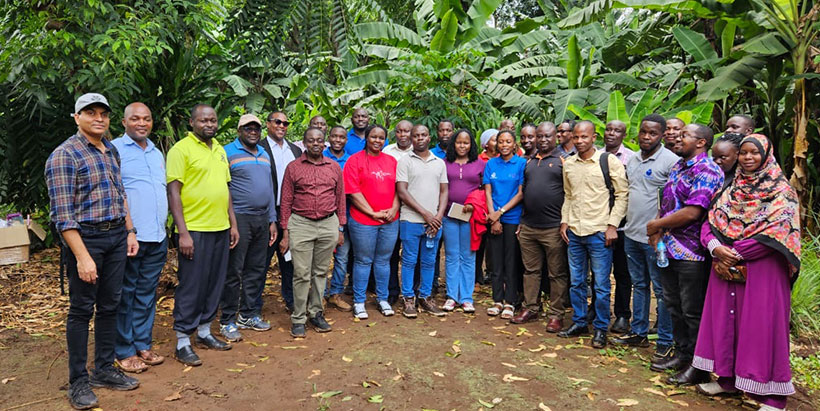
Participants after the field visit to the BBTV affected site in Moshi. (Photo by IITA)“I am saddened by what I have seen in the field,” commented Junior Ndesanjo, USAID-Tanzania. He reinforced the USAID mission commitment to a joint action to control the BBTV spread in the East Africa region, bring hope to the smallholder farmers affected by BBTV, and protect unaffected farms through preventive measures. He expressed optimism about the positive impact of the project interventions in alleviating BBTV stress on banana production.
“The project will mobilize the multipronged approach of ALLIANCE Strategy to contain the spread of BBTV in Africa by channeling tactics to recover banana production in the virus-affected farms and preventive measures to contain the spread,” added ALLIANCE lead and IITA Virologist Lava Kumar.
The project implementation planning workshop, which took place in March in Moshi, Tanzania, was attended by partners from Tanzania (TPHPA, TARI, and TAHA), Uganda (MAAIF and NARO), Kenya (KEHPHIS), and private sector organizations such as PlantVillage, Crop Bioscience, and Maua Mzuri. The priority actions finalized include:
a delimitation survey in Uganda,
a diagnostics survey in Kenya along the border regions, and
deployment of banana production recovery in Tanzania.
By working together and implementing comprehensive strategies, stakeholders can safeguard banana production, protect livelihoods, and preserve banana biodiversity in the region.
Contributed by George Mahuku (g.mahuku@cgiar.org) and Lava Kumar (L.kumar@cgiar.org)
Olamide Deborah Nwanze is a Senior Research Associate specializing in gender mainstreaming research to inform participatory and inclusive breeding, variety development, and seed systems policies regarding root, tuber, and banana (RTB) crops in the International Institute of Tropical Agriculture Headquarters, Ibadan, Nigeria. She is a PhD candidate at the University of Ibadan and holds an MSc and B. Agric in Agricultural Extension and Rural Development. Olamide is a fellow of the African Women in Agricultural Research and Development – Gender Responsive Agricultural Systems Policy (AWARD-GRASP) and the Gender Responsive Researchers Equipped for Agricultural Transformation (GREAT). She seeks to apply her gender-mainstreaming learnings, gender-responsive research, and policy development, and review expertise to facilitate women, youth, children, and vulnerable social group’s access to and adoption of agricultural Innovations that guarantee food, nutrition, income, and livelihood security in Africa. Her current roles include mentoring research fellows, development of guides and training manuals, implementation and adaptation of gender frameworks and tools, value chain actors’ engagement as citizen science partners, policy review and redesign, data management, and analysis. Her current research explores mixed methods and participatory and interdisciplinary approaches to capture and highlight gender dynamics, needs, preferences, and challenges stakeholders face within the agricultural livelihood value chain to prioritize gender-inclusive strategies in breeding programs, policy design, and implementation.
de Sousa, K., van Etten, J., Manners, R. Bello, A., Teeken, B., Olaosebikan, O., et al. 2024. The tricot approach: an agile framework for decentralized on-farm testing supported by citizen science. A retrospective. Agron. Sustain. Dev. 44, 8. https://doi.org/10.1007/s13593-023-00937-1
Madu, T., Onwuka, S., Nwafor, S., Onyemauwa, N., Ejechi, M., Ofoeze, M., Ukeje, B., Eluagu, C., Olaosebikan, O., Okoye, B., 2024. Gender-Inclusive Consumer Studies Improve Cassava Breeding in Nigeria in: Frontiers in Sociology, volume 9, number: 1224504, doi: 10.3389/fsoc.2024.1224504
Olaosebikan, O.; Bello, A.; Utoblo, O.; Okoye, B.; Olutegbe, N.; Garner, E.; Teeken, B.; Bryan, E.; Forsythe, L.; Cole, S.; Madu, T. 2023. Stressors and Resilience within the Cassava Value Chain in Nigeria: Preferred Cassava Variety Traits and Response Strategies of Men and Women to Inform Breeding. Sustainability 15, 7837. https://doi.org/10.3390/su15107837
Okoye, B., Ofoeze, M., Ejechi, M., Onwuka, S., Nwafor, S., Onyemauwa, N., Ukeje, B., Eluagu, C., Obidiegwu, J.*, Olaosebikan, O., Madu, T.* 2023. Prioritizing preferred traits in the yam value chain in Nigeria: a gender situation analysis in: Frontiers in Sociology, volume 8, number: 1232626, pages 1 – 9, ISSN 2297-7775, 2023. https://www.frontiersin.org/articles/10.3389/fsoc.2023.1232626/full
Olaosebikan, O., Bello, A. A., de Sousa, K., Ndjouenkeu, R., Adesokan, M., Alamu, E. O., Agbona, A., van Etten, J., Kegah, F. N.*, Dufour, D., Bouniol, A., Teeken, B. 2023. Consumer acceptability of cassava gari-eba food products across cultural and environmental settings using the triadic comparison of technologies approach (tricot) in: Journal of the Science of Food and Agriculture,
Teeken, B., Olaosebikan, O., Bello, A. A., Madu, T.*, Cole, S. M. 2023. Qualitative assessment on the positionality and preferences of dyads in relation to cassava-related activities: working with tricot trial citizen scientists https://hdl.handle.net/10568/138326 Type: Manual
Bouniol, A., Ceballos, H., Bello, A. A., Teeken, B., Olaosebikan, O., Owoade, D., Agbona, A., Fotso Kuate, A., Madu, T.*, Okoye, B.*, Ofoeze, M.*, Nwafor, S.*, Onyemauwa, N.*, Adinsi, L.*, Forsythe, L., Dufour, D. 2023. Varietal impact on women’s labour, workload and related drudgery in processing root, tuber and banana crops: focus on cassava in sub-Saharan Africa in: Journal of the Science of Food and Agriculture, pages 1 – 25, ISSN 0022-5142,
Bello, A. A., Agbona, A., Olaosebikan, O., Edughaen, G., Dufour, D., Bouniol, A., Iluebbey, P., Ndjouenkeu, R.*, Rabbi, I. Y., Teeken, B. 2023. Genetic and environmental effects on processing productivity and food product yield: drudgery of women’s work in: Journal of the Science of Food and Agriculture, pages 1 – 32, ISSN 0022-5142, 5
Cavicchioli, M., Zimbiti, T., Teeken, B., Nwanze, D.O., Liani, M., Parkes, E. & Bello, A. 2023. IITA-Gender Responsive Breeding Training Report. Genetic Resources Center, IITA-HQ, Ibadan, 21-23 September, 2022. Ibadan, Nigeria: IITA, (34 p.).https://hdl.handle.net/10568/131368
Agbona, A. Peteti P., Teeken B., Olaosebikan O. Bello, A. A., Parkes, E., Rabbi, I. Y., Mueller, L., Egesi, C., Kulakow, P. 2022. Data Management in Multi-disciplinary African RTB Crop Breeding Programs. In: Williamson, H.F., Leonelli, S. (eds) Towards Responsible Plant Data Linkage: Data Challenges for Agricultural Research and Development. Springer, Cham. https://doi.org/10.1007/978-3-031-13276-6_5
Lora Forsythe, Pricilla Marimo, Sarah Mayanja, Olamide D. Olaosebikan, Esme Stuart, Bela Teeken, Benjamin Okoye, Tessy Madu, (2021). Cross-product Gender Analysis of RTBfoods Step 2 Gendered Food Mapping on RTB Products. Understanding the Drivers of Trait Preferences and the Development of Multi-user RTB Product Profiles, WP1. London, UK: RTBfoods Field Scientific Report, 30 p.
Teeken, B., Garner, E., Agbona, A., Balogun, I., Olaosebikan, O., Bello, A., Madu, T., Okoye, B., Egesi, C., Kulakow, P. and Tufan, H.A. 2021. Beyond “Women’s Traits”: Exploring How Gender, Social Difference, and Household Characteristics Influence Trait Preferences. Frontiers Sustainable Food Systems 5:740926. https://doi.org/10.3389/fsufs.2021.740926
Teeken, B., Agbona, A., Bello, A., Olaosebikan, O., Alamu, E., Adesokan, M., Awoyale, W., Madu, T., Okoye, B., Chijioke, U., Owoade, D., Okoro, M., Bouniol, A., Dufour, D., Hershey, C., Rabbi, I., Maziya‐Dixon, B., Egesi, C., Tufan, H. and Kulakow, P. (020. Understanding cassava varietal preferences through pairwise ranking of gari‐eba and fufu prepared by local farmer–processors. Int J Food Sci Technol.https://doi.org/10.1111/ijfs.14862
Bela Teeken, Olamide Olaosebikan, Ireti Balogun, Benjamin Okoye, Tessy Madu, Steven Cole, Abolore Bello, Elizabeth Parkes. (2020). Piloting the G+ customer and product profile tools for gender-responsive cassava breeding in Nigeria. Nigeria: International Institute of Tropical Agriculture (IITA). https://hdl.handle.net/20.500.11766/13000