Forging partnerships to tackle invasive species in Ghana’s farming communities
May 10, 2024
In Ghana, pests and diseases cause food and agriculture-related losses valued at USD 1 billion annually, impacting the economy and the livelihoods of smallholder farmers. Climate change makes the challenge harder to address as warmer temperatures attract more invasive species. So, 11 public and private sector organizations collaboratively developed an Early Warning and Rapid Response System for Pests and Diseases to protect the country’s food system.
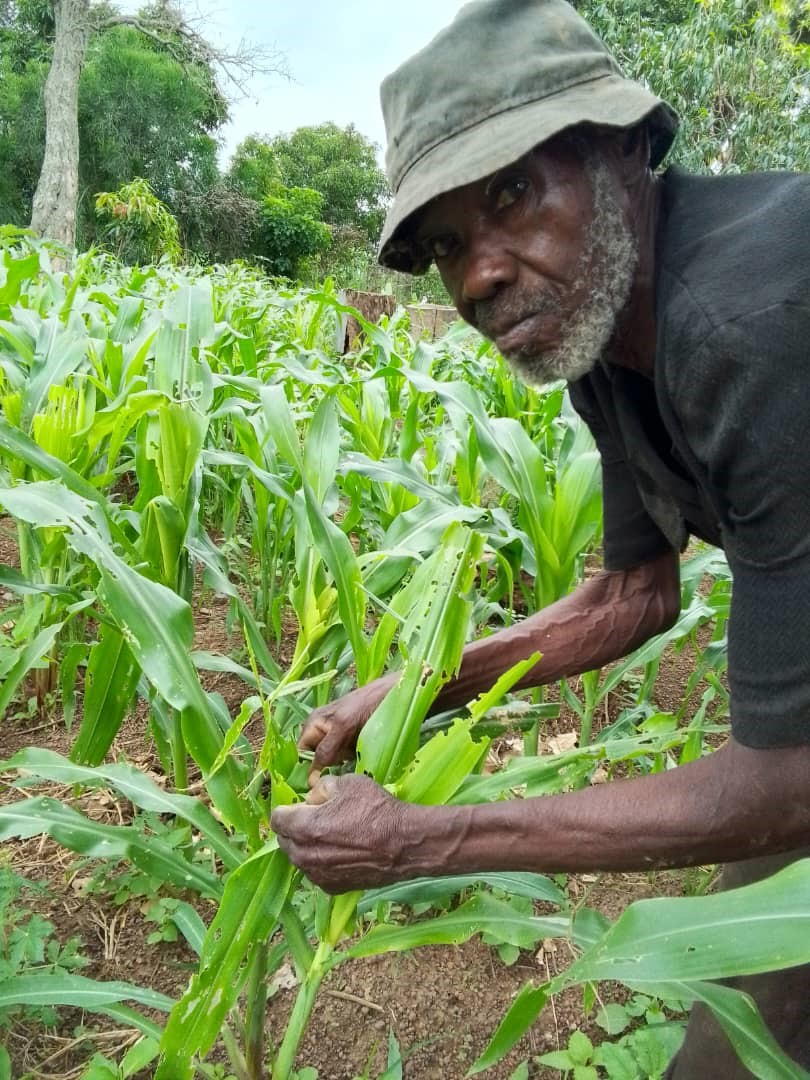
Gaetin’s maize crops are still at the mercy of the fall armyworm seven years after the devastating outbreak.
A fall armyworm outbreak in Ghana in 2016 led to a maize yield loss of USD 177 million, threatening food security and the livelihood of thousands of maize farmers.
Fortune Kangur, a 36-year-old maize farmer from Naburnye, a village in Lawra district of Ghana, was one of such farmers. She said the outbreak was devastating.
“The loss was severe. It left many maize farmers with nothing to harvest. Before the outbreak, I could harvest eight bags of maize on an acre of land, but I was lucky to get the three and a half bags I harvested that year”, she said.
Zuur Gaetin, a 74-year-old sorghum farmer from the same village, said the outbreak plunged farmers into crushing debts and left hunger, illnesses, and poverty in its wake.
“Many farmers who took loans to farm with tractors could not pay the loans. They are still poor and cannot return to their lands”, he said.
Like Kangur, Gaetin’s yields fell significantly. Both farmers have not fully recovered from their losses seven years after the outbreak. These days, Gaetin is happy to get eight bags per acre. While it is an improvement from the three bags he harvested at the height of the outbreak, it is still two bags less than the ten bags his fields used to produce.
In Ghana, the Plant Protection and Regulatory Services Directorate (PPRSD), an agency under the Ministry of Food and Agriculture (MoFA), is mandated to safeguard crops from pests and diseases.
Awudu Gariba, Assistant Director and Head of the Plant Pathology Unit of PPRSD, said the fall armyworm outbreak exposed the weaknesses in Ghana’s emergency response system.
“The systems for monitoring, detection, prediction, and warning for pests and diseases are weak, leading to invasive species going undetected until they become endemic and spread rapidly,” he said.
An emergency response plan for invasive alien plant pests drafted in the aftermath of the fall armyworm outbreak in 2019, according to Awudu, targeted only specific pests of imported commodities and failed to be validated for implementation.
Partnerships to tackle pests and diseases
The Accelerating the Impact of CGIAR Climate Research for Africa (AICCRA) project proposed a new framework that promotes multistakeholder participation in a climate-smart approach to Integrated Pests Management (CS-IPM).
The AICCRA team in Ghana, led by IITA, is promoting CS-IPM as a collaborative and sustainable approach to preventing and managing pests and diseases that attack crops.
Underpinned by the One Health concept, CS-IPM endorses natural enemies of pests and biopesticides as healthier and environmentally friendlier solutions than synthetic pesticides.
The new framework proposed by AICCRA informed a comprehensive emergency response anchored in the CS-IPM and implemented through stakeholder collaboration. PPRSD consulted relevant stakeholders across Ghana’s agriculture sector about an emergency response system for pests and diseases for Ghana, with AICCRA’s support.
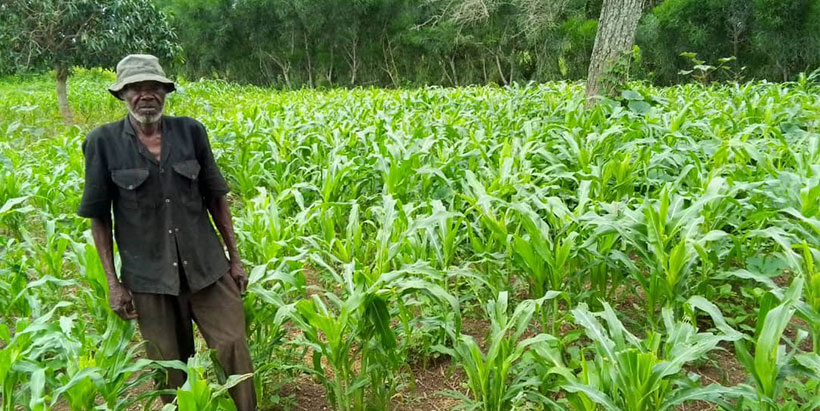
Gaetin on his maize in Naburnye, a village in the Lawra district of Ghana.
These consultations led to the development of an Early Warning and Rapid Response System for Crop Pests and Diseases (EWRRS-PD) and the signing of a Memorandum of Understanding (MoU) between prominent Ghanaian institutions: Plant Protection and Regulatory Services Directorate (PPRSD), Directorate of Agricultural Extension Services, Ghana Ministry of Food and Agriculture (MoFA), Crops Research Institute, Savannah Agricultural Research Institute, Institute of Scientific and Technological Information of Council for Scientific and Industrial Research (CSIR), Biotechnology and Nuclear Agriculture Research Institute, West African Centre for Water, Irrigation, and Sustainable Agriculture (WACWISA) of the University of Development Studies, Ghana Meteorological Agency, National Disaster Management Organisation (NADMO), Farmerline, and Environmental Protection Agency (EPA).
The EWRRS-PD, a revamp of the old emergency framework developed in 2019 after the fall armyworm outbreak, encompasses all crop pests and diseases and aims to prevent outbreaks by ensuring that potential outbreaks are detected and responded to quickly.
It establishes the EWRRS Authority, which constitutes experts at PPRSD, and a Technical Committee made up of experts from the organizations who are signatories to the MoU.
Under the EWRRS-PD, surveillance will be done by farmers, extension officers and field officers on farms and at the borders of Ghana. If any suspected invasive alien species are found, such detections will be communicated to the nearest District Agriculture Extension Agent (AEA) or PPRSD focal person.
Once a potential threat is reported to the EWRRS-PD Authority, the Authority will forward the information to the Technical Committee, which will initiate processes to validate the risk, carry out a risk assessment, and develop risk knowledge information, including an awareness and response plan.
The risk information and response will then be disseminated to farmers and other relevant stakeholders through PPRSD focal persons at the regional and district level, extension officers, and farmer-based organizations (FBOs).
Speaking at the signing of the MoU, Ghislain Tepa-Yotto, who leads the AICCRA team in Ghana, said the EWRRS-PD framework “places Ghana at the forefront of regional efforts to combat the outbreak and spread of crop pests and diseases.”
The Director of the Biotechnology and Nuclear Agricultural Research Institute (BNARI) of GAEC, Dr Michael Yao Osae, said the EWRRS-PD would ensure that protocols and tools are developed to sustain farmers’ yield and, ultimately, Ghana’s food exports.
NADMO collaborates with PPRSD in responding to plant pest and disease outbreaks. Its head of Research and Planning, Ruth Arthur, describes the response plan as the realization of a vision conceived years ago. “It will help us to anticipate better and prepare, so we are not surprised by any outbreak,” she said.
Looking forward
The partners who signed the MoU—most notably PPRSD and BNARI—have been training extension officers and lead farmers on monitoring and scouting technologies, CS-IPM, and how the EWRRS-PD works.
The training exercises, which began in communities where AICCRA has established project sites, are raising awareness of the EWRRS-PD among extension officers and farmers and enhancing their capacities to scout pests and diseases and communicate potential risks through the appropriate channels for rapid response.
For farmers like Gaetin and Kangur, the new pest and disease prevention and management framework is a welcome development.
“Many hands make light work. I am happy to learn that these big organizations are uniting to support us to protect our yields,” said Gaetin.
Contributed by Reginald Kyere
Olamide Deborah Nwanze is a Senior Research Associate specializing in gender mainstreaming research to inform participatory and inclusive breeding, variety development, and seed systems policies regarding root, tuber, and banana (RTB) crops in the International Institute of Tropical Agriculture Headquarters, Ibadan, Nigeria. She is a PhD candidate at the University of Ibadan and holds an MSc and B. Agric in Agricultural Extension and Rural Development. Olamide is a fellow of the African Women in Agricultural Research and Development – Gender Responsive Agricultural Systems Policy (AWARD-GRASP) and the Gender Responsive Researchers Equipped for Agricultural Transformation (GREAT). She seeks to apply her gender-mainstreaming learnings, gender-responsive research, and policy development, and review expertise to facilitate women, youth, children, and vulnerable social group’s access to and adoption of agricultural Innovations that guarantee food, nutrition, income, and livelihood security in Africa. Her current roles include mentoring research fellows, development of guides and training manuals, implementation and adaptation of gender frameworks and tools, value chain actors’ engagement as citizen science partners, policy review and redesign, data management, and analysis. Her current research explores mixed methods and participatory and interdisciplinary approaches to capture and highlight gender dynamics, needs, preferences, and challenges stakeholders face within the agricultural livelihood value chain to prioritize gender-inclusive strategies in breeding programs, policy design, and implementation.
de Sousa, K., van Etten, J., Manners, R. Bello, A., Teeken, B., Olaosebikan, O., et al. 2024. The tricot approach: an agile framework for decentralized on-farm testing supported by citizen science. A retrospective. Agron. Sustain. Dev. 44, 8. https://doi.org/10.1007/s13593-023-00937-1
Madu, T., Onwuka, S., Nwafor, S., Onyemauwa, N., Ejechi, M., Ofoeze, M., Ukeje, B., Eluagu, C., Olaosebikan, O., Okoye, B., 2024. Gender-Inclusive Consumer Studies Improve Cassava Breeding in Nigeria in: Frontiers in Sociology, volume 9, number: 1224504, doi: 10.3389/fsoc.2024.1224504
Olaosebikan, O.; Bello, A.; Utoblo, O.; Okoye, B.; Olutegbe, N.; Garner, E.; Teeken, B.; Bryan, E.; Forsythe, L.; Cole, S.; Madu, T. 2023. Stressors and Resilience within the Cassava Value Chain in Nigeria: Preferred Cassava Variety Traits and Response Strategies of Men and Women to Inform Breeding. Sustainability 15, 7837. https://doi.org/10.3390/su15107837
Okoye, B., Ofoeze, M., Ejechi, M., Onwuka, S., Nwafor, S., Onyemauwa, N., Ukeje, B., Eluagu, C., Obidiegwu, J.*, Olaosebikan, O., Madu, T.* 2023. Prioritizing preferred traits in the yam value chain in Nigeria: a gender situation analysis in: Frontiers in Sociology, volume 8, number: 1232626, pages 1 – 9, ISSN 2297-7775, 2023. https://www.frontiersin.org/articles/10.3389/fsoc.2023.1232626/full
Olaosebikan, O., Bello, A. A., de Sousa, K., Ndjouenkeu, R., Adesokan, M., Alamu, E. O., Agbona, A., van Etten, J., Kegah, F. N.*, Dufour, D., Bouniol, A., Teeken, B. 2023. Consumer acceptability of cassava gari-eba food products across cultural and environmental settings using the triadic comparison of technologies approach (tricot) in: Journal of the Science of Food and Agriculture,
Teeken, B., Olaosebikan, O., Bello, A. A., Madu, T.*, Cole, S. M. 2023. Qualitative assessment on the positionality and preferences of dyads in relation to cassava-related activities: working with tricot trial citizen scientists https://hdl.handle.net/10568/138326 Type: Manual
Bouniol, A., Ceballos, H., Bello, A. A., Teeken, B., Olaosebikan, O., Owoade, D., Agbona, A., Fotso Kuate, A., Madu, T.*, Okoye, B.*, Ofoeze, M.*, Nwafor, S.*, Onyemauwa, N.*, Adinsi, L.*, Forsythe, L., Dufour, D. 2023. Varietal impact on women’s labour, workload and related drudgery in processing root, tuber and banana crops: focus on cassava in sub-Saharan Africa in: Journal of the Science of Food and Agriculture, pages 1 – 25, ISSN 0022-5142,
Bello, A. A., Agbona, A., Olaosebikan, O., Edughaen, G., Dufour, D., Bouniol, A., Iluebbey, P., Ndjouenkeu, R.*, Rabbi, I. Y., Teeken, B. 2023. Genetic and environmental effects on processing productivity and food product yield: drudgery of women’s work in: Journal of the Science of Food and Agriculture, pages 1 – 32, ISSN 0022-5142, 5
Cavicchioli, M., Zimbiti, T., Teeken, B., Nwanze, D.O., Liani, M., Parkes, E. & Bello, A. 2023. IITA-Gender Responsive Breeding Training Report. Genetic Resources Center, IITA-HQ, Ibadan, 21-23 September, 2022. Ibadan, Nigeria: IITA, (34 p.).https://hdl.handle.net/10568/131368
Agbona, A. Peteti P., Teeken B., Olaosebikan O. Bello, A. A., Parkes, E., Rabbi, I. Y., Mueller, L., Egesi, C., Kulakow, P. 2022. Data Management in Multi-disciplinary African RTB Crop Breeding Programs. In: Williamson, H.F., Leonelli, S. (eds) Towards Responsible Plant Data Linkage: Data Challenges for Agricultural Research and Development. Springer, Cham. https://doi.org/10.1007/978-3-031-13276-6_5
Lora Forsythe, Pricilla Marimo, Sarah Mayanja, Olamide D. Olaosebikan, Esme Stuart, Bela Teeken, Benjamin Okoye, Tessy Madu, (2021). Cross-product Gender Analysis of RTBfoods Step 2 Gendered Food Mapping on RTB Products. Understanding the Drivers of Trait Preferences and the Development of Multi-user RTB Product Profiles, WP1. London, UK: RTBfoods Field Scientific Report, 30 p.
Teeken, B., Garner, E., Agbona, A., Balogun, I., Olaosebikan, O., Bello, A., Madu, T., Okoye, B., Egesi, C., Kulakow, P. and Tufan, H.A. 2021. Beyond “Women’s Traits”: Exploring How Gender, Social Difference, and Household Characteristics Influence Trait Preferences. Frontiers Sustainable Food Systems 5:740926. https://doi.org/10.3389/fsufs.2021.740926
Teeken, B., Agbona, A., Bello, A., Olaosebikan, O., Alamu, E., Adesokan, M., Awoyale, W., Madu, T., Okoye, B., Chijioke, U., Owoade, D., Okoro, M., Bouniol, A., Dufour, D., Hershey, C., Rabbi, I., Maziya‐Dixon, B., Egesi, C., Tufan, H. and Kulakow, P. (020. Understanding cassava varietal preferences through pairwise ranking of gari‐eba and fufu prepared by local farmer–processors. Int J Food Sci Technol.https://doi.org/10.1111/ijfs.14862
Bela Teeken, Olamide Olaosebikan, Ireti Balogun, Benjamin Okoye, Tessy Madu, Steven Cole, Abolore Bello, Elizabeth Parkes. (2020). Piloting the G+ customer and product profile tools for gender-responsive cassava breeding in Nigeria. Nigeria: International Institute of Tropical Agriculture (IITA). https://hdl.handle.net/20.500.11766/13000