
IITA-led project on breeding better banana surpasses major targets as it moves into its third year
May 13, 2017
A team of international banana experts have developed 48 hybrids of Matooke, a popular cooking banana in the highlands of Eastern Africa, that are now under field assessment in Uganda to select those with the highest yields and confirm resistance to four major pests and diseases.
The hybrids are one of the key achievements of a five-year, multi-partnership initiative to deliver improved varieties of cooking banana to smallholder farmers in Uganda and Tanzania. This was one of the accomplishments reported by the team at its third annual planning and review meeting on 24-26 April, in Kampala, Uganda, hosted by the National Agricultural Research Organization (NARO)―a key partner in the project. The team said that this was far above its target for Year 3 and if this pace were to be maintained, the project would outperform its goals.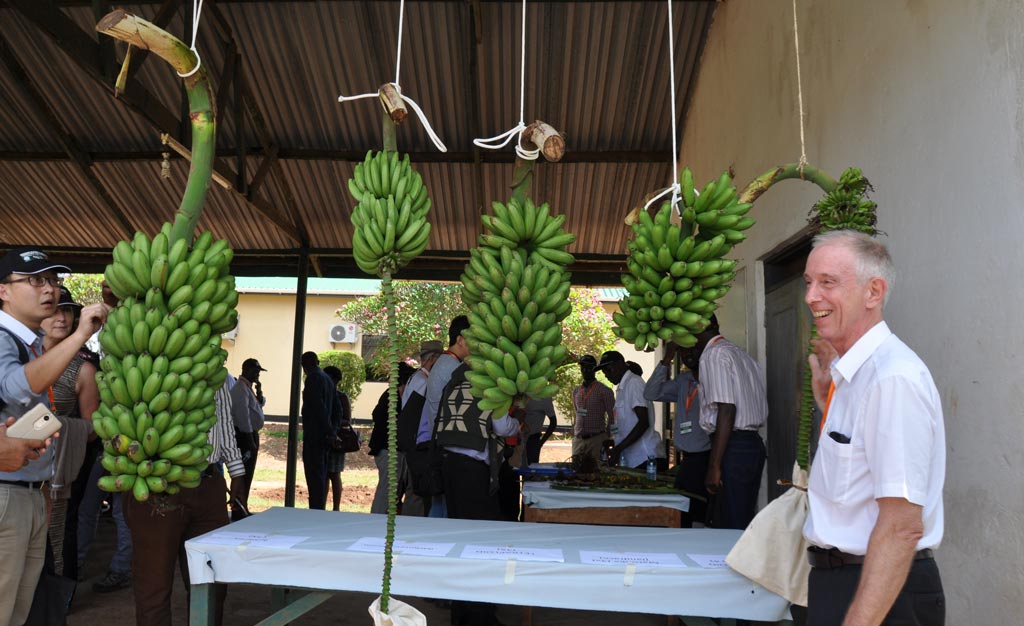
Rony Swennen explaining the hybrid breeding process that led to NARITA.
Banana hybrids hailed as a move in the right direction!
The meeting was officially opened by Ambrose Agona, Director General of NARO, who hailed the project as well thought out in its approach to increase the productivity of banana. “Most of the gains made in agricultural production in many countries in Africa have been made as a result of the expansion of agricultural land. However, we need to intensify production to increase yields of major crops. Therefore, the project’s objective of developing high-yielding banana hybrids is a move in the right direction,” he said. Also speaking at the meeting, Victor Manyong, IITA Director for Eastern Africa, noted that banana was not only a major food crop for smallholders but also a major commodity. Therefore, any efforts to increase the crop’s production would also translate into an improvement of their livelihoods.Building an efficient banana breeding program
The aim of the project is to develop hybrid banana varieties with an increase of 30% in yield and 50% in resistance to at least three of the major pests and diseases compared with the varieties currently grown by the farmers under the same on-farm conditions. “We are supporting the national breeding systems to make them more efficient and vibrant. At the end of five years, we want to deliver hybrid banana of Matooke and Mchare that are not only high yielding and disease resistant but also meet the needs and preferences of the end-user,” says Rony Swennen, Banana Breeder at IITA and the project’s Team Leader. “We are ahead of our main target as currently we have already developed 48 Matooke hybrids which are headed for Preliminary Yield Trials and we have many more in the pipeline,” he added. The project is focusing on the two most popular types of East African Highland cooking banana, Matooke in Uganda and Mchare in Tanzania, and the two major diseases attacking the crop―Fusarium Wilt and Black Leaf Streak (Sigatoka disease), and two major pests―parasitic nematodes (microscopic worms) and weevils. “In addition to the 48 hybrids, we have six other trials from which we expect to select over 600 hybrids for Preliminary Field Trials. We have also delivered great results on developing seeds for crossing to support the breeding work, adds Jerome Kubiriba from NARO who is also the team leader for the project’s breeding efforts. Bananas are sterile with very low seed sets making breeding very difficult. Researchers have to force them to develop seeds for crossing and developing varieties. “However, the varieties still have a long way to go before getting into the farmer’s hands. Usually it can take up to 20 years to develop new banana varieties but with this project, working with breeders from all over the world, we are exploring novel ways to reduce this time.” NARO is leading the project’s banana breeding efforts―the largest and most important component.Tools to speed up banana breeding
The project has also brought on board different experts to support and work alongside the breeding team to speed up and ease the lengthy and complicated banana breeding process. They have also made great progress in their objectives. Rapid screening of diseases against pathogens and pests “We have collected a lot of information on the most important disease pathogens and pests of the crop we are addressing―Fusarium Wilt and Black Sigatoka, and nematodes and weevils. We have also developed rapid screening methods that can help reduce to a half or a quarter the time it takes for breeders to screen their varieties for resistance.” “These tools will also contribute to speeding up banana breeding efforts globally,” says Albertus Viljoen from the University of Stellenbosch, who is leading these efforts. Developing molecular tools to hasten screening for resistance The project’s molecular biologists are developing biotech tools to support breeders in early screening. These include molecular markers that help breeders detect early in the breeding process the presence of the genes associated with the desired traits, such as resistance to pests and diseases, and only plantlets with those genes proceed for field trials. “We are mapping genetic markers to help us identify genes that control pest and disease resistance in the plants. We have also developed models for predicting yield and other traits based on genotypic markers which we will be evaluating in the coming years,” says Brigitte Uwimana, a molecular breeder with IITA-Uganda. Musabase – supporting data collection, storage, and sharing Data collection and analysis are a big part of the breeding effort; to facilitate this, the project has supported the development of digital tools including a database and a mobile data collection app. “If you want to use modern breeding techniques, you will need to collect a lot of genotypic (genetic) and phenotypic (physical) data. To do this you need a good database to efficiently store and share all these data. The Musabase is a database specifically for banana breeders. It will also help to create synergies across the teams,” says Lukas Mueller of the Boyce Thompson Institute—who is leading the bioinformatics efforts. A mobile app adapted to breeders’ needs in the field has also been developed to allow real time collection of data. The app is being tested with the team in Arusha before being rolled out to the rest of the team. “The database and mobile app will ensure data are collected, analyzed, and stored without leaving the digital ecosystem. We have also trained many researchers and technical staff in data collection and use of the database,” Mueller said. Field testing hybrids from previous IITA & NARO collaboration Past collaboration between IITA and NARO saw the development of 27 early Matooke hybrids named NARITA. Two of these were formally released by NARO in 2010 in Uganda and are now being grown in at least 15% of the banana farms in Uganda. The project is supporting the evaluation of 20 of these NARITA hybrids in Uganda and Tanzania for local suitability and acceptance by farmers. “We are evaluating the NARITAs in five field locations in the two countries to recommend for official release those that have the highest levels of yield and disease resistance and meet farmers’ needs,” says Inge Van den Bergh from Bioversity International and leader of this objective. “We have also conducted a baseline survey to understand the traits farmers look for in banana. We have interviewed over 1,000 households and held over 100 focus group discussions; we are analyzing the data. These will be shared with the breeders to assist them in breeding banana that meet farmers’ and other end-users’ needs.” The tools and methodologies developed by the project will also support banana breeding all over the world.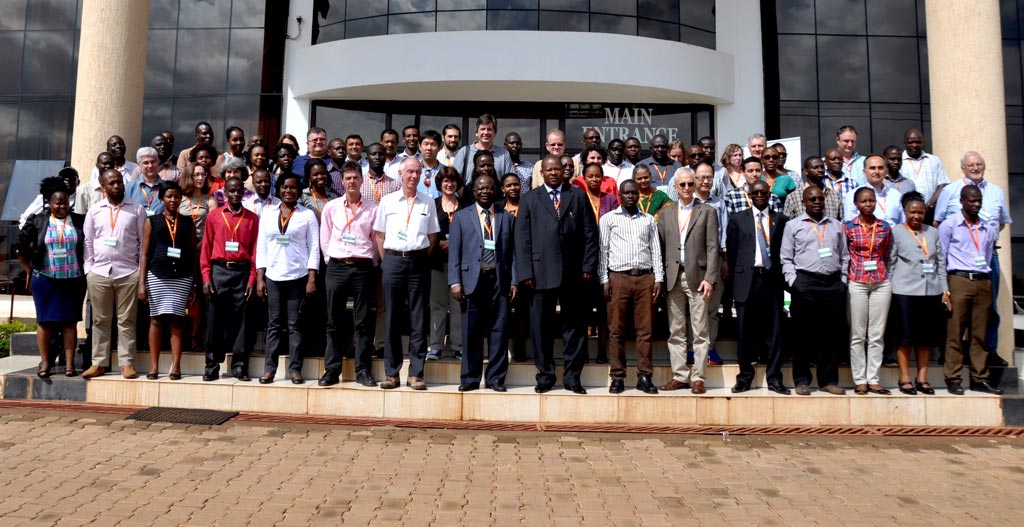
Group photo of participants
Contributed by
Recent stories
No items found