
IITA NEWS

A regional hub for fertilizers and soil health opens in Ibadan, Nigeria
July 1, 2024

Combining cutting-edge laboratory testing and training facilities with cross-sector experts to support development of advanced soil health and fertilizer technologies in West Africa and the Sahel.
Dr Benard Vanlauwe, Research for Development (R4D) Director, highlighting the way forward in farming systems analysis

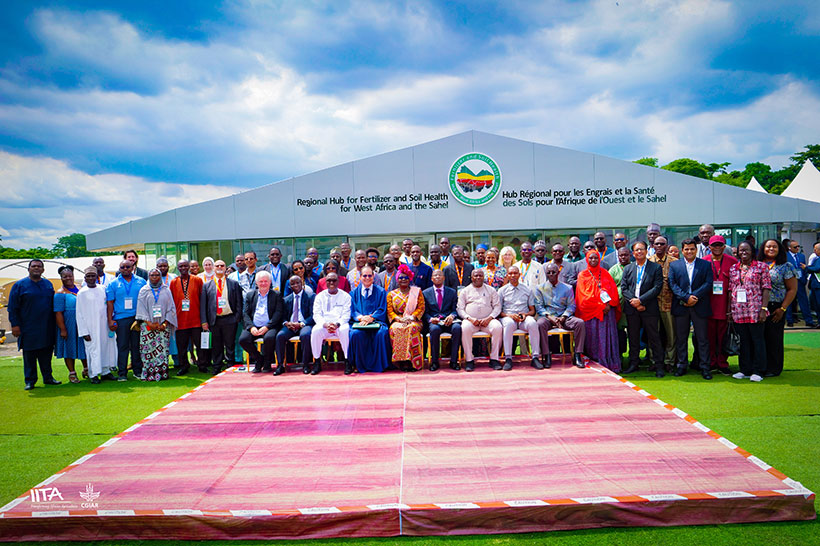
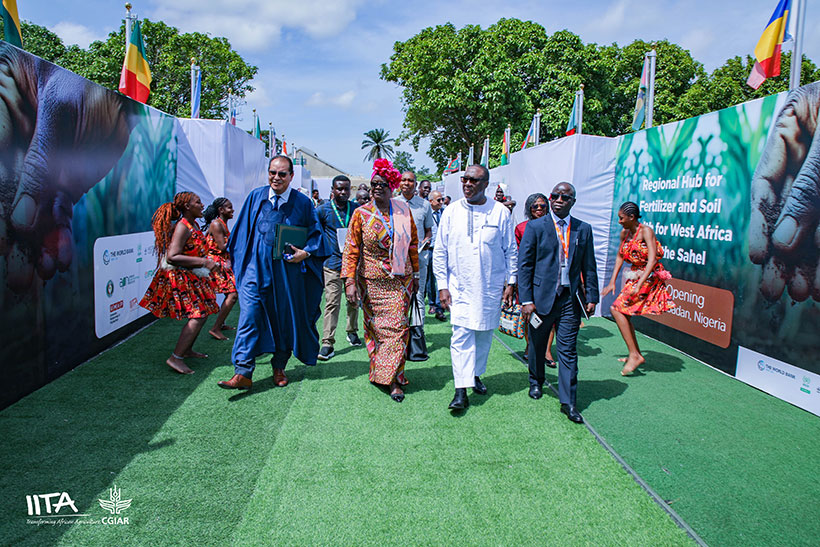
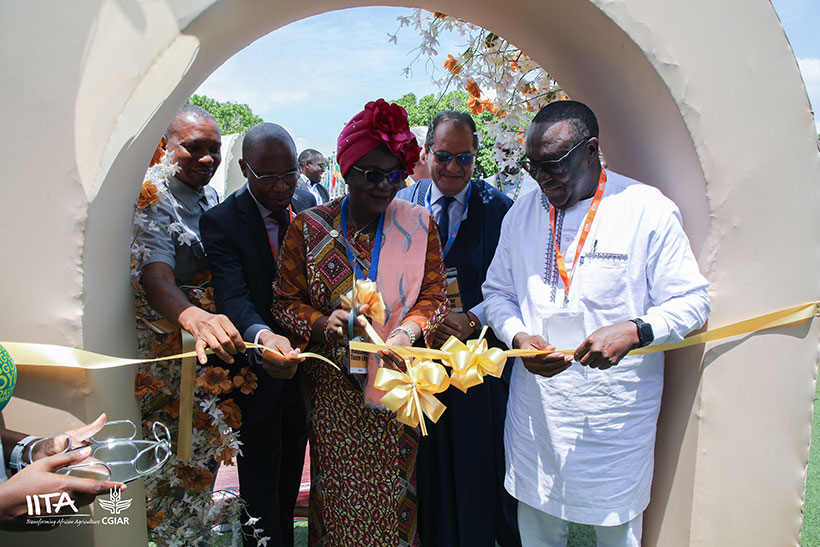
The Regional Hub for Fertilizer and Soil Health for West Africa and the Sahel has officially opened today at the International Institute of Tropical Agriculture (IITA) Headquarters in Ibadan, Nigeria, to significantly enhance agricultural productivity and sustainable profitability across West Africa and the Sahel. By 2033, the Hub will help increase yields and income for three million farmers, improve soil health on 1.5 million hectares of land, and equip 1.5 million farmers to adapt to climate change.

The Hub leverages a step-change in coordination and collaboration to tackle the critical agricultural production challenges in the region by promoting sustainable soil health and optimum fertilizer practices that will enhance the sustainability and resilience of agricultural production and food security. “This regional Hub is a groundbreaking step towards revolutionizing agricultural practices in West Africa and the Sahel,” remarked Simeon Ehui, Director-General of IITA. “By leveraging our extensive research experience and collaborating with key stakeholders, we will empower farmers with the knowledge and tools to improve soil health and achieve sustainable food security across the region.”
 

Dr. Jens Andersson, a researcher at Wageningen University, moderating the symposium

In Africa, two-thirds of the land available for agricultural production is considered degraded, resulting is low crop and livestock productivity, poverty, and degradation of natural resources. Average fertilizer application rate is 22 kilograms per hectare, compared to a world average seven-times higher (146 kilograms per hectare), while skyrocketing and highly volatile fertilizer prices reduce their application even further. Moreover, the fertilizers applied are not always suitable to the soil and crops needs, and complementary inputs and advisory services are usually missing, leading to low profitability for the farmer and sometimes even further soil degradation in the long run. The new Hub combines cutting-edge laboratory testing and training facilities with cross-sector experts including the private sector to support development and delivery at scale of advanced soil health and fertilizer technologies. It provides access to rigorous internal scientific research and on-farm testing, ensuring practical solutions tailored to farm-specific challenges and thereby delivering significant value to growers.


“The Fertilizer and Soil Health Hub is critical for agricultural development in West Africa,” commented Mrs. Massandje Toure-Litse, ECOWAS Commissioner for Economic Affairs and Agriculture at the Economic Commission for West African States (ECOWAS). “By focusing on knowledge sharing, capacity development, and evidence-based practices, it perfectly aligns with the strategic guidance outlined in the Lomé Declaration on Fertilizers and Soil Health in West Africa and the Sahel, adopted on May 2023 to empower our member states to achieve their sustainable agriculture goals.”


The Hub’s strategy is framed by the priorities of the Fertilizer and Soil Health Roadmap 2023 and the Nairobi Declaration from the Africa Fertilizer and Soil Health Summit 2024. The Hub is propelled by significant financial commitments, including support from the World Bank ($10 million) over the next five years through the Accelerating Impacts of CGIAR Climate Research for Africa (AICCRA) project, and from OCP Africa over the same period.


We are committed to helping achieve Sustainable Development Goals 2 and 13 to eliminate hunger, achieve food security, improve nutrition and promote sustainable agriculture, and to take urgent actions to address climate change and its impacts,” said Chakib Jenane, World Bank Regional Director for Sustainable Development. “Integrated soil fertility management and the restoration of soil health are therefore key to ensure the resilience of food systems and achieve food security in West Africa and the Sahel.”
 

 Dr. Shamie Zingore, Director of Research and Development at the African Plant Nutrition Institute, making his presentation
Dr. Shamie Zingore, Director of Research and Development at the African Plant Nutrition Institute, making his presentation

The operationalization of the Hub is part of commitments signed in Marrakech in October 2023 between the World Bank, IITA, and OCP Africa. “OCP Africa is demonstrating a strong commitment to sustainable agriculture and food systems in Africa. Our contribution to the establishment of this Hub underscores our dedication to these goals, and our unconditioned commitment to make the program a pilot to be upscaled in all the continent, » said OCP Africa’s CEO, Dr. Mohamed Anouar Jamali.


About the Regional Hub:

The Regional Hub for Fertilizer and Soil Health for West Africa and the Sahel is a collaborative effort initiated at the Africa Fertilizer and Soil Health Summit in Nairobi on May 8, 2024, focusing on combating soil health decline in the region. It brings together key stakeholders, including IITA, OCP Africa, the African Plant Nutrition Institute (APNI), University Mohammed VI Polytechnic (UM6P), International Fertilizer Development Centre (IFDC), and the World Bank. The Hub invites partnerships with other organizations, research institutions, and private sector entities to achieve a thriving agricultural future in the region.


Media Contact

Barbra Sehlule Muzata

b.muzata@cgiar.org


Contributed by

Related news

No items found

Leave a Reply

Your email address will not be published. Required fields are marked *

Scroll to Top
Olaosebikan, Olamide

Olamide Deborah Nwanze is a Senior Research Associate specializing in gender mainstreaming research to inform participatory and inclusive breeding, variety development, and seed systems policies regarding root, tuber, and banana (RTB) crops in the International Institute of Tropical Agriculture Headquarters, Ibadan, Nigeria. She is a PhD candidate at the University of Ibadan and holds an MSc and B. Agric in Agricultural Extension and Rural Development. Olamide is a fellow of the African Women in Agricultural Research and Development – Gender Responsive Agricultural Systems Policy (AWARD-GRASP) and the Gender Responsive Researchers Equipped for Agricultural Transformation (GREAT). She seeks to apply her gender-mainstreaming learnings, gender-responsive research, and policy development, and review expertise to facilitate women, youth, children, and vulnerable social group’s access to and adoption of agricultural Innovations that guarantee food, nutrition, income, and livelihood security in Africa. Her current roles include mentoring research fellows, development of guides and training manuals, implementation and adaptation of gender frameworks and tools, value chain actors’ engagement as citizen science partners, policy review and redesign, data management, and analysis. Her current research explores mixed methods and participatory and interdisciplinary approaches to capture and highlight gender dynamics, needs, preferences, and challenges stakeholders face within the agricultural livelihood value chain to prioritize gender-inclusive strategies in breeding programs, policy design, and implementation.

At IITA, she contributes to the implementation of the CGIAR Accelerated Breeding Initiative and Genetic Innovation Programs; participatory and gender research within the NextGen CassavaHarvestPlusRTBFoods, and Tricot-ClimMob 1000Farms Projects; and gender knowledge communication via the G-LENS webinar series, video documentary, policy briefspublications, and blogs.


Recent publications

de Sousa, K., van Etten, J., Manners, R. Bello, A., Teeken, B., Olaosebikan, O., et al. 2024. The tricot approach: an agile framework for decentralized on-farm testing supported by citizen science. A retrospective. Agron. Sustain. Dev. 44, 8. https://doi.org/10.1007/s13593-023-00937-1

Madu, T., Onwuka, S., Nwafor, S., Onyemauwa, N., Ejechi, M., Ofoeze, M., Ukeje, B., Eluagu, C., Olaosebikan, O., Okoye, B., 2024. Gender-Inclusive Consumer Studies Improve Cassava Breeding in Nigeria in: Frontiers in Sociology, volume 9, number: 1224504, doi: 10.3389/fsoc.2024.1224504

Olaosebikan, O.; Bello, A.; Utoblo, O.; Okoye, B.; Olutegbe, N.; Garner, E.; Teeken, B.; Bryan, E.; Forsythe, L.; Cole, S.; Madu, T. 2023.  Stressors and Resilience within the Cassava Value Chain in Nigeria: Preferred Cassava Variety Traits and Response Strategies of Men and Women to Inform Breeding. Sustainability 15, 7837. https://doi.org/10.3390/su15107837

Okoye, B., Ofoeze, M., Ejechi, M., Onwuka, S., Nwafor, S., Onyemauwa, N., Ukeje, B., Eluagu, C., Obidiegwu, J.*, Olaosebikan, O., Madu, T.* 2023. Prioritizing preferred traits in the yam value chain in Nigeria: a gender situation analysis in: Frontiers in Sociology, volume 8, number: 1232626, pages 1 – 9, ISSN 2297-7775, 2023. https://www.frontiersin.org/articles/10.3389/fsoc.2023.1232626/full

Olaosebikan, O., Bello, A. A., de Sousa, K., Ndjouenkeu, R., Adesokan, M., Alamu, E. O., Agbona, A., van Etten, J., Kegah, F. N.*, Dufour, D., Bouniol, A., Teeken, B. 2023. Consumer acceptability of cassava gari-eba food products across cultural and environmental settings using the triadic comparison of technologies approach (tricot) in: Journal of the Science of Food and Agriculture,

Teeken, B., Olaosebikan, O., Bello, A. A., Madu, T.*, Cole, S. M. 2023. Qualitative assessment on the positionality and preferences of dyads in relation to cassava-related activities: working with tricot trial citizen scientists https://hdl.handle.net/10568/138326 Type: Manual

Bouniol, A., Ceballos, H., Bello, A. A., Teeken, B., Olaosebikan, O., Owoade, D., Agbona, A., Fotso Kuate, A., Madu, T.*, Okoye, B.*, Ofoeze, M.*, Nwafor, S.*, Onyemauwa, N.*, Adinsi, L.*, Forsythe, L., Dufour, D. 2023. Varietal impact on women’s labour, workload and related drudgery in processing root, tuber and banana crops: focus on cassava in sub-Saharan Africa in: Journal of the Science of Food and Agriculture, pages 1 – 25, ISSN 0022-5142,

Bello, A. A., Agbona, A., Olaosebikan, O., Edughaen, G., Dufour, D., Bouniol, A., Iluebbey, P., Ndjouenkeu, R.*, Rabbi, I. Y., Teeken, B. 2023. Genetic and environmental effects on processing productivity and food product yield: drudgery of women’s work in: Journal of the Science of Food and Agriculture, pages 1 – 32, ISSN 0022-5142, 5

Cavicchioli, M., Zimbiti, T., Teeken, B., Nwanze, D.O., Liani, M., Parkes, E. & Bello, A. 2023. IITA-Gender Responsive Breeding Training Report. Genetic Resources Center, IITA-HQ, Ibadan, 21-23 September, 2022. Ibadan, Nigeria: IITA, (34 p.).https://hdl.handle.net/10568/131368

Agbona, A. Peteti P., Teeken B., Olaosebikan O. Bello, A. A., Parkes, E., Rabbi, I. Y., Mueller, L., Egesi, C., Kulakow, P. 2022. Data Management in Multi-disciplinary African RTB Crop Breeding Programs. In: Williamson, H.F., Leonelli, S. (eds) Towards Responsible Plant Data Linkage: Data Challenges for Agricultural Research and Development. Springer, Cham. https://doi.org/10.1007/978-3-031-13276-6_5

Lora Forsythe, Pricilla Marimo, Sarah Mayanja, Olamide D. Olaosebikan, Esme Stuart, Bela Teeken, Benjamin Okoye, Tessy Madu, (2021). Cross-product Gender Analysis of RTBfoods Step 2 Gendered Food Mapping on RTB Products. Understanding the Drivers of Trait Preferences and the Development of Multi-user RTB Product Profiles, WP1. London, UK: RTBfoods Field Scientific Report, 30 p.

Teeken, B., Garner, E., Agbona, A., Balogun, I., Olaosebikan, O., Bello, A., Madu, T., Okoye, B., Egesi, C., Kulakow, P. and Tufan, H.A. 2021. Beyond “Women’s Traits”: Exploring How Gender, Social Difference, and Household Characteristics Influence Trait Preferences. Frontiers Sustainable Food Systems 5:740926. https://doi.org/10.3389/fsufs.2021.740926

Teeken, B., Agbona, A., Bello, A., Olaosebikan, O., Alamu, E., Adesokan, M., Awoyale, W., Madu, T., Okoye, B., Chijioke, U., Owoade, D., Okoro, M., Bouniol, A., Dufour, D., Hershey, C., Rabbi, I., Maziya‐Dixon, B., Egesi, C., Tufan, H. and Kulakow, P. (020. Understanding cassava varietal preferences through pairwise ranking of gari‐eba and fufu prepared by local farmer–processors. Int J Food Sci Technol. https://doi.org/10.1111/ijfs.14862

Bela Teeken, Olamide Olaosebikan, Ireti Balogun, Benjamin Okoye, Tessy Madu, Steven Cole, Abolore Bello, Elizabeth Parkes. (2020). Piloting the G+ customer and product profile tools for gender-responsive cassava breeding in Nigeria. Nigeria: International Institute of Tropical Agriculture (IITA). https://hdl.handle.net/20.500.11766/13000