
A cassava agronomy project finds ways to reduce the yield gap to increase cassava production in Africa
December 10, 2016
Strategies and methods aimed at reducing the yield gap in cassava and leading to increased production for the benefit of farmers and processors have been mapped out during the inaugural meeting of the African Cassava Agronomy Initiatives (ACAI) project, at IITA, Ibadan, 5-7 December. At this meeting stakeholders converged to review the project’s activities since its launch earlier in the year and organize plans for implementing the program for 2017.
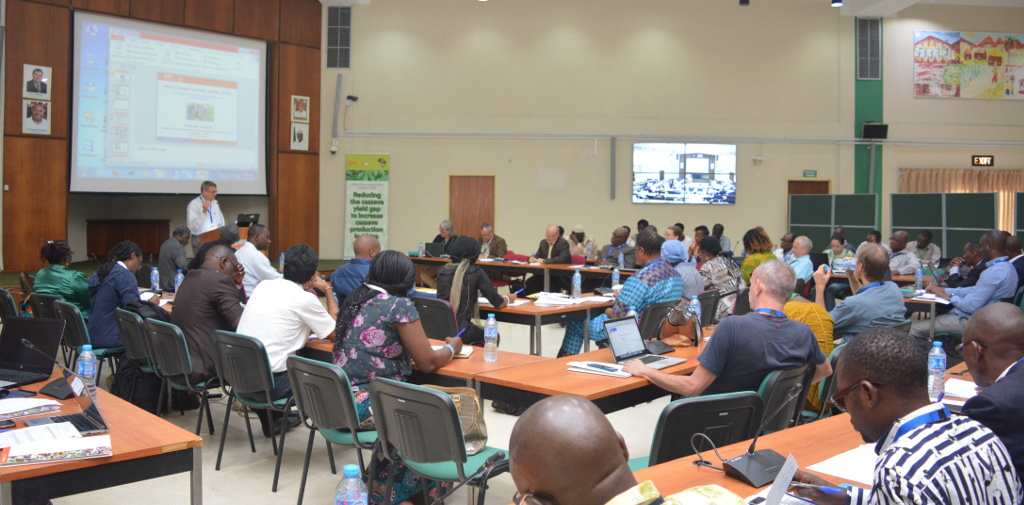 The project aims at increasing the income of farmers through improved cassava yields, root quality and the supply to processing sectors by developing and promoting best-bet agronomic practices. The review and planning workshop comprised a series of presentations ranging from cluster forums involving cassava value chains to modelling, geospatial analysis as well as scaling out methodologies. All of these were discussed around project use cases that had been identified by stakeholders who are working in ACAI target communities and improving the livelihoods of cassava smallholder farmers. The use cases are Fertilizer Recommendation, Fertilizer Blending, Scheduled Planting, High Starch Content, Intercropping, and Best Planting Practices (PP) which are required by ACAI partners.
Lawrence Kent, a representative from the Bill & Melinda Gates Foundation, said that it is essential to be attentive to the demands of partners, and research should aim at fulfilling their demands at all times. “There are certain partners that have priorities and we are trying to organize research to be responsive to their demands; we have to ensure there is an immediate answer to their needs”, Kent said.
Bernard Vanlauwe, IITA Director for Central Africa, who is the Principal Investigator of the project, expressed satisfaction over the workshop. “The meeting was good. Plans were drafted and we got feedback from the Project Advisory Committee on how to do things better. The youths will also be involved in the delivery,” Vanlauwe stated.
Expected outputs were delivered, with stakeholders having a common understanding of the issues in the implementing framework.
ACAI’s Project Coordinator, Abdulai Jalloh, said the meeting marked an important milestone in consolidating the required partnership that will ensure effective project implementation. He noted that the three days brought a diverse range of key stakeholders that have shared ideas and learned from one another to improve cassava production. He went on to appreciate everyone for their active participation.
ACAI is a five-year project that seeks to increase the availability of appropriate and affordable technologies to sustainably improve short- and long-term agricultural productivity of cassava. The project has been in existence for the past one year under the leadership of IITA, and is funded by the Gates Foundation.
The project aims at increasing the income of farmers through improved cassava yields, root quality and the supply to processing sectors by developing and promoting best-bet agronomic practices. The review and planning workshop comprised a series of presentations ranging from cluster forums involving cassava value chains to modelling, geospatial analysis as well as scaling out methodologies. All of these were discussed around project use cases that had been identified by stakeholders who are working in ACAI target communities and improving the livelihoods of cassava smallholder farmers. The use cases are Fertilizer Recommendation, Fertilizer Blending, Scheduled Planting, High Starch Content, Intercropping, and Best Planting Practices (PP) which are required by ACAI partners.
Lawrence Kent, a representative from the Bill & Melinda Gates Foundation, said that it is essential to be attentive to the demands of partners, and research should aim at fulfilling their demands at all times. “There are certain partners that have priorities and we are trying to organize research to be responsive to their demands; we have to ensure there is an immediate answer to their needs”, Kent said.
Bernard Vanlauwe, IITA Director for Central Africa, who is the Principal Investigator of the project, expressed satisfaction over the workshop. “The meeting was good. Plans were drafted and we got feedback from the Project Advisory Committee on how to do things better. The youths will also be involved in the delivery,” Vanlauwe stated.
Expected outputs were delivered, with stakeholders having a common understanding of the issues in the implementing framework.
ACAI’s Project Coordinator, Abdulai Jalloh, said the meeting marked an important milestone in consolidating the required partnership that will ensure effective project implementation. He noted that the three days brought a diverse range of key stakeholders that have shared ideas and learned from one another to improve cassava production. He went on to appreciate everyone for their active participation.
ACAI is a five-year project that seeks to increase the availability of appropriate and affordable technologies to sustainably improve short- and long-term agricultural productivity of cassava. The project has been in existence for the past one year under the leadership of IITA, and is funded by the Gates Foundation.
Agronomists and other stakeholders meet in IITA, Ibadan to review project activities
Contributed by
Recent stories
No items found