
PASIC study findings and Humidtropics’ Innovation Platforms factored in Uganda’s newly passed National
December 7, 2016
The approval of the National Agricultural Extension Policy (NAEP) and its strategy (NAES) in October 2016 by the Cabinet of the Government of Uganda was a major milestone for IITA and partners in their efforts to push for wide consultation with stakeholders in policy formulation.
 The policy incorporated findings from a study on Policy and Institutions by Policy Action for Sustainable Intensification of Cropping Systems (PASIC), an IITA-led research project that seeks to have an impact on intensification policy. The studies showed that national level policy consultations often excluded the contributions of agricultural producers and local governments and were instead dominated by technical staff. Consequently, there was limited use of evidence and incorporation of concerns and issues from local level into the policies.
Another finding was that there was a disconnect between policy processes at local and national levels, which
later affected policy implementation. These findings therefore led to nationwide consultations in the formulation of the national agricultural extension policy (NAEP), its strategy, and Regulatory Impact Assessment (RIA).
Another major influencer in the extension policy and strategies were the experiences of the IITA-led Humidtropics program which established innovation platforms as a way to bridge the disconnect between researchers and farmers’ needs.
The platforms, also known as multi-stakeholder platforms, bring together different stakeholders to share their learning and experiences as well as jointly implement activities together. They try to bridge the gap between demand and supply for both technologies and knowledge. These platforms were nationally facilitated by the National Agricultural Research Organization (NARO) and Makerere University.
The success of these platforms led to a similar approach being included in extension policy strategy 4.2 which states that the Ministry of Agriculture, Animal Industry and Fisheries (MAAIF) will establish a formal working relationship with research organizations/institutions to ensure participation of the extension services and farmers in identifying, testing and evaluating technological solutions including indigenous knowledge.
This strategy emphasizes the development and strengthening of multi-stakeholder innovation platforms at the national, zonal, district, and sub-county levels.
Fred Mukulu, Chairperson of the Mukono–Wakiso innovation platform, and also the District Production and Marketing Officer for Mukono, was one of the key informants consulted by the technical committee that formulated this policy and its implementation strategy.
“Mukono-Wakiso IP was a result of ‘frustrations’. Scientific researchers were frustrated because their technologies were not being taken on and they were asking themselves why? Farmers too were frustrated because they were faced with challenges which they thought scientists could have provided a solution to; but the solution was nowhere to be found. The government too was frustrated because farmers were not taking on new technologies at the rate they were expected to,” remarked Mukulu.
“The IP provides a platform for the scientists to communicate their technologies to the farmers, and for farmers to communicate their fears over the technologies and to acquire knowledge on how to practice modern farming using different technologies,” says Mukulu, building a case for the IP.
The World Bank has already committed to supporting implementation of the strategy under the Agricultural Technology and Agribusiness Advisory Services (ATAAS). The funding will be received by NARO and distributed to local governments through NARO branches at different zones and to MAAIF for the management and supervisory role. Mukono District, for example, will be receiving UGX 220 million shillings to support the district agricultural plans, which in this case are spearheaded by the Innovation Platform.
“I plan to hold a training workshop for district production and marketing officers in the 21 districts within the central region to share my experience on how to successfully establish an IP and sustain it,” noted Mukulu.
The policy incorporated findings from a study on Policy and Institutions by Policy Action for Sustainable Intensification of Cropping Systems (PASIC), an IITA-led research project that seeks to have an impact on intensification policy. The studies showed that national level policy consultations often excluded the contributions of agricultural producers and local governments and were instead dominated by technical staff. Consequently, there was limited use of evidence and incorporation of concerns and issues from local level into the policies.
Another finding was that there was a disconnect between policy processes at local and national levels, which
later affected policy implementation. These findings therefore led to nationwide consultations in the formulation of the national agricultural extension policy (NAEP), its strategy, and Regulatory Impact Assessment (RIA).
Another major influencer in the extension policy and strategies were the experiences of the IITA-led Humidtropics program which established innovation platforms as a way to bridge the disconnect between researchers and farmers’ needs.
The platforms, also known as multi-stakeholder platforms, bring together different stakeholders to share their learning and experiences as well as jointly implement activities together. They try to bridge the gap between demand and supply for both technologies and knowledge. These platforms were nationally facilitated by the National Agricultural Research Organization (NARO) and Makerere University.
The success of these platforms led to a similar approach being included in extension policy strategy 4.2 which states that the Ministry of Agriculture, Animal Industry and Fisheries (MAAIF) will establish a formal working relationship with research organizations/institutions to ensure participation of the extension services and farmers in identifying, testing and evaluating technological solutions including indigenous knowledge.
This strategy emphasizes the development and strengthening of multi-stakeholder innovation platforms at the national, zonal, district, and sub-county levels.
Fred Mukulu, Chairperson of the Mukono–Wakiso innovation platform, and also the District Production and Marketing Officer for Mukono, was one of the key informants consulted by the technical committee that formulated this policy and its implementation strategy.
“Mukono-Wakiso IP was a result of ‘frustrations’. Scientific researchers were frustrated because their technologies were not being taken on and they were asking themselves why? Farmers too were frustrated because they were faced with challenges which they thought scientists could have provided a solution to; but the solution was nowhere to be found. The government too was frustrated because farmers were not taking on new technologies at the rate they were expected to,” remarked Mukulu.
“The IP provides a platform for the scientists to communicate their technologies to the farmers, and for farmers to communicate their fears over the technologies and to acquire knowledge on how to practice modern farming using different technologies,” says Mukulu, building a case for the IP.
The World Bank has already committed to supporting implementation of the strategy under the Agricultural Technology and Agribusiness Advisory Services (ATAAS). The funding will be received by NARO and distributed to local governments through NARO branches at different zones and to MAAIF for the management and supervisory role. Mukono District, for example, will be receiving UGX 220 million shillings to support the district agricultural plans, which in this case are spearheaded by the Innovation Platform.
“I plan to hold a training workshop for district production and marketing officers in the 21 districts within the central region to share my experience on how to successfully establish an IP and sustain it,” noted Mukulu.
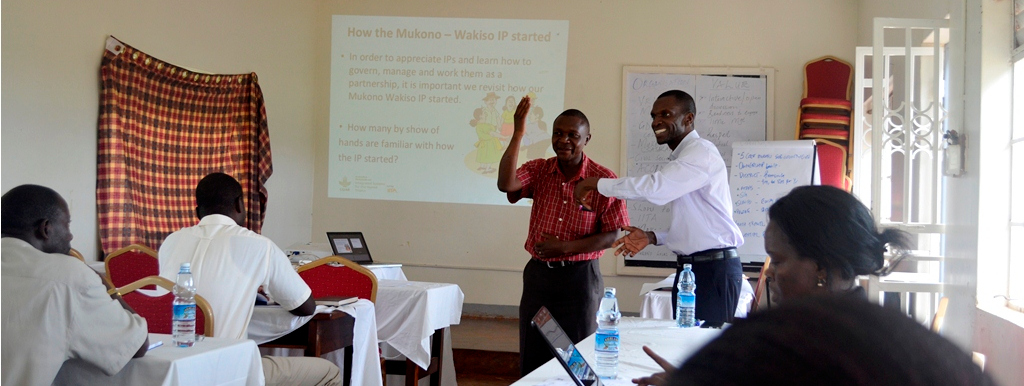
Mukulu making a presentation at one of the IP workshops.
Contributed by
Recent stories
No items found