
IITA NEWS

How youth agripreneurs contribute to food security and wealth creation
September 13, 2024

To fulfill the IITA Youth Agripreneurs’ (IYA) mandate to drive youth participation in agriculture for improved food systems and job creation, many beneficiaries of the various projects in the unit have continued to make significant contributions to agricultural productivity through their various enterprises.
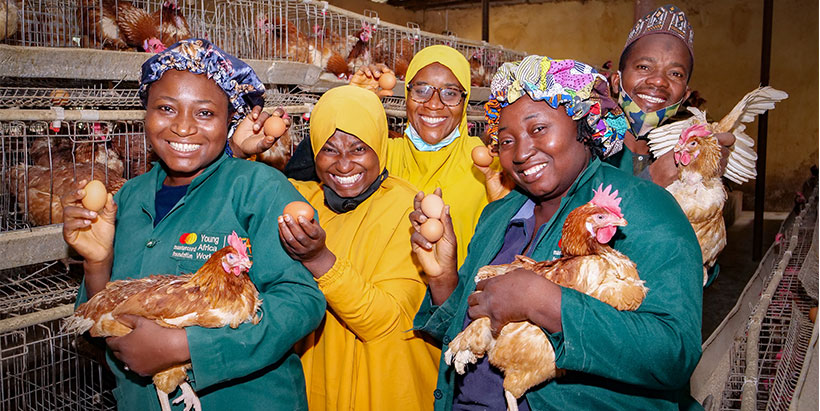
Mariam Abass and her colleagues at their 2,000 bird capacity poultry.

In addition to training in the value chains of various commodities, including poultry, aquaculture, livestock, horticulture, cassava, maize, yam, and groundnuts, beneficiaries have also been supported to start or scale up their enterprises.

Many beneficiaries in over 17 countries have thriving enterprises in fish production and processing, cassava production and processing, livestock farming, poultry farming, and groundnut production and processing, among many others.

Since the program’s inception in 2012, success stories of young farmers strengthening food security and creating wealth through their businesses abound across the continent.

For example, in the bustling Nigerian city of Lagos, the CEO of Farm2Fill Enterprises, Evelyn Areo, stands as a testament to the transformative power of determination, innovation, and the potential of a meager NG₦10,000 (US$11) seed capital invested with the right knowledge and mentoring.
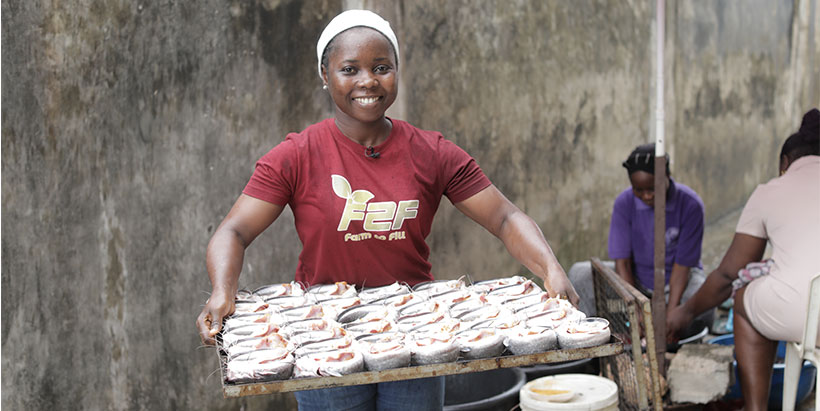
CEO of Farm2Fill Enterprises, Evelyn Areo, preparing a batch of cat fish for smoking.

Areo, a young agribusiness owner, has, since the commencement of her business in 2021, contributed to the availability of processed foods nationally and internationally. As of 2023, her once modest startup has blossomed into a thriving business, generating an impressive ₦28,000,000 (about $17,000) in revenue.

Farm2Fill, which has provided full-time and part-time employment for four youths and six women, produces spicy kulikuli, tasty smoked fish, processed snails and rabbits, and several other products in local stores across Nigeria and other locations abroad. Meanwhile, her venture into the value-addition component of the value chain has helped reduce food wastage and made options available to many, including Nigerians living abroad.

With a monthly revenue of ₦2,000,000 ($1,250), Areo’s business sustains itself and has become a channel for empowering others. She has gone beyond the conventional bounds of entrepreneurship by actively assisting ten youths in building their unique brands using Farm2Fill products. Areo’s mentorship has also ignited a spark of entrepreneurship in these individuals, allowing them to carve their respective paths in agribusiness.

Similarly, in Zaria, Kaduna State, Mariam Abass has become a beacon of hope and resilience for women in agriculture. At IYA’s agribusiness park, Mariam and her cooperative members have transformed a 2,000-bird (layers) capacity into a thriving enterprise contributing significantly to the local economy.

Operating seamlessly within the agribusiness park, Mariam and her team distribute an impressive 322 crates of eggs weekly, meeting the demands of local retailers and establishing themselves as key players in the region’s poultry industry. Their enterprise has helped to bridge the demand for eggs in their locality while creating job opportunities for retailers and marketers.

In Ibadan, Oyo State, Nurudeen Farayola, who rears turkeys, chickens, goats, rams, rabbits, and ducks, also contributes to the availability of eggs and these varieties in the local market.

Rather than stay on one breed of livestock, Farayola, who benefitted from the training by one of the projects in the unit, said he decided to diversify so that the wealth of knowledge he had gained would not be lost and he could increase his income.

Since the creation of the IYA, there have been more than one million participants, while youth-led agribusinesses created, spanning the entire value chain, especially production and processing, are over 12,500, all contributing to food security in their various locations. In addition, the innovations by some of the beneficiaries are improving food systems, including safe processing and distribution.

Contributed by IITA Youth in Agribusiness Office

Other Resources:
I-Youth Agribusiness Park | Encouraging Collaborative Growth (youtube.com)

Awala Women: Pioneering Change in Local Milk Production (youtube.com)


Contributed by

Related news

No items found

Leave a Reply

Your email address will not be published. Required fields are marked *

Scroll to Top
Olaosebikan, Olamide

Olamide Deborah Nwanze is a Senior Research Associate specializing in gender mainstreaming research to inform participatory and inclusive breeding, variety development, and seed systems policies regarding root, tuber, and banana (RTB) crops in the International Institute of Tropical Agriculture Headquarters, Ibadan, Nigeria. She is a PhD candidate at the University of Ibadan and holds an MSc and B. Agric in Agricultural Extension and Rural Development. Olamide is a fellow of the African Women in Agricultural Research and Development – Gender Responsive Agricultural Systems Policy (AWARD-GRASP) and the Gender Responsive Researchers Equipped for Agricultural Transformation (GREAT). She seeks to apply her gender-mainstreaming learnings, gender-responsive research, and policy development, and review expertise to facilitate women, youth, children, and vulnerable social group’s access to and adoption of agricultural Innovations that guarantee food, nutrition, income, and livelihood security in Africa. Her current roles include mentoring research fellows, development of guides and training manuals, implementation and adaptation of gender frameworks and tools, value chain actors’ engagement as citizen science partners, policy review and redesign, data management, and analysis. Her current research explores mixed methods and participatory and interdisciplinary approaches to capture and highlight gender dynamics, needs, preferences, and challenges stakeholders face within the agricultural livelihood value chain to prioritize gender-inclusive strategies in breeding programs, policy design, and implementation.

At IITA, she contributes to the implementation of the CGIAR Accelerated Breeding Initiative and Genetic Innovation Programs; participatory and gender research within the NextGen CassavaHarvestPlusRTBFoods, and Tricot-ClimMob 1000Farms Projects; and gender knowledge communication via the G-LENS webinar series, video documentary, policy briefspublications, and blogs.


Recent publications

de Sousa, K., van Etten, J., Manners, R. Bello, A., Teeken, B., Olaosebikan, O., et al. 2024. The tricot approach: an agile framework for decentralized on-farm testing supported by citizen science. A retrospective. Agron. Sustain. Dev. 44, 8. https://doi.org/10.1007/s13593-023-00937-1

Madu, T., Onwuka, S., Nwafor, S., Onyemauwa, N., Ejechi, M., Ofoeze, M., Ukeje, B., Eluagu, C., Olaosebikan, O., Okoye, B., 2024. Gender-Inclusive Consumer Studies Improve Cassava Breeding in Nigeria in: Frontiers in Sociology, volume 9, number: 1224504, doi: 10.3389/fsoc.2024.1224504

Olaosebikan, O.; Bello, A.; Utoblo, O.; Okoye, B.; Olutegbe, N.; Garner, E.; Teeken, B.; Bryan, E.; Forsythe, L.; Cole, S.; Madu, T. 2023.  Stressors and Resilience within the Cassava Value Chain in Nigeria: Preferred Cassava Variety Traits and Response Strategies of Men and Women to Inform Breeding. Sustainability 15, 7837. https://doi.org/10.3390/su15107837

Okoye, B., Ofoeze, M., Ejechi, M., Onwuka, S., Nwafor, S., Onyemauwa, N., Ukeje, B., Eluagu, C., Obidiegwu, J.*, Olaosebikan, O., Madu, T.* 2023. Prioritizing preferred traits in the yam value chain in Nigeria: a gender situation analysis in: Frontiers in Sociology, volume 8, number: 1232626, pages 1 – 9, ISSN 2297-7775, 2023. https://www.frontiersin.org/articles/10.3389/fsoc.2023.1232626/full

Olaosebikan, O., Bello, A. A., de Sousa, K., Ndjouenkeu, R., Adesokan, M., Alamu, E. O., Agbona, A., van Etten, J., Kegah, F. N.*, Dufour, D., Bouniol, A., Teeken, B. 2023. Consumer acceptability of cassava gari-eba food products across cultural and environmental settings using the triadic comparison of technologies approach (tricot) in: Journal of the Science of Food and Agriculture,

Teeken, B., Olaosebikan, O., Bello, A. A., Madu, T.*, Cole, S. M. 2023. Qualitative assessment on the positionality and preferences of dyads in relation to cassava-related activities: working with tricot trial citizen scientists https://hdl.handle.net/10568/138326 Type: Manual

Bouniol, A., Ceballos, H., Bello, A. A., Teeken, B., Olaosebikan, O., Owoade, D., Agbona, A., Fotso Kuate, A., Madu, T.*, Okoye, B.*, Ofoeze, M.*, Nwafor, S.*, Onyemauwa, N.*, Adinsi, L.*, Forsythe, L., Dufour, D. 2023. Varietal impact on women’s labour, workload and related drudgery in processing root, tuber and banana crops: focus on cassava in sub-Saharan Africa in: Journal of the Science of Food and Agriculture, pages 1 – 25, ISSN 0022-5142,

Bello, A. A., Agbona, A., Olaosebikan, O., Edughaen, G., Dufour, D., Bouniol, A., Iluebbey, P., Ndjouenkeu, R.*, Rabbi, I. Y., Teeken, B. 2023. Genetic and environmental effects on processing productivity and food product yield: drudgery of women’s work in: Journal of the Science of Food and Agriculture, pages 1 – 32, ISSN 0022-5142, 5

Cavicchioli, M., Zimbiti, T., Teeken, B., Nwanze, D.O., Liani, M., Parkes, E. & Bello, A. 2023. IITA-Gender Responsive Breeding Training Report. Genetic Resources Center, IITA-HQ, Ibadan, 21-23 September, 2022. Ibadan, Nigeria: IITA, (34 p.).https://hdl.handle.net/10568/131368

Agbona, A. Peteti P., Teeken B., Olaosebikan O. Bello, A. A., Parkes, E., Rabbi, I. Y., Mueller, L., Egesi, C., Kulakow, P. 2022. Data Management in Multi-disciplinary African RTB Crop Breeding Programs. In: Williamson, H.F., Leonelli, S. (eds) Towards Responsible Plant Data Linkage: Data Challenges for Agricultural Research and Development. Springer, Cham. https://doi.org/10.1007/978-3-031-13276-6_5

Lora Forsythe, Pricilla Marimo, Sarah Mayanja, Olamide D. Olaosebikan, Esme Stuart, Bela Teeken, Benjamin Okoye, Tessy Madu, (2021). Cross-product Gender Analysis of RTBfoods Step 2 Gendered Food Mapping on RTB Products. Understanding the Drivers of Trait Preferences and the Development of Multi-user RTB Product Profiles, WP1. London, UK: RTBfoods Field Scientific Report, 30 p.

Teeken, B., Garner, E., Agbona, A., Balogun, I., Olaosebikan, O., Bello, A., Madu, T., Okoye, B., Egesi, C., Kulakow, P. and Tufan, H.A. 2021. Beyond “Women’s Traits”: Exploring How Gender, Social Difference, and Household Characteristics Influence Trait Preferences. Frontiers Sustainable Food Systems 5:740926. https://doi.org/10.3389/fsufs.2021.740926

Teeken, B., Agbona, A., Bello, A., Olaosebikan, O., Alamu, E., Adesokan, M., Awoyale, W., Madu, T., Okoye, B., Chijioke, U., Owoade, D., Okoro, M., Bouniol, A., Dufour, D., Hershey, C., Rabbi, I., Maziya‐Dixon, B., Egesi, C., Tufan, H. and Kulakow, P. (020. Understanding cassava varietal preferences through pairwise ranking of gari‐eba and fufu prepared by local farmer–processors. Int J Food Sci Technol. https://doi.org/10.1111/ijfs.14862

Bela Teeken, Olamide Olaosebikan, Ireti Balogun, Benjamin Okoye, Tessy Madu, Steven Cole, Abolore Bello, Elizabeth Parkes. (2020). Piloting the G+ customer and product profile tools for gender-responsive cassava breeding in Nigeria. Nigeria: International Institute of Tropical Agriculture (IITA). https://hdl.handle.net/20.500.11766/13000