
IITA NEWS

Fighting cassava’s deadliest enemies in western Kenya
October 10, 2024

Cassava production in western Kenya is being threatened by an army of pests and diseases that could decimate harvests. This starchy crop—the second most important in Kenya’s western and coastal regions, after maize—feeds over 500 million people in sub-Saharan Africa, and the challenge from these threats could have devastating consequences for food security in the region. But, new research offers hope for both farmers and consumers.
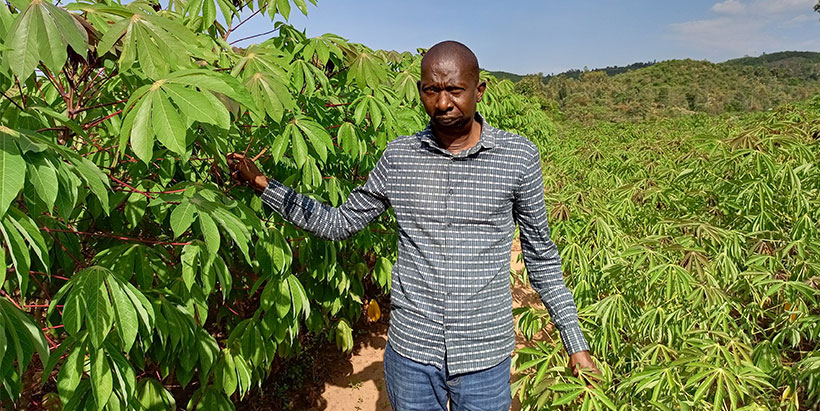
Senior KALRO researcher Vincent Woyengo in a cassava field with improved varieties—MM96.4271 and Migyera.

In a recent study titled “Occurrence and Distribution of Major Cassava Pests and Diseases in Cultivated Cassava Varieties in Western Kenya,” scientists from IITA and the Kenya Agricultural and Livestock Research Institute (KALRO) conducted field surveys across six major cassava-producing counties to understand how two devastating diseases—Cassava Mosaic Disease (CMD) and Cassava Brown Streak Disease (CBSD)—and pests like whiteflies and cassava green mites (CGM) are affecting cassava production. Their discoveries highlight both the challenges and potential solutions to these “invisible” enemies.

CMD and CBSD are spread by whiteflies—tiny insects that feed on cassava plants. CMD causes yellow, twisted leaves, stunting plant growth, while CBSD—which causes extreme yield loss—results in brown streaks inside the cassava roots, rendering them unmarketable and inedible. These diseases are a major cause of food loss in the region.

The surveys—conducted in 2022 and 2023—revealed that CMD is widespread, but thanks to improved cassava varieties, it is not as rampant as it once was. On average, CMD affected 26.4% of plants in 2022, but improved varieties, like MM96/4271, showed far lower infection rates—only 5.9%. This variety is popular among farmers and is resistant to CMD and tolerant of CBSD, helping protect cassava yields.
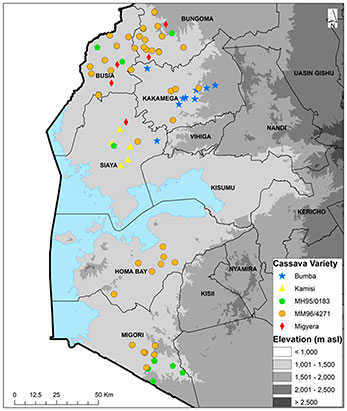
Geographic distribution of the top five cassava varieties cultivated in 2022 and 2023 in six counties of western Kenya.

One of the scientists, Senior KALRO researcher Vincent Woyengo, was pleased with the widespread adoption of KALRO-promoted improved varieties. He said, “KALRO improved varieties are tolerant to the effects of the major cassava virus diseases as well as being high yielding and adapted to environments in western Kenya. However, KALRO is keen to build on improved variety adoption by strengthening seed delivery systems, improving marketing structures, and training farmers in good agricultural practices.”

However, this multiple-front fight involves more than just disease. Whiteflies are multiplying rapidly, with 28% of surveyed fields in 2023 showing alarming infestations. CGMs are another threat, with their numbers increasing due to unpredictable weather, potentially linked to climate change. These mites feed on young cassava leaves, slowing plant growth and reducing yields.

IITA Vector Entomologist Everlyne Wosula, who led the survey team, emphasized the urgent need to re-establish routine surveillance of plant pests and diseases. She explained: “The reemergence of CGM despite previous biocontrol efforts calls for immediate research to understand the resurgence and to develop effective control measures. This is crucial, as cassava is being championed as a climate-resilient crop for food security, yet it remains vulnerable to pest outbreaks, especially under dry conditions.”
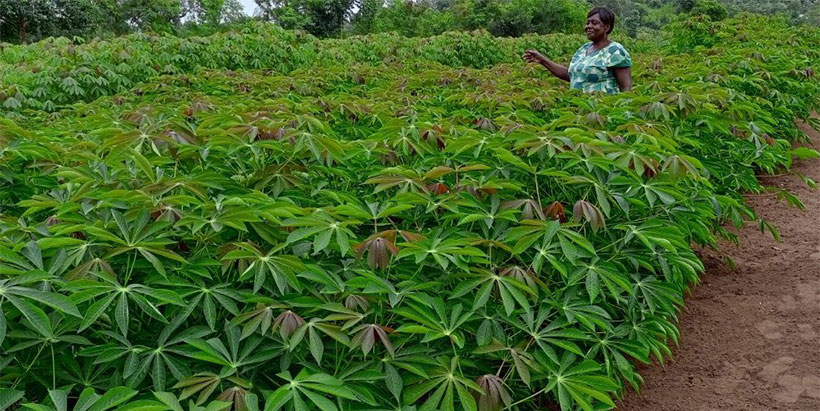
A cassava farmer showcasing the improved Migyera cassava variety.

This study highlights these ongoing threats to cassava production in western Kenya, but there is good news. The extensive adoption of improved varieties like MM96/4271 shows promise in reducing the impact of these diseases. Scientists believe they can reduce crop losses and ensure cassava’s future as a reliable food source by developing disease-resistant strains and promoting better seed systems, thereby expanding the adoption of improved varieties, developing IPM strategies, and enhancing cassava’s resilience to both pests and climate-related stressors. Combining these efforts with integrated pest management will further protect cassava against its relentless enemies.

IITA Plant Health Scientist James Legg, who provides oversight for IITA’s cassava pest and disease research in East Africa, was encouraged to see how improved varieties, jointly developed by IITA, KALRO, and Uganda’s National Agricultural Research Organisation (NARO), have been widely adopted by farmers in western Kenya. Legg noted, “Teams of researchers from IITA, KALRO, and NARO put a huge effort into introducing cassava virus-resistant varieties from Uganda to Kenya in the late 1990s. This was when an epidemic of severe CMD was spreading through western Kenya like wildfire. It is wonderful to see now that several of these varieties have been so widely adopted by Kenyan farmers and are clearly helping them to produce abundant food as well as earning extra income.”

The outcomes demonstrated by the new study have far-reaching implications for food security in Kenya and across sub-Saharan Africa, and with climate change adding pressure to African agriculture, safeguarding cassava is more important than ever.

Contributed by Uzoma Agha


Contributed by

Related news

No items found

Leave a Reply

Your email address will not be published. Required fields are marked *

Scroll to Top
Olaosebikan, Olamide

Olamide Deborah Nwanze is a Senior Research Associate specializing in gender mainstreaming research to inform participatory and inclusive breeding, variety development, and seed systems policies regarding root, tuber, and banana (RTB) crops in the International Institute of Tropical Agriculture Headquarters, Ibadan, Nigeria. She is a PhD candidate at the University of Ibadan and holds an MSc and B. Agric in Agricultural Extension and Rural Development. Olamide is a fellow of the African Women in Agricultural Research and Development – Gender Responsive Agricultural Systems Policy (AWARD-GRASP) and the Gender Responsive Researchers Equipped for Agricultural Transformation (GREAT). She seeks to apply her gender-mainstreaming learnings, gender-responsive research, and policy development, and review expertise to facilitate women, youth, children, and vulnerable social group’s access to and adoption of agricultural Innovations that guarantee food, nutrition, income, and livelihood security in Africa. Her current roles include mentoring research fellows, development of guides and training manuals, implementation and adaptation of gender frameworks and tools, value chain actors’ engagement as citizen science partners, policy review and redesign, data management, and analysis. Her current research explores mixed methods and participatory and interdisciplinary approaches to capture and highlight gender dynamics, needs, preferences, and challenges stakeholders face within the agricultural livelihood value chain to prioritize gender-inclusive strategies in breeding programs, policy design, and implementation.

At IITA, she contributes to the implementation of the CGIAR Accelerated Breeding Initiative and Genetic Innovation Programs; participatory and gender research within the NextGen CassavaHarvestPlusRTBFoods, and Tricot-ClimMob 1000Farms Projects; and gender knowledge communication via the G-LENS webinar series, video documentary, policy briefspublications, and blogs.


Recent publications

de Sousa, K., van Etten, J., Manners, R. Bello, A., Teeken, B., Olaosebikan, O., et al. 2024. The tricot approach: an agile framework for decentralized on-farm testing supported by citizen science. A retrospective. Agron. Sustain. Dev. 44, 8. https://doi.org/10.1007/s13593-023-00937-1

Madu, T., Onwuka, S., Nwafor, S., Onyemauwa, N., Ejechi, M., Ofoeze, M., Ukeje, B., Eluagu, C., Olaosebikan, O., Okoye, B., 2024. Gender-Inclusive Consumer Studies Improve Cassava Breeding in Nigeria in: Frontiers in Sociology, volume 9, number: 1224504, doi: 10.3389/fsoc.2024.1224504

Olaosebikan, O.; Bello, A.; Utoblo, O.; Okoye, B.; Olutegbe, N.; Garner, E.; Teeken, B.; Bryan, E.; Forsythe, L.; Cole, S.; Madu, T. 2023.  Stressors and Resilience within the Cassava Value Chain in Nigeria: Preferred Cassava Variety Traits and Response Strategies of Men and Women to Inform Breeding. Sustainability 15, 7837. https://doi.org/10.3390/su15107837

Okoye, B., Ofoeze, M., Ejechi, M., Onwuka, S., Nwafor, S., Onyemauwa, N., Ukeje, B., Eluagu, C., Obidiegwu, J.*, Olaosebikan, O., Madu, T.* 2023. Prioritizing preferred traits in the yam value chain in Nigeria: a gender situation analysis in: Frontiers in Sociology, volume 8, number: 1232626, pages 1 – 9, ISSN 2297-7775, 2023. https://www.frontiersin.org/articles/10.3389/fsoc.2023.1232626/full

Olaosebikan, O., Bello, A. A., de Sousa, K., Ndjouenkeu, R., Adesokan, M., Alamu, E. O., Agbona, A., van Etten, J., Kegah, F. N.*, Dufour, D., Bouniol, A., Teeken, B. 2023. Consumer acceptability of cassava gari-eba food products across cultural and environmental settings using the triadic comparison of technologies approach (tricot) in: Journal of the Science of Food and Agriculture,

Teeken, B., Olaosebikan, O., Bello, A. A., Madu, T.*, Cole, S. M. 2023. Qualitative assessment on the positionality and preferences of dyads in relation to cassava-related activities: working with tricot trial citizen scientists https://hdl.handle.net/10568/138326 Type: Manual

Bouniol, A., Ceballos, H., Bello, A. A., Teeken, B., Olaosebikan, O., Owoade, D., Agbona, A., Fotso Kuate, A., Madu, T.*, Okoye, B.*, Ofoeze, M.*, Nwafor, S.*, Onyemauwa, N.*, Adinsi, L.*, Forsythe, L., Dufour, D. 2023. Varietal impact on women’s labour, workload and related drudgery in processing root, tuber and banana crops: focus on cassava in sub-Saharan Africa in: Journal of the Science of Food and Agriculture, pages 1 – 25, ISSN 0022-5142,

Bello, A. A., Agbona, A., Olaosebikan, O., Edughaen, G., Dufour, D., Bouniol, A., Iluebbey, P., Ndjouenkeu, R.*, Rabbi, I. Y., Teeken, B. 2023. Genetic and environmental effects on processing productivity and food product yield: drudgery of women’s work in: Journal of the Science of Food and Agriculture, pages 1 – 32, ISSN 0022-5142, 5

Cavicchioli, M., Zimbiti, T., Teeken, B., Nwanze, D.O., Liani, M., Parkes, E. & Bello, A. 2023. IITA-Gender Responsive Breeding Training Report. Genetic Resources Center, IITA-HQ, Ibadan, 21-23 September, 2022. Ibadan, Nigeria: IITA, (34 p.).https://hdl.handle.net/10568/131368

Agbona, A. Peteti P., Teeken B., Olaosebikan O. Bello, A. A., Parkes, E., Rabbi, I. Y., Mueller, L., Egesi, C., Kulakow, P. 2022. Data Management in Multi-disciplinary African RTB Crop Breeding Programs. In: Williamson, H.F., Leonelli, S. (eds) Towards Responsible Plant Data Linkage: Data Challenges for Agricultural Research and Development. Springer, Cham. https://doi.org/10.1007/978-3-031-13276-6_5

Lora Forsythe, Pricilla Marimo, Sarah Mayanja, Olamide D. Olaosebikan, Esme Stuart, Bela Teeken, Benjamin Okoye, Tessy Madu, (2021). Cross-product Gender Analysis of RTBfoods Step 2 Gendered Food Mapping on RTB Products. Understanding the Drivers of Trait Preferences and the Development of Multi-user RTB Product Profiles, WP1. London, UK: RTBfoods Field Scientific Report, 30 p.

Teeken, B., Garner, E., Agbona, A., Balogun, I., Olaosebikan, O., Bello, A., Madu, T., Okoye, B., Egesi, C., Kulakow, P. and Tufan, H.A. 2021. Beyond “Women’s Traits”: Exploring How Gender, Social Difference, and Household Characteristics Influence Trait Preferences. Frontiers Sustainable Food Systems 5:740926. https://doi.org/10.3389/fsufs.2021.740926

Teeken, B., Agbona, A., Bello, A., Olaosebikan, O., Alamu, E., Adesokan, M., Awoyale, W., Madu, T., Okoye, B., Chijioke, U., Owoade, D., Okoro, M., Bouniol, A., Dufour, D., Hershey, C., Rabbi, I., Maziya‐Dixon, B., Egesi, C., Tufan, H. and Kulakow, P. (020. Understanding cassava varietal preferences through pairwise ranking of gari‐eba and fufu prepared by local farmer–processors. Int J Food Sci Technol. https://doi.org/10.1111/ijfs.14862

Bela Teeken, Olamide Olaosebikan, Ireti Balogun, Benjamin Okoye, Tessy Madu, Steven Cole, Abolore Bello, Elizabeth Parkes. (2020). Piloting the G+ customer and product profile tools for gender-responsive cassava breeding in Nigeria. Nigeria: International Institute of Tropical Agriculture (IITA). https://hdl.handle.net/20.500.11766/13000