
IITA NEWS

Empowering women to safeguard aquatic food systems in a changing climate
January 21, 2025

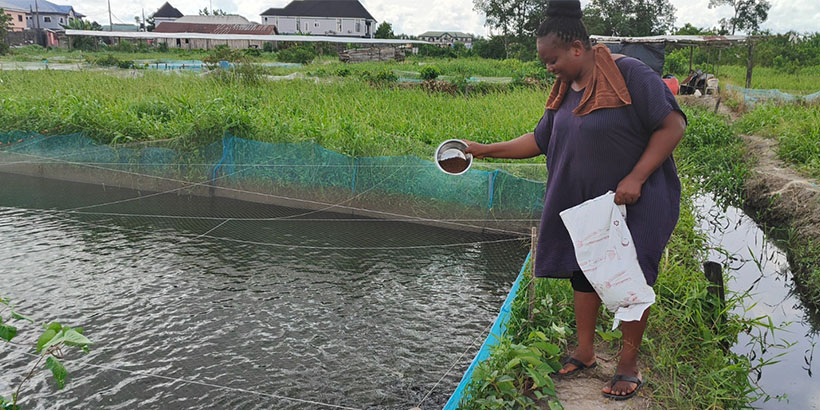
WorldFish project beneficiary, Agbor Delta State.
WorldFish project beneficiary, Agbor Delta State. (Photo credit: Olaniyi Ajibola/WorldFish).

Aquatic foods, sourced from inland and marine fisheries or cultivated through aquaculture, are vital pillars for global food security, poverty alleviation, and economic development. Across the world, millions of people depend on these aquatic food systems (AFS) for their livelihoods and sustenance. However, these systems are facing growing threats from human activities. Overfishing, habitat destruction, pollution, and the worsening impacts of climate change are placing unprecedented pressure on AFS.

The changing climate, marked by rising temperatures, ocean acidification, and extreme weather events, compounds these challenges. Without intervention, lower-income countries in Africa, the Indo-Pacific, and South and Southeast Asia stand to face the gravest risks by 2100. The consequences will affect nutrition, health, social structures, economies, and the environment. Ironically, higher-income countries contribute the most to greenhouse gas emissions and are projected to experience comparatively lower climate risks.

However, not everyone experiences these challenges equally. The harshest impacts of climate change fall on those who already live with inequality. Women, in particular, are disproportionately vulnerable due to their reliance on natural resources and the burdens of household, caregiving, and productive labor. Despite their critical role in AFS, women often lack the resources and opportunities to adapt, restrained by entrenched gender norms and power imbalances.
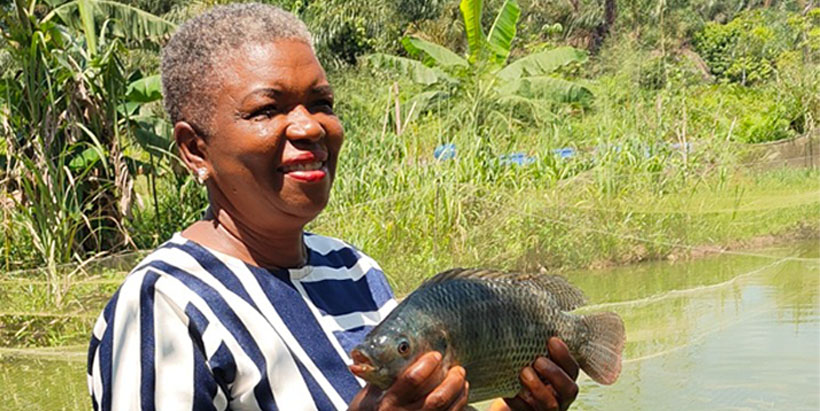
WorldFish project beneficiary, Agbor Delta State.
WorldFish project beneficiary, Asaba Delta State. (Photo credit: Olaniyi Ajibola/WorldFish).

To tackle this challenge, a team of gender researchers carried out a study to understand how gender and other social identities shape the adaptive capacity of AFS. This initiative, spearheaded by WorldFish, the International Water Management Institute, and other CGIAR centers, including IITA, aimed to explore how women and marginalized groups respond to climate risks and build resilience.

The team developed a conceptual framework to map how climate stressors interact with gender and socio-economic factors, influencing AFS outcomes. A comprehensive literature review spanning 2017 to 2022 was conducted to capture the latest insights. The research also drew from global datasets, including the Illuminating Hidden Harvests project, to analyze participation in small-scale fisheries. Bangladesh, a leading aquaculture producer, was a case study to delve deeper into how women navigate and adapt to climate challenges.

Findings showed that women are central to small-scale fisheries and aquaculture economies, yet their contributions often go unrecognized. Addressing this invisibility is essential to achieving Sustainable Development Goal 14, which calls for the conservation and sustainable use of oceans and marine resources. For sustainable progress, the focus must shift towards empowering women and fostering resilience within AFS.

The study proposed several pathways for policy, research, and intervention. First, addressing power inequalities is paramount to drive meaningful change. Women need greater decision-making power over resource allocation and income. This can be achieved by involving both women and men in initiatives that enhance food security and diversify livelihoods.

Second, the value of women’s work across the aquatic food value chain must be acknowledged and documented. Gender-sensitive approaches should be integrated into project planning, supported by sex-disaggregated data to track progress and outcomes.

Third, research must continue to investigate the intersection of gender, climate change, and small-scale fisheries, amplifying the voices of local actors and reinforcing their role in shaping solutions. This inclusive approach ensures that communities actively participate in building sustainable, equitable, and resilient AFS.

As climate change continues to reshape our world, the resilience of aquatic food systems depends on scientific innovation and social transformation. According to one of the researchers, a Senior Scientist and Gender Specialist at IITA, Steven Cole,
“By addressing gender inequalities and embracing intersectional perspectives, we pave the way for a future where AFS thrive, communities prosper, and the oceans remain a source of life for generations to come.”

Contributed by Ochuwa Favour Daramola


Contributed by

Related news

No items found

Leave a Reply

Your email address will not be published. Required fields are marked *

Scroll to Top
Olaosebikan, Olamide

Olamide Deborah Nwanze is a Senior Research Associate specializing in gender mainstreaming research to inform participatory and inclusive breeding, variety development, and seed systems policies regarding root, tuber, and banana (RTB) crops in the International Institute of Tropical Agriculture Headquarters, Ibadan, Nigeria. She is a PhD candidate at the University of Ibadan and holds an MSc and B. Agric in Agricultural Extension and Rural Development. Olamide is a fellow of the African Women in Agricultural Research and Development – Gender Responsive Agricultural Systems Policy (AWARD-GRASP) and the Gender Responsive Researchers Equipped for Agricultural Transformation (GREAT). She seeks to apply her gender-mainstreaming learnings, gender-responsive research, and policy development, and review expertise to facilitate women, youth, children, and vulnerable social group’s access to and adoption of agricultural Innovations that guarantee food, nutrition, income, and livelihood security in Africa. Her current roles include mentoring research fellows, development of guides and training manuals, implementation and adaptation of gender frameworks and tools, value chain actors’ engagement as citizen science partners, policy review and redesign, data management, and analysis. Her current research explores mixed methods and participatory and interdisciplinary approaches to capture and highlight gender dynamics, needs, preferences, and challenges stakeholders face within the agricultural livelihood value chain to prioritize gender-inclusive strategies in breeding programs, policy design, and implementation.

At IITA, she contributes to the implementation of the CGIAR Accelerated Breeding Initiative and Genetic Innovation Programs; participatory and gender research within the NextGen CassavaHarvestPlusRTBFoods, and Tricot-ClimMob 1000Farms Projects; and gender knowledge communication via the G-LENS webinar series, video documentary, policy briefspublications, and blogs.


Recent publications

de Sousa, K., van Etten, J., Manners, R. Bello, A., Teeken, B., Olaosebikan, O., et al. 2024. The tricot approach: an agile framework for decentralized on-farm testing supported by citizen science. A retrospective. Agron. Sustain. Dev. 44, 8. https://doi.org/10.1007/s13593-023-00937-1

Madu, T., Onwuka, S., Nwafor, S., Onyemauwa, N., Ejechi, M., Ofoeze, M., Ukeje, B., Eluagu, C., Olaosebikan, O., Okoye, B., 2024. Gender-Inclusive Consumer Studies Improve Cassava Breeding in Nigeria in: Frontiers in Sociology, volume 9, number: 1224504, doi: 10.3389/fsoc.2024.1224504

Olaosebikan, O.; Bello, A.; Utoblo, O.; Okoye, B.; Olutegbe, N.; Garner, E.; Teeken, B.; Bryan, E.; Forsythe, L.; Cole, S.; Madu, T. 2023.  Stressors and Resilience within the Cassava Value Chain in Nigeria: Preferred Cassava Variety Traits and Response Strategies of Men and Women to Inform Breeding. Sustainability 15, 7837. https://doi.org/10.3390/su15107837

Okoye, B., Ofoeze, M., Ejechi, M., Onwuka, S., Nwafor, S., Onyemauwa, N., Ukeje, B., Eluagu, C., Obidiegwu, J.*, Olaosebikan, O., Madu, T.* 2023. Prioritizing preferred traits in the yam value chain in Nigeria: a gender situation analysis in: Frontiers in Sociology, volume 8, number: 1232626, pages 1 – 9, ISSN 2297-7775, 2023. https://www.frontiersin.org/articles/10.3389/fsoc.2023.1232626/full

Olaosebikan, O., Bello, A. A., de Sousa, K., Ndjouenkeu, R., Adesokan, M., Alamu, E. O., Agbona, A., van Etten, J., Kegah, F. N.*, Dufour, D., Bouniol, A., Teeken, B. 2023. Consumer acceptability of cassava gari-eba food products across cultural and environmental settings using the triadic comparison of technologies approach (tricot) in: Journal of the Science of Food and Agriculture,

Teeken, B., Olaosebikan, O., Bello, A. A., Madu, T.*, Cole, S. M. 2023. Qualitative assessment on the positionality and preferences of dyads in relation to cassava-related activities: working with tricot trial citizen scientists https://hdl.handle.net/10568/138326 Type: Manual

Bouniol, A., Ceballos, H., Bello, A. A., Teeken, B., Olaosebikan, O., Owoade, D., Agbona, A., Fotso Kuate, A., Madu, T.*, Okoye, B.*, Ofoeze, M.*, Nwafor, S.*, Onyemauwa, N.*, Adinsi, L.*, Forsythe, L., Dufour, D. 2023. Varietal impact on women’s labour, workload and related drudgery in processing root, tuber and banana crops: focus on cassava in sub-Saharan Africa in: Journal of the Science of Food and Agriculture, pages 1 – 25, ISSN 0022-5142,

Bello, A. A., Agbona, A., Olaosebikan, O., Edughaen, G., Dufour, D., Bouniol, A., Iluebbey, P., Ndjouenkeu, R.*, Rabbi, I. Y., Teeken, B. 2023. Genetic and environmental effects on processing productivity and food product yield: drudgery of women’s work in: Journal of the Science of Food and Agriculture, pages 1 – 32, ISSN 0022-5142, 5

Cavicchioli, M., Zimbiti, T., Teeken, B., Nwanze, D.O., Liani, M., Parkes, E. & Bello, A. 2023. IITA-Gender Responsive Breeding Training Report. Genetic Resources Center, IITA-HQ, Ibadan, 21-23 September, 2022. Ibadan, Nigeria: IITA, (34 p.).https://hdl.handle.net/10568/131368

Agbona, A. Peteti P., Teeken B., Olaosebikan O. Bello, A. A., Parkes, E., Rabbi, I. Y., Mueller, L., Egesi, C., Kulakow, P. 2022. Data Management in Multi-disciplinary African RTB Crop Breeding Programs. In: Williamson, H.F., Leonelli, S. (eds) Towards Responsible Plant Data Linkage: Data Challenges for Agricultural Research and Development. Springer, Cham. https://doi.org/10.1007/978-3-031-13276-6_5

Lora Forsythe, Pricilla Marimo, Sarah Mayanja, Olamide D. Olaosebikan, Esme Stuart, Bela Teeken, Benjamin Okoye, Tessy Madu, (2021). Cross-product Gender Analysis of RTBfoods Step 2 Gendered Food Mapping on RTB Products. Understanding the Drivers of Trait Preferences and the Development of Multi-user RTB Product Profiles, WP1. London, UK: RTBfoods Field Scientific Report, 30 p.

Teeken, B., Garner, E., Agbona, A., Balogun, I., Olaosebikan, O., Bello, A., Madu, T., Okoye, B., Egesi, C., Kulakow, P. and Tufan, H.A. 2021. Beyond “Women’s Traits”: Exploring How Gender, Social Difference, and Household Characteristics Influence Trait Preferences. Frontiers Sustainable Food Systems 5:740926. https://doi.org/10.3389/fsufs.2021.740926

Teeken, B., Agbona, A., Bello, A., Olaosebikan, O., Alamu, E., Adesokan, M., Awoyale, W., Madu, T., Okoye, B., Chijioke, U., Owoade, D., Okoro, M., Bouniol, A., Dufour, D., Hershey, C., Rabbi, I., Maziya‐Dixon, B., Egesi, C., Tufan, H. and Kulakow, P. (020. Understanding cassava varietal preferences through pairwise ranking of gari‐eba and fufu prepared by local farmer–processors. Int J Food Sci Technol. https://doi.org/10.1111/ijfs.14862

Bela Teeken, Olamide Olaosebikan, Ireti Balogun, Benjamin Okoye, Tessy Madu, Steven Cole, Abolore Bello, Elizabeth Parkes. (2020). Piloting the G+ customer and product profile tools for gender-responsive cassava breeding in Nigeria. Nigeria: International Institute of Tropical Agriculture (IITA). https://hdl.handle.net/20.500.11766/13000