
Kicking off the IITA Knowledge Café series for 2025, Shakiru Quadri, the IITA Technical Advisor for the CGIAR Fragility, Conflict and Migration (FCM) Initiative, delivered an insightful presentation on his research work. The discussion, which was held on 22 January and coordinated by IITA Director for Sahel Africa Hub Tahirou Abdoulaye, focused on the impact of climate change on household food security in the semi-arid regions of Nigeria.
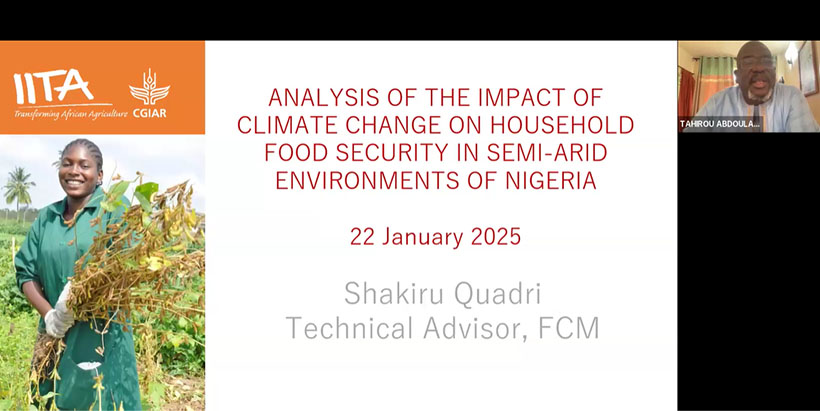
Quadri mentioned that the study was inspired by his research team’s experience working in fragile and conflict-affected areas of Nigeria. These regions are uniquely vulnerable to climate change due to their reliance on natural systems and resources critical for survival in dryland environments. He added that climate change has become a pressing issue globally, significantly affecting agriculture and food security. This reality spurred researchers to investigate the implications for communities in northern Nigeria.
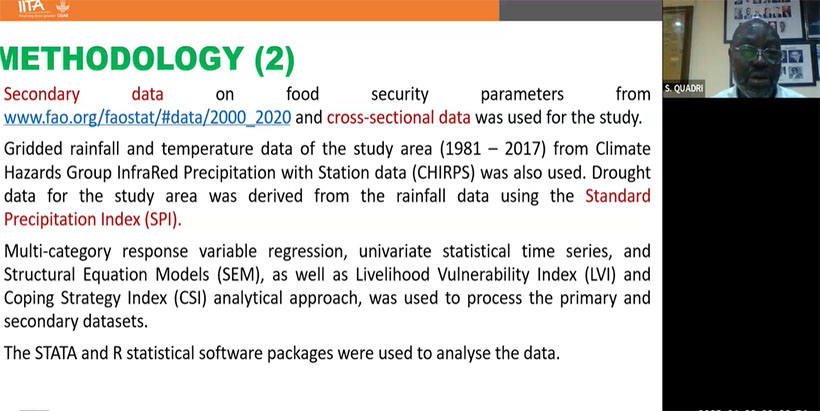
Conducted in the semi-arid eco-climatic zone, where recurrent droughts and conflicts are common, the study analyzed data from 626 respondents across three states: Borno, Katsina, and Sokoto. Using secondary data from the Food and Agriculture Organization (FAO) alongside cross-sectional data, the team employed multi-stage sampling techniques and specified several linear and non-linear models to analyze the trends.
The study showed that food security across the three states is highly vulnerable to climate variability, with a statistically significant impact at the 1% level. Forecasts for five years (up to 2025) shows a continued decline in food availability. A combined normalized livelihood exposure index of 0.79 indicates a high level of exposure to climate risks, while the adaptive capacity remains moderate at 0.35. The data revealed a 51% reduction in household food availability due to conflicts. Also, variables such as rainfall, drought, temperature, and conflict were found to significantly affect food security at both 1% and 5% significance levels.
The study concluded that climate variability and extreme weather events, compounded by disruptions from the COVID-19 pandemic, rising fertilizer and fuel costs, widespread banditry, and insurgency, have significantly destabilized the region’s food systems. The likelihood of a major food system shock remained high through 2024.
The study has proposed several solutions to address these challenges, including promoting drought- and flood-tolerant crop varieties, adopting climate-smart and precision farming practices, and expanding agricultural innovation. The suggested solutions were also to invest in functional irrigation systems, routinely desilting rivers and streams, and strengthening social safety nets.
Developing sustainable, climate-adaptive food systems that minimize environmental damage and promote long-term resilience were also suggested solutions.
Quadri emphasized the urgent need for coordinated efforts to protect vulnerable communities and build sustainable systems capable of withstanding future climate challenges. “There is a need for collective action to secure food systems for the 21st century and beyond,” he concluded.
Contributed by Ochuwa Favour Daramola
Contributed by
Recent stories