
IITA NEWS

Harnessing Cowpea and Bambara Groundnut for a resilient future
February 10, 2025

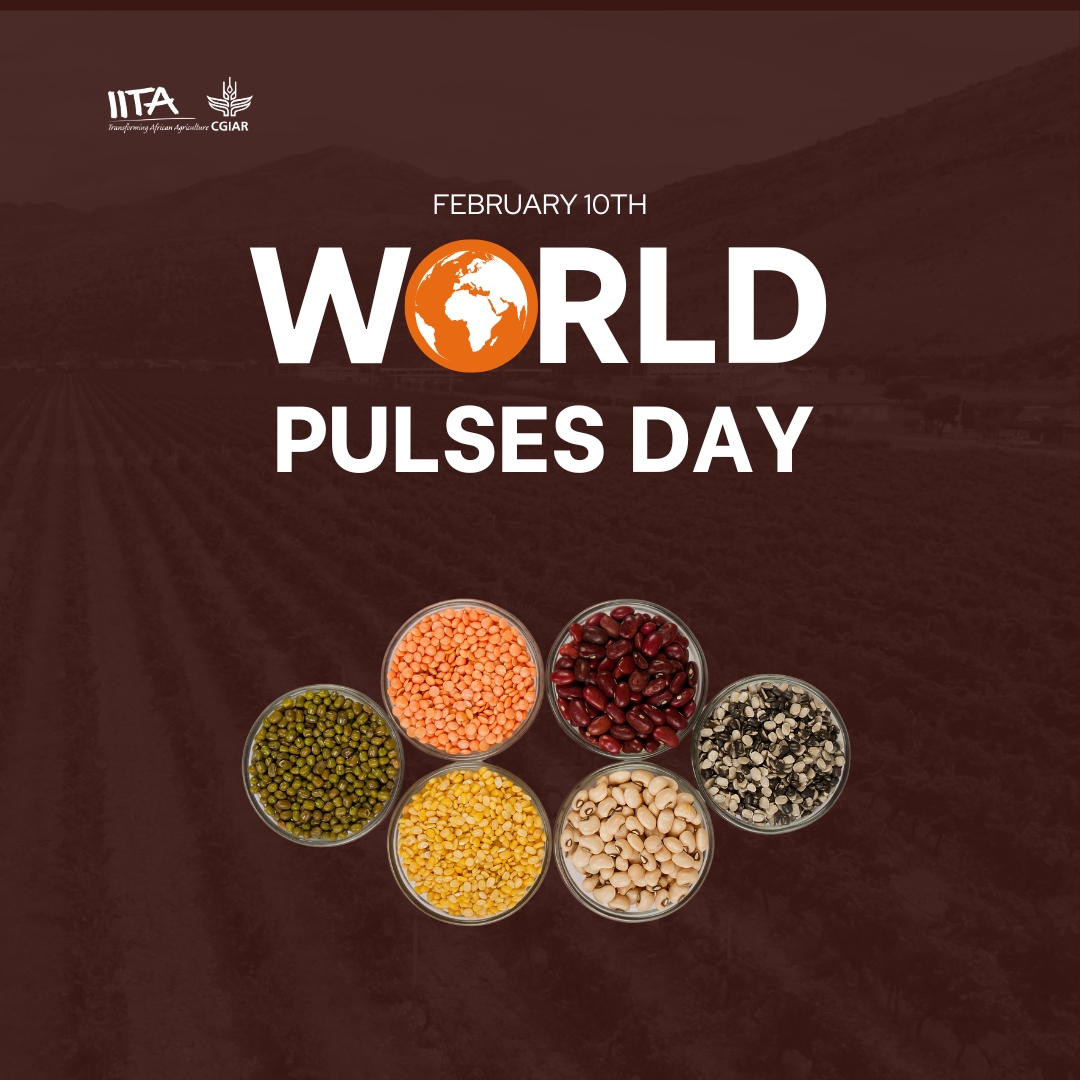
World Pulses Day e-card design

Growing up in Kenya, I looked forward to the occasions—once or twice a month—when meat was part of our meal and disliked the numerous days that we ate pulses—edible seeds of plants in the legume family. After I became a nutritionist and learned more about their nourishing value, I stopped seeing them as a boring dish and now regularly serve pulses to my family as a snack or in stews, sauces, or coconut milk.

Today, many Africans still underappreciate pulses as I did. World Pulses Day on February 10 is a chance for everyone to learn of their immense value—not just as nutritious seeds but as catalysts for transforming agrifood systems. Two climate-smart crops, Cowpea and Bambara groundnut, particularly deserve attention for their untapped potential.

Cowpea and Bambara groundnut are more than staple food crops; they could be lifelines for millions across sub-Saharan Africa. Cowpea, often referred to as “the poor man’s meat,” is renowned for its rich protein content and its ability to thrive in drought-prone areas. This makes it a critical food source for communities grappling with climate variability. Recent advances showcased at the 7th World Cowpea Research Conference in September 2024 highlight climate-resilient cowpea varieties with higher yields and improved nutritional profiles. These innovations provide smallholder farmers with a dependable crop, growing even in harsh environmental conditions, bolstering food security and economic resilience.

Bambara groundnut, on the other hand, is often called “the complete food” due to its nutrient density and resilience. It thrives in marginal soils where other crops fail, offering hope for combating food insecurity. At the International Institute of Tropical Agriculture (IITA) where I work, ongoing research is uncovering innovative ways to integrate Bambara groundnut into diverse farming systems across Africa. This pulse not only improves nutrition but also enhances household incomes and agricultural sustainability. Its dual role as a nutrient-dense food and an adaptable crop underscores its potential as a game-changer in the fight against hunger and malnutrition.

Pulses like Cowpea and Bambara groundnut are critical because they are uniquely positioned to counter the adverse effects of climate change. Their natural drought tolerance ensures consistent food production in arid and semi-arid regions. This resilience is crucial for communities, particularly in West Africa, which rely on these stable food sources amid increasingly unpredictable weather patterns. Additionally, pulses play a vital role in improving soil health. Through nitrogen fixation, they enrich soil fertility, reducing dependency on synthetic fertilizers and promoting sustainable agriculture. Moreover, compared to crops like rice and wheat, pulses are better for the environment as produce lower greenhouse gas emissions, helping to reduce pollution and climate change.

Despite their immense potential, Cowpea and Bambara groundnut remain underutilized due to limited private-sector investment and low consumer awareness. Bridging this gap requires strategic interventions to promote these crops as staples in both local and global markets. For instance, more private-sector investment in the value chains of Cowpea and Bambara groundnut can look at how investors led to quinoa’s integration into the mainstream and niche markets through innovative products such as fortified flours, snacks, healthy foods, and ready-to-eat meals.

Consumer awareness among the younger generation in Africa is another critical area of focus. They did not grow up eating pulses since meat is relatively more affordable. Public campaigns highlighting the nutritional and environmental benefits of pulses can transform perceptions and encourage widespread adoption. Educating communities about the versatility and health benefits of these crops can make them everyday staples, fostering healthier diets and sustainable consumption patterns. For smallholder farmers, government support must extend beyond awareness. Providing access to improved seed varieties, technical training, and market linkages is essential for empowering farmers to scale their operations sustainably. This holistic approach ensures that farmers maximize their benefits while contributing to the resilience of food systems.

The theme of this year’s World Pulses Day, “Pulses: Bringing Diversity to Agrifood Systems,” underscores the transformative power of crops like Cowpea and Bambara groundnut in building resilient food systems. However, realizing their full potential requires concerted efforts from all stakeholders, including governments, development agencies, and philanthropic organizations. Robust investment in research by entities like CGIAR through its research centers and in partnership with National Agricultural Research Systems (NARS), infrastructure improvements, and market development is critical to unlocking their value and ensuring they reach the communities that need them the most.

On this World Pulses Day, let us pledge to champion Cowpea and Bambara groundnut—not just as crops but as instruments of change. Together, we can make these pulses household names in Africa and vital contributors to food security, nutrition, and environmental sustainability.

Contributed by Mercy Lung’aho
Program Lead for Food Security, Nutrition and Health


Contributed by

Recent stories

No items found

Leave a Reply

Your email address will not be published. Required fields are marked *

Scroll to Top
Olaosebikan, Olamide

Olamide Deborah Nwanze is a Senior Research Associate specializing in gender mainstreaming research to inform participatory and inclusive breeding, variety development, and seed systems policies regarding root, tuber, and banana (RTB) crops in the International Institute of Tropical Agriculture Headquarters, Ibadan, Nigeria. She is a PhD candidate at the University of Ibadan and holds an MSc and B. Agric in Agricultural Extension and Rural Development. Olamide is a fellow of the African Women in Agricultural Research and Development – Gender Responsive Agricultural Systems Policy (AWARD-GRASP) and the Gender Responsive Researchers Equipped for Agricultural Transformation (GREAT). She seeks to apply her gender-mainstreaming learnings, gender-responsive research, and policy development, and review expertise to facilitate women, youth, children, and vulnerable social group’s access to and adoption of agricultural Innovations that guarantee food, nutrition, income, and livelihood security in Africa. Her current roles include mentoring research fellows, development of guides and training manuals, implementation and adaptation of gender frameworks and tools, value chain actors’ engagement as citizen science partners, policy review and redesign, data management, and analysis. Her current research explores mixed methods and participatory and interdisciplinary approaches to capture and highlight gender dynamics, needs, preferences, and challenges stakeholders face within the agricultural livelihood value chain to prioritize gender-inclusive strategies in breeding programs, policy design, and implementation.

At IITA, she contributes to the implementation of the CGIAR Accelerated Breeding Initiative and Genetic Innovation Programs; participatory and gender research within the NextGen CassavaHarvestPlusRTBFoods, and Tricot-ClimMob 1000Farms Projects; and gender knowledge communication via the G-LENS webinar series, video documentary, policy briefspublications, and blogs.


Recent publications

de Sousa, K., van Etten, J., Manners, R. Bello, A., Teeken, B., Olaosebikan, O., et al. 2024. The tricot approach: an agile framework for decentralized on-farm testing supported by citizen science. A retrospective. Agron. Sustain. Dev. 44, 8. https://doi.org/10.1007/s13593-023-00937-1

Madu, T., Onwuka, S., Nwafor, S., Onyemauwa, N., Ejechi, M., Ofoeze, M., Ukeje, B., Eluagu, C., Olaosebikan, O., Okoye, B., 2024. Gender-Inclusive Consumer Studies Improve Cassava Breeding in Nigeria in: Frontiers in Sociology, volume 9, number: 1224504, doi: 10.3389/fsoc.2024.1224504

Olaosebikan, O.; Bello, A.; Utoblo, O.; Okoye, B.; Olutegbe, N.; Garner, E.; Teeken, B.; Bryan, E.; Forsythe, L.; Cole, S.; Madu, T. 2023.  Stressors and Resilience within the Cassava Value Chain in Nigeria: Preferred Cassava Variety Traits and Response Strategies of Men and Women to Inform Breeding. Sustainability 15, 7837. https://doi.org/10.3390/su15107837

Okoye, B., Ofoeze, M., Ejechi, M., Onwuka, S., Nwafor, S., Onyemauwa, N., Ukeje, B., Eluagu, C., Obidiegwu, J.*, Olaosebikan, O., Madu, T.* 2023. Prioritizing preferred traits in the yam value chain in Nigeria: a gender situation analysis in: Frontiers in Sociology, volume 8, number: 1232626, pages 1 – 9, ISSN 2297-7775, 2023. https://www.frontiersin.org/articles/10.3389/fsoc.2023.1232626/full

Olaosebikan, O., Bello, A. A., de Sousa, K., Ndjouenkeu, R., Adesokan, M., Alamu, E. O., Agbona, A., van Etten, J., Kegah, F. N.*, Dufour, D., Bouniol, A., Teeken, B. 2023. Consumer acceptability of cassava gari-eba food products across cultural and environmental settings using the triadic comparison of technologies approach (tricot) in: Journal of the Science of Food and Agriculture,

Teeken, B., Olaosebikan, O., Bello, A. A., Madu, T.*, Cole, S. M. 2023. Qualitative assessment on the positionality and preferences of dyads in relation to cassava-related activities: working with tricot trial citizen scientists https://hdl.handle.net/10568/138326 Type: Manual

Bouniol, A., Ceballos, H., Bello, A. A., Teeken, B., Olaosebikan, O., Owoade, D., Agbona, A., Fotso Kuate, A., Madu, T.*, Okoye, B.*, Ofoeze, M.*, Nwafor, S.*, Onyemauwa, N.*, Adinsi, L.*, Forsythe, L., Dufour, D. 2023. Varietal impact on women’s labour, workload and related drudgery in processing root, tuber and banana crops: focus on cassava in sub-Saharan Africa in: Journal of the Science of Food and Agriculture, pages 1 – 25, ISSN 0022-5142,

Bello, A. A., Agbona, A., Olaosebikan, O., Edughaen, G., Dufour, D., Bouniol, A., Iluebbey, P., Ndjouenkeu, R.*, Rabbi, I. Y., Teeken, B. 2023. Genetic and environmental effects on processing productivity and food product yield: drudgery of women’s work in: Journal of the Science of Food and Agriculture, pages 1 – 32, ISSN 0022-5142, 5

Cavicchioli, M., Zimbiti, T., Teeken, B., Nwanze, D.O., Liani, M., Parkes, E. & Bello, A. 2023. IITA-Gender Responsive Breeding Training Report. Genetic Resources Center, IITA-HQ, Ibadan, 21-23 September, 2022. Ibadan, Nigeria: IITA, (34 p.).https://hdl.handle.net/10568/131368

Agbona, A. Peteti P., Teeken B., Olaosebikan O. Bello, A. A., Parkes, E., Rabbi, I. Y., Mueller, L., Egesi, C., Kulakow, P. 2022. Data Management in Multi-disciplinary African RTB Crop Breeding Programs. In: Williamson, H.F., Leonelli, S. (eds) Towards Responsible Plant Data Linkage: Data Challenges for Agricultural Research and Development. Springer, Cham. https://doi.org/10.1007/978-3-031-13276-6_5

Lora Forsythe, Pricilla Marimo, Sarah Mayanja, Olamide D. Olaosebikan, Esme Stuart, Bela Teeken, Benjamin Okoye, Tessy Madu, (2021). Cross-product Gender Analysis of RTBfoods Step 2 Gendered Food Mapping on RTB Products. Understanding the Drivers of Trait Preferences and the Development of Multi-user RTB Product Profiles, WP1. London, UK: RTBfoods Field Scientific Report, 30 p.

Teeken, B., Garner, E., Agbona, A., Balogun, I., Olaosebikan, O., Bello, A., Madu, T., Okoye, B., Egesi, C., Kulakow, P. and Tufan, H.A. 2021. Beyond “Women’s Traits”: Exploring How Gender, Social Difference, and Household Characteristics Influence Trait Preferences. Frontiers Sustainable Food Systems 5:740926. https://doi.org/10.3389/fsufs.2021.740926

Teeken, B., Agbona, A., Bello, A., Olaosebikan, O., Alamu, E., Adesokan, M., Awoyale, W., Madu, T., Okoye, B., Chijioke, U., Owoade, D., Okoro, M., Bouniol, A., Dufour, D., Hershey, C., Rabbi, I., Maziya‐Dixon, B., Egesi, C., Tufan, H. and Kulakow, P. (020. Understanding cassava varietal preferences through pairwise ranking of gari‐eba and fufu prepared by local farmer–processors. Int J Food Sci Technol. https://doi.org/10.1111/ijfs.14862

Bela Teeken, Olamide Olaosebikan, Ireti Balogun, Benjamin Okoye, Tessy Madu, Steven Cole, Abolore Bello, Elizabeth Parkes. (2020). Piloting the G+ customer and product profile tools for gender-responsive cassava breeding in Nigeria. Nigeria: International Institute of Tropical Agriculture (IITA). https://hdl.handle.net/20.500.11766/13000