
NEWS

IITA drives regional agricultural transformation at Africa Business Forum
March 7, 2025

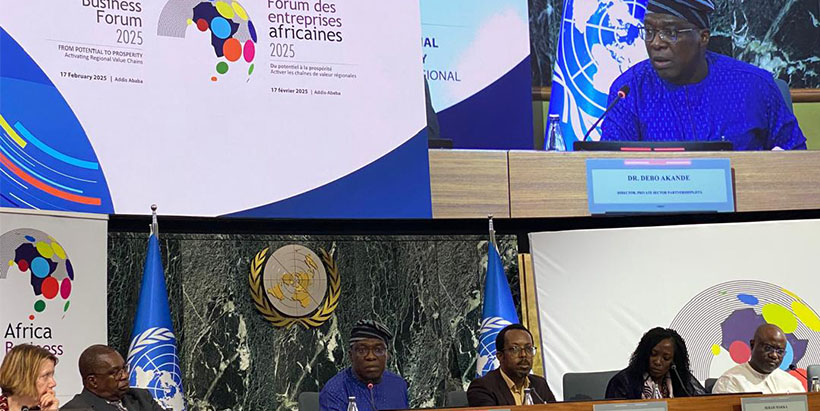
Dr Akande speaking about IITA’s Technology for African Agricultural Transformation (TAAT) program and BIP’s scaling models during the Roundtable Two.

At the recently concluded Africa Business Forum (ABF) 2025 in Addis Ababa, Ethiopia, IITACGIAR Director of Private Sector Partnerships, Dr Debo Akande, led an IITA delegation at the high-profile event hosted by the United Nations Economic Commission for Africa (UNECA). Centered around the theme, “From Potential to Prosperity: Activating Africa’s Regional Value Chains,” the forum brought together key stakeholders to drive discussions on sustainable industrialization, development of regional value chains, and food security across the continent.

Over 200 participants with several honoraries, including Heads of State, H.E. President Taye Atske Selassie of Ethiopia, H.E. President Duma Gideon Boko of Botswana, and H.E. President John Dramani Mahama of Ghana, attended the Forum.

Other notable attendees included the Chairperson of the United Nations General Assembly, Philemon Yang, Director General of the World Trade Organization (WTO), Dr Ngozi Okonjo-Iweala, Secretary General of the AU African Continental Free Trade Area (AfCFTA), Wamkele Mena, and two subnational governmental range of dignitaries from the international finance community, development banks, and the business world.
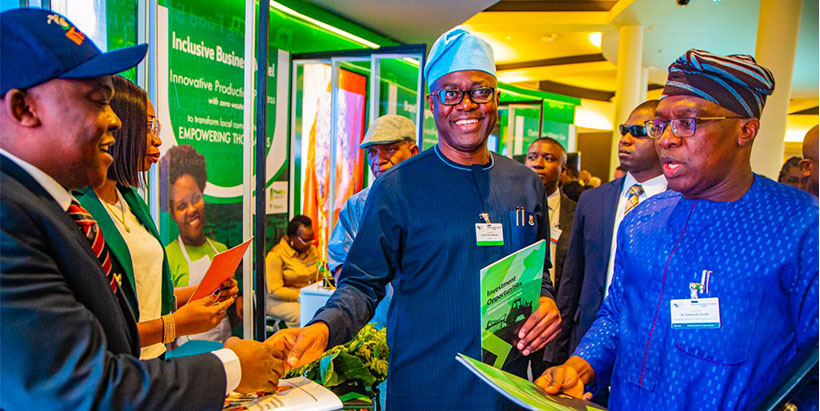
Oyo State Governor, H.E. Engineer Seyi Makinde with IITA Director of Private Sector Partnerships, Dr Debo Akande at the IITA Exhibition booth.

A presidential dialogue with Presidents of Botswana and Ghana followed the opening ceremony. They emphasized the critical role of pan-African cooperation in activating regional value chains. Additionally, panel sessions focused on solutions for financing, trade facilitation, and technological innovation.

Speaking during Roundtable Two, moderated by Zuzana Schwidrowski of UNECA, Dr Akande highlighted the impact of IITA’s Technology for African Agricultural Transformation (TAAT) program and IITA Business Incubation Platform (IITA-BIP) scaling models, adding that these initiatives aim to deliver productivity-enhancing technologies to farmers, aligning African agricultural industries with global standards.

IITA’s exhibition booth attracted high-profile visitors, including the President of Ethiopia, the Governor of Oyo State, representatives from UNECA, Israel’s Ministry of Foreign Affairs, and other international organizations.

During the exhibition, TAAT Private Sector Engagement Officer, Geoffrey Nsofon Guemuh, and IITA Agribusiness Development Manager, Gift Peter engaged with partners from African Canadian Business Chamber, International Trade Centre, UNESCO, and Quanomic, exploring future collaborative areas.
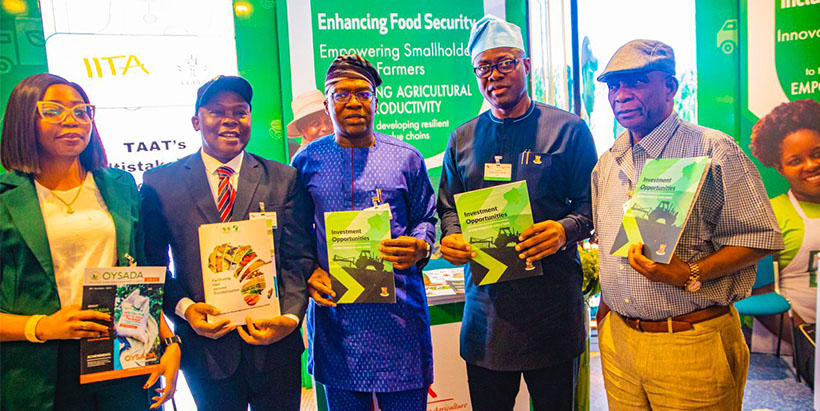
The IITA team with Oyo State Governor, H.E. Engineer Seyi Makinde and IITA Director of Private Sector Partnerships, Dr Debo Akande during the Africa Business Forum (ABF) 2025 in Addis Ababa, Ethiopia.

In his remark, Claver Gatete, UNECA’s Under-Secretary-General and Executive Secretary, stressed the need to accelerate the implementation of the African Continental Free Trade Area (AfCFTA) to strengthen regional value chains, particularly in the pharmaceuticals and agriculture industries. He said reduced trade costs, improved infrastructure, and investment in value-added production are essential steps toward a competitive Africa.

Gatete urged African governments and businesses to reshape global perceptions by demonstrating the quality and competitiveness of African products. The Forum concluded with a collective commitment to regional integration, value chain development, and industrialization, positioning AfCFTA and strategic partnerships as catalysts for Africa’s economic transformation.

With several potential partnerships in view – the Israel Ministry of Foreign Affairs, the African Canadian Business Chamber, the International Trade Centre, UNESCO, the Pan African Chamber of Commerce and Industry, and UNECA, future collaborations will enhance the activities of TAAT and BIP, expanding their reach and impact.

IITA’s engagement at ABF 2025 emphasizes dedication to advancing agricultural innovation, strengthening public-private partnerships, and supporting Africa’s regional value chains for long-term growth and food security.

Contributed by Gift Peter and Debo Akande


Contributed by

Recent stories

No items found

Leave a Reply

Your email address will not be published. Required fields are marked *

Scroll to Top
Olaosebikan, Olamide

Olamide Deborah Nwanze is a Senior Research Associate specializing in gender mainstreaming research to inform participatory and inclusive breeding, variety development, and seed systems policies regarding root, tuber, and banana (RTB) crops in the International Institute of Tropical Agriculture Headquarters, Ibadan, Nigeria. She is a PhD candidate at the University of Ibadan and holds an MSc and B. Agric in Agricultural Extension and Rural Development. Olamide is a fellow of the African Women in Agricultural Research and Development – Gender Responsive Agricultural Systems Policy (AWARD-GRASP) and the Gender Responsive Researchers Equipped for Agricultural Transformation (GREAT). She seeks to apply her gender-mainstreaming learnings, gender-responsive research, and policy development, and review expertise to facilitate women, youth, children, and vulnerable social group’s access to and adoption of agricultural Innovations that guarantee food, nutrition, income, and livelihood security in Africa. Her current roles include mentoring research fellows, development of guides and training manuals, implementation and adaptation of gender frameworks and tools, value chain actors’ engagement as citizen science partners, policy review and redesign, data management, and analysis. Her current research explores mixed methods and participatory and interdisciplinary approaches to capture and highlight gender dynamics, needs, preferences, and challenges stakeholders face within the agricultural livelihood value chain to prioritize gender-inclusive strategies in breeding programs, policy design, and implementation.

At IITA, she contributes to the implementation of the CGIAR Accelerated Breeding Initiative and Genetic Innovation Programs; participatory and gender research within the NextGen CassavaHarvestPlusRTBFoods, and Tricot-ClimMob 1000Farms Projects; and gender knowledge communication via the G-LENS webinar series, video documentary, policy briefspublications, and blogs.


Recent publications

de Sousa, K., van Etten, J., Manners, R. Bello, A., Teeken, B., Olaosebikan, O., et al. 2024. The tricot approach: an agile framework for decentralized on-farm testing supported by citizen science. A retrospective. Agron. Sustain. Dev. 44, 8. https://doi.org/10.1007/s13593-023-00937-1

Madu, T., Onwuka, S., Nwafor, S., Onyemauwa, N., Ejechi, M., Ofoeze, M., Ukeje, B., Eluagu, C., Olaosebikan, O., Okoye, B., 2024. Gender-Inclusive Consumer Studies Improve Cassava Breeding in Nigeria in: Frontiers in Sociology, volume 9, number: 1224504, doi: 10.3389/fsoc.2024.1224504

Olaosebikan, O.; Bello, A.; Utoblo, O.; Okoye, B.; Olutegbe, N.; Garner, E.; Teeken, B.; Bryan, E.; Forsythe, L.; Cole, S.; Madu, T. 2023.  Stressors and Resilience within the Cassava Value Chain in Nigeria: Preferred Cassava Variety Traits and Response Strategies of Men and Women to Inform Breeding. Sustainability 15, 7837. https://doi.org/10.3390/su15107837

Okoye, B., Ofoeze, M., Ejechi, M., Onwuka, S., Nwafor, S., Onyemauwa, N., Ukeje, B., Eluagu, C., Obidiegwu, J.*, Olaosebikan, O., Madu, T.* 2023. Prioritizing preferred traits in the yam value chain in Nigeria: a gender situation analysis in: Frontiers in Sociology, volume 8, number: 1232626, pages 1 – 9, ISSN 2297-7775, 2023. https://www.frontiersin.org/articles/10.3389/fsoc.2023.1232626/full

Olaosebikan, O., Bello, A. A., de Sousa, K., Ndjouenkeu, R., Adesokan, M., Alamu, E. O., Agbona, A., van Etten, J., Kegah, F. N.*, Dufour, D., Bouniol, A., Teeken, B. 2023. Consumer acceptability of cassava gari-eba food products across cultural and environmental settings using the triadic comparison of technologies approach (tricot) in: Journal of the Science of Food and Agriculture,

Teeken, B., Olaosebikan, O., Bello, A. A., Madu, T.*, Cole, S. M. 2023. Qualitative assessment on the positionality and preferences of dyads in relation to cassava-related activities: working with tricot trial citizen scientists https://hdl.handle.net/10568/138326 Type: Manual

Bouniol, A., Ceballos, H., Bello, A. A., Teeken, B., Olaosebikan, O., Owoade, D., Agbona, A., Fotso Kuate, A., Madu, T.*, Okoye, B.*, Ofoeze, M.*, Nwafor, S.*, Onyemauwa, N.*, Adinsi, L.*, Forsythe, L., Dufour, D. 2023. Varietal impact on women’s labour, workload and related drudgery in processing root, tuber and banana crops: focus on cassava in sub-Saharan Africa in: Journal of the Science of Food and Agriculture, pages 1 – 25, ISSN 0022-5142,

Bello, A. A., Agbona, A., Olaosebikan, O., Edughaen, G., Dufour, D., Bouniol, A., Iluebbey, P., Ndjouenkeu, R.*, Rabbi, I. Y., Teeken, B. 2023. Genetic and environmental effects on processing productivity and food product yield: drudgery of women’s work in: Journal of the Science of Food and Agriculture, pages 1 – 32, ISSN 0022-5142, 5

Cavicchioli, M., Zimbiti, T., Teeken, B., Nwanze, D.O., Liani, M., Parkes, E. & Bello, A. 2023. IITA-Gender Responsive Breeding Training Report. Genetic Resources Center, IITA-HQ, Ibadan, 21-23 September, 2022. Ibadan, Nigeria: IITA, (34 p.).https://hdl.handle.net/10568/131368

Agbona, A. Peteti P., Teeken B., Olaosebikan O. Bello, A. A., Parkes, E., Rabbi, I. Y., Mueller, L., Egesi, C., Kulakow, P. 2022. Data Management in Multi-disciplinary African RTB Crop Breeding Programs. In: Williamson, H.F., Leonelli, S. (eds) Towards Responsible Plant Data Linkage: Data Challenges for Agricultural Research and Development. Springer, Cham. https://doi.org/10.1007/978-3-031-13276-6_5

Lora Forsythe, Pricilla Marimo, Sarah Mayanja, Olamide D. Olaosebikan, Esme Stuart, Bela Teeken, Benjamin Okoye, Tessy Madu, (2021). Cross-product Gender Analysis of RTBfoods Step 2 Gendered Food Mapping on RTB Products. Understanding the Drivers of Trait Preferences and the Development of Multi-user RTB Product Profiles, WP1. London, UK: RTBfoods Field Scientific Report, 30 p.

Teeken, B., Garner, E., Agbona, A., Balogun, I., Olaosebikan, O., Bello, A., Madu, T., Okoye, B., Egesi, C., Kulakow, P. and Tufan, H.A. 2021. Beyond “Women’s Traits”: Exploring How Gender, Social Difference, and Household Characteristics Influence Trait Preferences. Frontiers Sustainable Food Systems 5:740926. https://doi.org/10.3389/fsufs.2021.740926

Teeken, B., Agbona, A., Bello, A., Olaosebikan, O., Alamu, E., Adesokan, M., Awoyale, W., Madu, T., Okoye, B., Chijioke, U., Owoade, D., Okoro, M., Bouniol, A., Dufour, D., Hershey, C., Rabbi, I., Maziya‐Dixon, B., Egesi, C., Tufan, H. and Kulakow, P. (020. Understanding cassava varietal preferences through pairwise ranking of gari‐eba and fufu prepared by local farmer–processors. Int J Food Sci Technol. https://doi.org/10.1111/ijfs.14862

Bela Teeken, Olamide Olaosebikan, Ireti Balogun, Benjamin Okoye, Tessy Madu, Steven Cole, Abolore Bello, Elizabeth Parkes. (2020). Piloting the G+ customer and product profile tools for gender-responsive cassava breeding in Nigeria. Nigeria: International Institute of Tropical Agriculture (IITA). https://hdl.handle.net/20.500.11766/13000