
IITA NEWS

Unlocking the future of hybrid maize seed production: Rwandan seed companies visit IITA maize breeding research and Nigerian seed companies
April 14, 2025

A group of production managers from Rwandan seed companies recently embarked on a transformative journey to Nigeria, seeking to revolutionize seed production in their home country. With the pressing need for high-quality, climate-resilient maize seeds, IITACGIAR, in collaboration with Rwanda Agriculture and Animal Resource Board (RAB) and the National Seed Consortium, facilitated an immersive training program to bridge the gap between research outputs and their application by stakeholders.
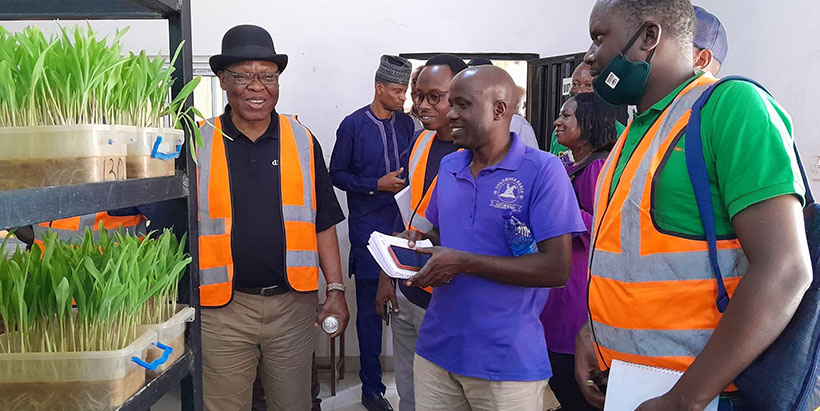
Trainees are observing the performance of maize seed during the germination test at Premier Seed, in Zaria, Kaduna State.

This program aimed to provide valuable insights into hybrid maize development and seed production, equipping participants with the expertise needed to improve seed production efforts in Rwanda.

Over a two-week period, from 24 February to 9 March 2025, participants gained practical experience in advanced seed production techniques at the IITA breeding unit in Ibadan, ensuring that Rwandan farmers will soon benefit from the availability of hybrid maize seed with improved quality.

The IITA maize breeders, Dr Menkir Abebe, Dr Sam Ajala, and Benjamin O. Olumide, hosted the team and shared their technical expertise with them. Through theoretical and hands-on training, they learned about the purification and maintenance of parent lines. Additionally, they were exposed to different processes involved in evaluating the performance of hybrid maize seeds under different biotic and abiotic stress conditions, such as fall armyworm and drought, before subjecting them to regional and international trials.

The team also had the opportunity to visit two large-scale maize seed companies, Premier Seed Ltd and Value Seed Ltd, in Kaduna state and exchanged best practices and experiences in seed production. These visits provided firsthand exposure to large-scale seed production processes, where participants learned about market-driven seed production, innovation in breeding programs, and robust quality control measures.
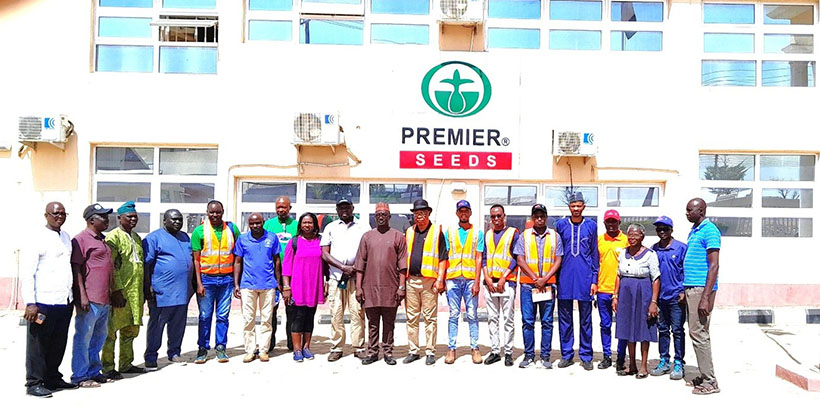
The team visited Premier Seeds Ltd, in Kaduna, - Nigeria, to have a practical experience on the maize seed production by a private company.
The team visited Premier Seeds Ltd, in Kaduna, – Nigeria, to have a practical experience on the maize seed production by a private company.

One of the participants, Tumusifu Dieudonne from Top Quality Seed Production Ltd, said, “The knowledge and skills we have gained during this training will undoubtedly transform our approach to seed production. I particularly appreciated the hands-on training, where we witnessed and practiced the work done by breeders in variety development. These practical experiences have turned theoretical concepts into real-world expertise.”

While on the field visits, the Rwandan team learned about aligning maize seed development with farmers’ demand for quality seed under diverse climatic conditions. Premier Seeds, established in 1984, has released 17 hybrid maize varieties with yields of up to 9 tons per hectare, emphasizing research-backed production. Meanwhile, Value Seeds collaborates with other companies to enhance industry-wide efficiency, demonstrating the power of strategic partnerships in the seed sector. They have released seven maize varieties so far in partnership with research organizations, including IITA.

Jean Bosco Kanakuze, from IABM seed cooperative, emphasized the importance of the Standard Operating Procedures (SOPs) in all processes involved in maize seed production.

“We covered the importance of SOPs in ensuring quality control, increasing productivity, and mitigating risks. Developing structured procedures will help us maintain consistency and improve seed production efficiency in Rwanda.”
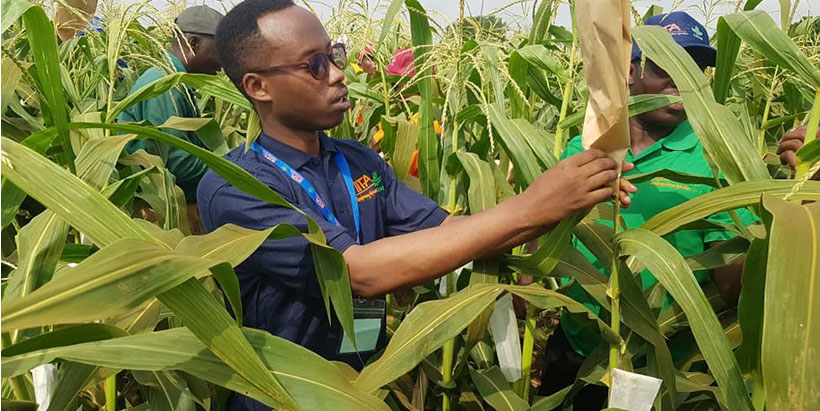
Rwahamira in the photo Collecting pollen in a pollination bag before transferring it to silks of the ear for controlled pollination.

Beyond production techniques, the participants explored breeding objectives focused on developing high-yielding maize germplasm with resistance to pests, diseases, and climate stressors. Emmy Rwahamira, a participant, also shared his experience.

“We explored strategies to develop maize germplasm with high yield, resistance to biotic and abiotic stresses, and improved nutrient use. Understanding diverse crossing methods and critical hybrid development stages was particularly enlightening.”

The training also included exposure to pest management strategies, such as visiting a Fall Armyworm rearing facility where researchers demonstrated controlled infestation and pest resistance testing techniques.

As the Rwandan delegation returns home, they are committed to applying the knowledge and skills acquired to enhance local maize seed production. The training emphasized the importance of collaboration with national and international research organizations, such as IITA and RAB, in exchanging materials (e.g., germplasm) and expertise for the benefit of smallholder farmers.

“This training is not the conclusion but the beginning of a long-term collaboration. We look forward to continued technical support, participation in research trials, and contributing to Rwanda’s seed industry’s growth,” said Tumusifu.

The insights gained from Nigeria’s advanced seed production systems will significantly contribute to Rwanda’s agricultural transformation. They will ensure farmers have access to high-quality, climate-resilient maize seeds to boost productivity and food security.

This training program is part of a wider IITA intervention to improve the quality of hybrid maize produced in the country. Other capacity-building interventions are scheduled for more seed companies and staff from RAB and RICA.


Contributed by

Ritha Bumwe

Related news

No items found
Scroll to Top
Olaosebikan, Olamide

Olamide Deborah Nwanze is a Senior Research Associate specializing in gender mainstreaming research to inform participatory and inclusive breeding, variety development, and seed systems policies regarding root, tuber, and banana (RTB) crops in the International Institute of Tropical Agriculture Headquarters, Ibadan, Nigeria. She is a PhD candidate at the University of Ibadan and holds an MSc and B. Agric in Agricultural Extension and Rural Development. Olamide is a fellow of the African Women in Agricultural Research and Development – Gender Responsive Agricultural Systems Policy (AWARD-GRASP) and the Gender Responsive Researchers Equipped for Agricultural Transformation (GREAT). She seeks to apply her gender-mainstreaming learnings, gender-responsive research, and policy development, and review expertise to facilitate women, youth, children, and vulnerable social group’s access to and adoption of agricultural Innovations that guarantee food, nutrition, income, and livelihood security in Africa. Her current roles include mentoring research fellows, development of guides and training manuals, implementation and adaptation of gender frameworks and tools, value chain actors’ engagement as citizen science partners, policy review and redesign, data management, and analysis. Her current research explores mixed methods and participatory and interdisciplinary approaches to capture and highlight gender dynamics, needs, preferences, and challenges stakeholders face within the agricultural livelihood value chain to prioritize gender-inclusive strategies in breeding programs, policy design, and implementation.

At IITA, she contributes to the implementation of the CGIAR Accelerated Breeding Initiative and Genetic Innovation Programs; participatory and gender research within the NextGen CassavaHarvestPlusRTBFoods, and Tricot-ClimMob 1000Farms Projects; and gender knowledge communication via the G-LENS webinar series, video documentary, policy briefspublications, and blogs.


Recent publications

de Sousa, K., van Etten, J., Manners, R. Bello, A., Teeken, B., Olaosebikan, O., et al. 2024. The tricot approach: an agile framework for decentralized on-farm testing supported by citizen science. A retrospective. Agron. Sustain. Dev. 44, 8. https://doi.org/10.1007/s13593-023-00937-1

Madu, T., Onwuka, S., Nwafor, S., Onyemauwa, N., Ejechi, M., Ofoeze, M., Ukeje, B., Eluagu, C., Olaosebikan, O., Okoye, B., 2024. Gender-Inclusive Consumer Studies Improve Cassava Breeding in Nigeria in: Frontiers in Sociology, volume 9, number: 1224504, doi: 10.3389/fsoc.2024.1224504

Olaosebikan, O.; Bello, A.; Utoblo, O.; Okoye, B.; Olutegbe, N.; Garner, E.; Teeken, B.; Bryan, E.; Forsythe, L.; Cole, S.; Madu, T. 2023.  Stressors and Resilience within the Cassava Value Chain in Nigeria: Preferred Cassava Variety Traits and Response Strategies of Men and Women to Inform Breeding. Sustainability 15, 7837. https://doi.org/10.3390/su15107837

Okoye, B., Ofoeze, M., Ejechi, M., Onwuka, S., Nwafor, S., Onyemauwa, N., Ukeje, B., Eluagu, C., Obidiegwu, J.*, Olaosebikan, O., Madu, T.* 2023. Prioritizing preferred traits in the yam value chain in Nigeria: a gender situation analysis in: Frontiers in Sociology, volume 8, number: 1232626, pages 1 – 9, ISSN 2297-7775, 2023. https://www.frontiersin.org/articles/10.3389/fsoc.2023.1232626/full

Olaosebikan, O., Bello, A. A., de Sousa, K., Ndjouenkeu, R., Adesokan, M., Alamu, E. O., Agbona, A., van Etten, J., Kegah, F. N.*, Dufour, D., Bouniol, A., Teeken, B. 2023. Consumer acceptability of cassava gari-eba food products across cultural and environmental settings using the triadic comparison of technologies approach (tricot) in: Journal of the Science of Food and Agriculture,

Teeken, B., Olaosebikan, O., Bello, A. A., Madu, T.*, Cole, S. M. 2023. Qualitative assessment on the positionality and preferences of dyads in relation to cassava-related activities: working with tricot trial citizen scientists https://hdl.handle.net/10568/138326 Type: Manual

Bouniol, A., Ceballos, H., Bello, A. A., Teeken, B., Olaosebikan, O., Owoade, D., Agbona, A., Fotso Kuate, A., Madu, T.*, Okoye, B.*, Ofoeze, M.*, Nwafor, S.*, Onyemauwa, N.*, Adinsi, L.*, Forsythe, L., Dufour, D. 2023. Varietal impact on women’s labour, workload and related drudgery in processing root, tuber and banana crops: focus on cassava in sub-Saharan Africa in: Journal of the Science of Food and Agriculture, pages 1 – 25, ISSN 0022-5142,

Bello, A. A., Agbona, A., Olaosebikan, O., Edughaen, G., Dufour, D., Bouniol, A., Iluebbey, P., Ndjouenkeu, R.*, Rabbi, I. Y., Teeken, B. 2023. Genetic and environmental effects on processing productivity and food product yield: drudgery of women’s work in: Journal of the Science of Food and Agriculture, pages 1 – 32, ISSN 0022-5142, 5

Cavicchioli, M., Zimbiti, T., Teeken, B., Nwanze, D.O., Liani, M., Parkes, E. & Bello, A. 2023. IITA-Gender Responsive Breeding Training Report. Genetic Resources Center, IITA-HQ, Ibadan, 21-23 September, 2022. Ibadan, Nigeria: IITA, (34 p.).https://hdl.handle.net/10568/131368

Agbona, A. Peteti P., Teeken B., Olaosebikan O. Bello, A. A., Parkes, E., Rabbi, I. Y., Mueller, L., Egesi, C., Kulakow, P. 2022. Data Management in Multi-disciplinary African RTB Crop Breeding Programs. In: Williamson, H.F., Leonelli, S. (eds) Towards Responsible Plant Data Linkage: Data Challenges for Agricultural Research and Development. Springer, Cham. https://doi.org/10.1007/978-3-031-13276-6_5

Lora Forsythe, Pricilla Marimo, Sarah Mayanja, Olamide D. Olaosebikan, Esme Stuart, Bela Teeken, Benjamin Okoye, Tessy Madu, (2021). Cross-product Gender Analysis of RTBfoods Step 2 Gendered Food Mapping on RTB Products. Understanding the Drivers of Trait Preferences and the Development of Multi-user RTB Product Profiles, WP1. London, UK: RTBfoods Field Scientific Report, 30 p.

Teeken, B., Garner, E., Agbona, A., Balogun, I., Olaosebikan, O., Bello, A., Madu, T., Okoye, B., Egesi, C., Kulakow, P. and Tufan, H.A. 2021. Beyond “Women’s Traits”: Exploring How Gender, Social Difference, and Household Characteristics Influence Trait Preferences. Frontiers Sustainable Food Systems 5:740926. https://doi.org/10.3389/fsufs.2021.740926

Teeken, B., Agbona, A., Bello, A., Olaosebikan, O., Alamu, E., Adesokan, M., Awoyale, W., Madu, T., Okoye, B., Chijioke, U., Owoade, D., Okoro, M., Bouniol, A., Dufour, D., Hershey, C., Rabbi, I., Maziya‐Dixon, B., Egesi, C., Tufan, H. and Kulakow, P. (020. Understanding cassava varietal preferences through pairwise ranking of gari‐eba and fufu prepared by local farmer–processors. Int J Food Sci Technol. https://doi.org/10.1111/ijfs.14862

Bela Teeken, Olamide Olaosebikan, Ireti Balogun, Benjamin Okoye, Tessy Madu, Steven Cole, Abolore Bello, Elizabeth Parkes. (2020). Piloting the G+ customer and product profile tools for gender-responsive cassava breeding in Nigeria. Nigeria: International Institute of Tropical Agriculture (IITA). https://hdl.handle.net/20.500.11766/13000