
IITA NEWS

Cassava farmers, processors, and researchers unite to drive innovation at RadioIITA outreach
June 27, 2025

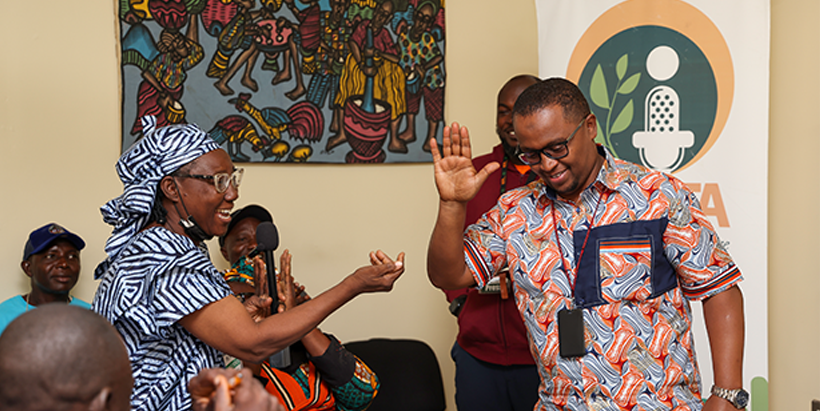
Dr Ismail Rabbi, IITA Cassava Breeding Program Lead interacting with a female cassava farmer-processor.

In a compelling show of research-community collaboration, the IITACGIAR recently hosted its annual Cassava Farmers-Processors Outreach Program—a flagship event jointly organized by Radio IITA and the Cassava Breeding Program (CBP). The event brought together farmers, processors, researchers, and communication experts with a common goal: to transform cassava productivity through innovation, knowledge sharing, adoption of improved varieties, and value addition.

Farmers and processors from Osun, Oyo, Ogun, Ekiti, and Lagos States participated in the outreach, which was designed as a “train-the-trainer” initiative. Additional participants engaged on Facebook. This model empowers selected participants to serve as ambassadors, returning to their communities with valuable knowledge on best agronomic practices, improved cassava varieties, and value-added food products.

Dr Ismail Rabbi, Head of the IITA Cassava Breeding Unit, emphasized the program’s participatory approach. “Cassava farmers are central to our mission,” he said. “This outreach is not just about delivering innovation; it’s about listening, learning, and co-creating solutions that work in the field and for users.”
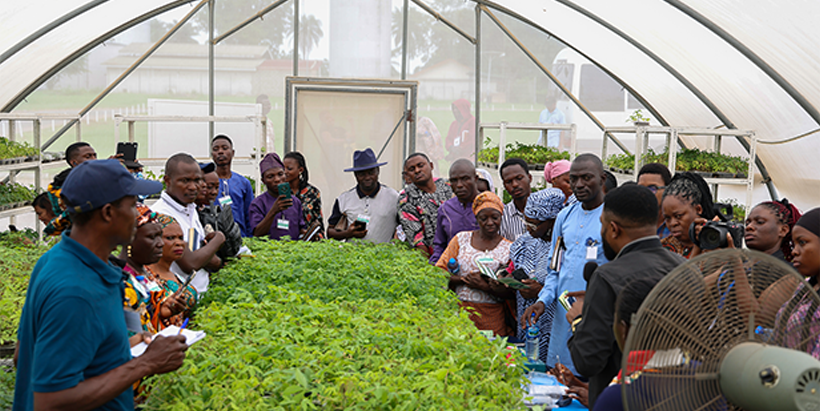
Participants at the Semi-Autotrophic Hydroponics (SAH) screen house facility.

The Head of IITA Communication Office, Katherine Lopez, emphasized the impact of the outreach. “This program bridges the gap between research and the field. When farmers engage directly with our scientists, the results are transformational for yields and livelihoods.”

Dajie Odok Blessing, Radio IITA Lead, noted, “The impact stories we have heard from past participants are proof of the model’s success. Our follow-up visits show that real change is taking place across communities.”

During the interactive sessions, farmers shared challenges and success stories. Felicia Owolabi from Oyo State praised the new ‘Biggie’ variety for its high yield after just eight months while voicing concerns about rodent damage. Another farmer highlighted the need for varieties with longer in-ground shelf lives to allow harvest flexibility during favorable market conditions.
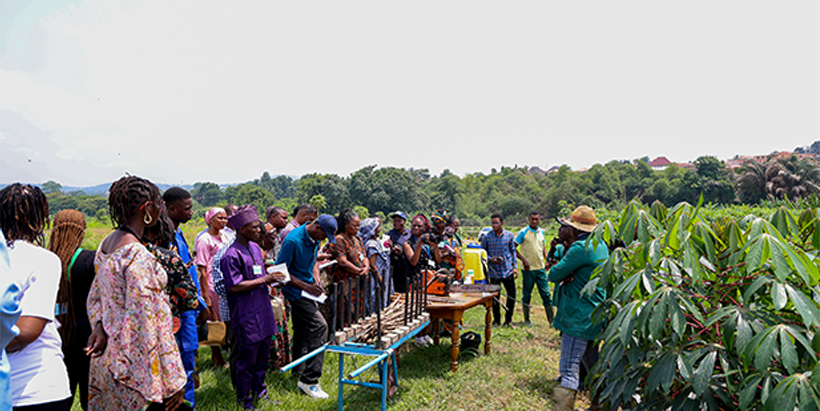
Hands-on training on weed control and fertilizer use led by experts Toye Ayankanmi, Oke Esezobor, and Abolore Bello.

In response, Dr Rabbi explained ongoing breeding efforts to address such concerns. He mentioned that the breeding program was screening its collection for varieties showing less attraction to rodents and those that can stay in the ground for more than 12 months without rotting or becoming fibrous. He advised farmers to use the updated cassava variety handbook to select varieties suited to their specific conditions. He also urged farmers near IITA testing stations to collaborate by offering parts of their land for use as demonstration plots. To improve stem preservation, he recommended a simple method: storing cut stems upright with their bases in moist soil under shade, which can extend their viability for several weeks.

Participants received hands-on weed control, fertilizer use, and herbicide application training led by experts, Toye Ayankanmi, Oke Esezobor, and Abolore Bello. These practical sessions complemented a visit to IITA’s state-of-the-art cassava processing center, where participants witnessed the transformation of cassava into high-value nutritious food products such as cassava cake, snacks, leaf soup, and even cassava ice cream, highlighting opportunities for value addition and income diversification. These innovations, showcased by Abioye Racheal, Dayo Ogunade, and Owoade Durodola, directly address marketability and income diversification for farmers.
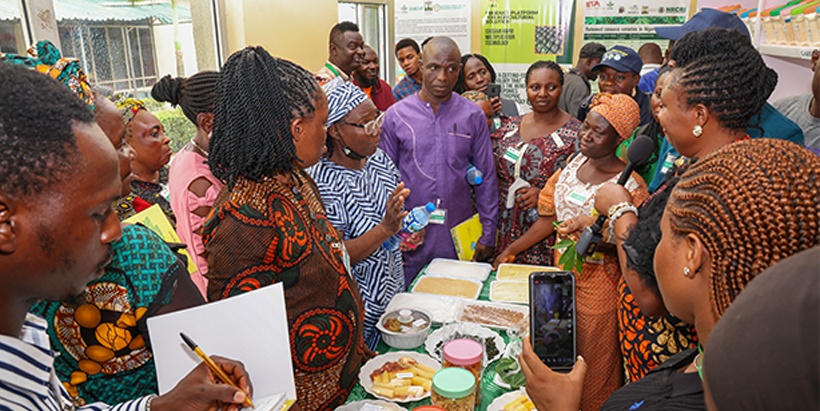
Interactive cassava food products exhibition at the cassava modern supermarket with outreach participants led by Racheal Abioye.

A major highlight was the tour of the Semi-Autotrophic Hydroponics (SAH) laboratory led by ThankGod Ogwuche, who demonstrated the use of clean, certified stems and advanced multiplication techniques to ensure timely access to healthy planting materials, crucial for food security and genetic integrity.

With continued follow-up, increased farmer-scientist collaboration, and a commitment to knowledge dissemination, IITA Cassava Outreach is advancing a more productive, resilient cassava sector for Nigeria and Africa.

Contributed by Ismail Rabbi and Bamise Dada


Contributed by

Related news

No items found

Leave a Reply

Your email address will not be published. Required fields are marked *

Scroll to Top
Olaosebikan, Olamide

Olamide Deborah Nwanze is a Senior Research Associate specializing in gender mainstreaming research to inform participatory and inclusive breeding, variety development, and seed systems policies regarding root, tuber, and banana (RTB) crops in the International Institute of Tropical Agriculture Headquarters, Ibadan, Nigeria. She is a PhD candidate at the University of Ibadan and holds an MSc and B. Agric in Agricultural Extension and Rural Development. Olamide is a fellow of the African Women in Agricultural Research and Development – Gender Responsive Agricultural Systems Policy (AWARD-GRASP) and the Gender Responsive Researchers Equipped for Agricultural Transformation (GREAT). She seeks to apply her gender-mainstreaming learnings, gender-responsive research, and policy development, and review expertise to facilitate women, youth, children, and vulnerable social group’s access to and adoption of agricultural Innovations that guarantee food, nutrition, income, and livelihood security in Africa. Her current roles include mentoring research fellows, development of guides and training manuals, implementation and adaptation of gender frameworks and tools, value chain actors’ engagement as citizen science partners, policy review and redesign, data management, and analysis. Her current research explores mixed methods and participatory and interdisciplinary approaches to capture and highlight gender dynamics, needs, preferences, and challenges stakeholders face within the agricultural livelihood value chain to prioritize gender-inclusive strategies in breeding programs, policy design, and implementation.

At IITA, she contributes to the implementation of the CGIAR Accelerated Breeding Initiative and Genetic Innovation Programs; participatory and gender research within the NextGen CassavaHarvestPlusRTBFoods, and Tricot-ClimMob 1000Farms Projects; and gender knowledge communication via the G-LENS webinar series, video documentary, policy briefspublications, and blogs.


Recent publications

de Sousa, K., van Etten, J., Manners, R. Bello, A., Teeken, B., Olaosebikan, O., et al. 2024. The tricot approach: an agile framework for decentralized on-farm testing supported by citizen science. A retrospective. Agron. Sustain. Dev. 44, 8. https://doi.org/10.1007/s13593-023-00937-1

Madu, T., Onwuka, S., Nwafor, S., Onyemauwa, N., Ejechi, M., Ofoeze, M., Ukeje, B., Eluagu, C., Olaosebikan, O., Okoye, B., 2024. Gender-Inclusive Consumer Studies Improve Cassava Breeding in Nigeria in: Frontiers in Sociology, volume 9, number: 1224504, doi: 10.3389/fsoc.2024.1224504

Olaosebikan, O.; Bello, A.; Utoblo, O.; Okoye, B.; Olutegbe, N.; Garner, E.; Teeken, B.; Bryan, E.; Forsythe, L.; Cole, S.; Madu, T. 2023.  Stressors and Resilience within the Cassava Value Chain in Nigeria: Preferred Cassava Variety Traits and Response Strategies of Men and Women to Inform Breeding. Sustainability 15, 7837. https://doi.org/10.3390/su15107837

Okoye, B., Ofoeze, M., Ejechi, M., Onwuka, S., Nwafor, S., Onyemauwa, N., Ukeje, B., Eluagu, C., Obidiegwu, J.*, Olaosebikan, O., Madu, T.* 2023. Prioritizing preferred traits in the yam value chain in Nigeria: a gender situation analysis in: Frontiers in Sociology, volume 8, number: 1232626, pages 1 – 9, ISSN 2297-7775, 2023. https://www.frontiersin.org/articles/10.3389/fsoc.2023.1232626/full

Olaosebikan, O., Bello, A. A., de Sousa, K., Ndjouenkeu, R., Adesokan, M., Alamu, E. O., Agbona, A., van Etten, J., Kegah, F. N.*, Dufour, D., Bouniol, A., Teeken, B. 2023. Consumer acceptability of cassava gari-eba food products across cultural and environmental settings using the triadic comparison of technologies approach (tricot) in: Journal of the Science of Food and Agriculture,

Teeken, B., Olaosebikan, O., Bello, A. A., Madu, T.*, Cole, S. M. 2023. Qualitative assessment on the positionality and preferences of dyads in relation to cassava-related activities: working with tricot trial citizen scientists https://hdl.handle.net/10568/138326 Type: Manual

Bouniol, A., Ceballos, H., Bello, A. A., Teeken, B., Olaosebikan, O., Owoade, D., Agbona, A., Fotso Kuate, A., Madu, T.*, Okoye, B.*, Ofoeze, M.*, Nwafor, S.*, Onyemauwa, N.*, Adinsi, L.*, Forsythe, L., Dufour, D. 2023. Varietal impact on women’s labour, workload and related drudgery in processing root, tuber and banana crops: focus on cassava in sub-Saharan Africa in: Journal of the Science of Food and Agriculture, pages 1 – 25, ISSN 0022-5142,

Bello, A. A., Agbona, A., Olaosebikan, O., Edughaen, G., Dufour, D., Bouniol, A., Iluebbey, P., Ndjouenkeu, R.*, Rabbi, I. Y., Teeken, B. 2023. Genetic and environmental effects on processing productivity and food product yield: drudgery of women’s work in: Journal of the Science of Food and Agriculture, pages 1 – 32, ISSN 0022-5142, 5

Cavicchioli, M., Zimbiti, T., Teeken, B., Nwanze, D.O., Liani, M., Parkes, E. & Bello, A. 2023. IITA-Gender Responsive Breeding Training Report. Genetic Resources Center, IITA-HQ, Ibadan, 21-23 September, 2022. Ibadan, Nigeria: IITA, (34 p.).https://hdl.handle.net/10568/131368

Agbona, A. Peteti P., Teeken B., Olaosebikan O. Bello, A. A., Parkes, E., Rabbi, I. Y., Mueller, L., Egesi, C., Kulakow, P. 2022. Data Management in Multi-disciplinary African RTB Crop Breeding Programs. In: Williamson, H.F., Leonelli, S. (eds) Towards Responsible Plant Data Linkage: Data Challenges for Agricultural Research and Development. Springer, Cham. https://doi.org/10.1007/978-3-031-13276-6_5

Lora Forsythe, Pricilla Marimo, Sarah Mayanja, Olamide D. Olaosebikan, Esme Stuart, Bela Teeken, Benjamin Okoye, Tessy Madu, (2021). Cross-product Gender Analysis of RTBfoods Step 2 Gendered Food Mapping on RTB Products. Understanding the Drivers of Trait Preferences and the Development of Multi-user RTB Product Profiles, WP1. London, UK: RTBfoods Field Scientific Report, 30 p.

Teeken, B., Garner, E., Agbona, A., Balogun, I., Olaosebikan, O., Bello, A., Madu, T., Okoye, B., Egesi, C., Kulakow, P. and Tufan, H.A. 2021. Beyond “Women’s Traits”: Exploring How Gender, Social Difference, and Household Characteristics Influence Trait Preferences. Frontiers Sustainable Food Systems 5:740926. https://doi.org/10.3389/fsufs.2021.740926

Teeken, B., Agbona, A., Bello, A., Olaosebikan, O., Alamu, E., Adesokan, M., Awoyale, W., Madu, T., Okoye, B., Chijioke, U., Owoade, D., Okoro, M., Bouniol, A., Dufour, D., Hershey, C., Rabbi, I., Maziya‐Dixon, B., Egesi, C., Tufan, H. and Kulakow, P. (020. Understanding cassava varietal preferences through pairwise ranking of gari‐eba and fufu prepared by local farmer–processors. Int J Food Sci Technol. https://doi.org/10.1111/ijfs.14862

Bela Teeken, Olamide Olaosebikan, Ireti Balogun, Benjamin Okoye, Tessy Madu, Steven Cole, Abolore Bello, Elizabeth Parkes. (2020). Piloting the G+ customer and product profile tools for gender-responsive cassava breeding in Nigeria. Nigeria: International Institute of Tropical Agriculture (IITA). https://hdl.handle.net/20.500.11766/13000