
IITA NEWS

Bridging continents with yam: Australian delegates visit IITA for knowledge exchange
July 18, 2025

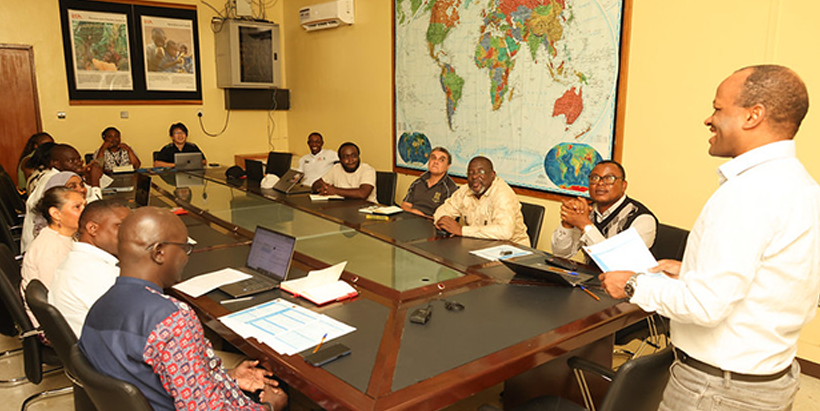
Dr Asrat Amele, in company of IITA Yam Breeding experts and IITA Management Team welcoming the Australian delegates for their weeklong training program.

A spirit of collaboration, curiosity, and cultural connection defined the recent visit of four Australian delegates to IITA from 7-11 July. The team, led by Professor Yasmina Sultanbawa, Director of Scientific Nutrition and Food Systems, University of Queensland, Australia, enjoyed a weeklong interactive exchange focused on deepening understanding of yam research and exploring innovative strategies to enhance yam production and utilization within Australia, particularly among Indigenous communities.

What began as initial conversations between research colleagues across continents became robust interactions across multiple IITA teams, offering the Australian delegation a rich, firsthand exploration of yam breeding, production, and value addition at IITA.

The IITA Director for Strategic Planning and Chief of Staff, Ibnou Dieng, and the Acting Deputy Director General Partnerships for Delivery, Dr Tahirou Abdoulaye, welcomed the delegates on behalf of IITA Management. They stressed the economic importance and the opportunities to explore yam breeding at IITA. “The objective is really to take yams to higher heights. Let’s make this happen together,” said Dr Abdoulaye, emphasizing yams’ role in regional economies and their untapped potential globally.
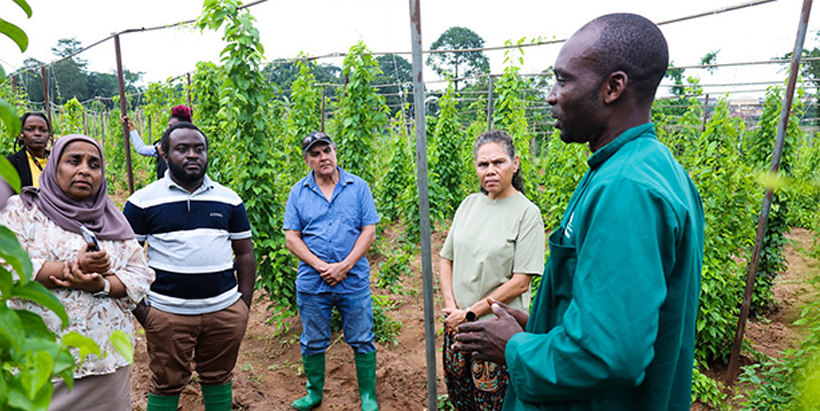
The Australian delegates in IITA Yam field learning yam pollination techniques.

Through the training sessions, led by Yam Breeding Experts at IITA, participants gained insight into IITA’s yam breeding strategies, processing techniques, disease and pest management, yam seed systems, pollination, phenotyping, and propagation technologies. Their exploration extended beyond IITA’s campus, including a visit to Bodija Market to observe yam trade dynamics and a tour of NIJI Group’s processing facilities, reinforcing the link between research, industry, and market realities.

Responding to the resourceful package of the weeklong training program, Prof Yasmina said, “The interactions and the laughter between teams are very visible.” “The knowledge system you have here is second to none—advanced and world-class. For us in Australia, this knowledge can help us reintroduce yam into our climate-challenged environment and reconnect Indigenous communities with their traditional food sources. We won’t reinvent the wheel—we’ll ride on the wealth of IITA’s research to find adaptive solutions.”

The delegation included Prof Yasmina’s PhD student, Samson Fawale, and two members of the Yidinji community, Roy and Tracy Gray. “Yams may be the next European potatoes—affordable and accessible,” Roy noted. “Indigenous people are reclaiming their health, and traditional foods like yams are part of that resilience.” Tracy added, “Blending our ancestral knowledge with scientific research has been impactful. We’ll take these insights home to improve our food systems and share with our tribes.”
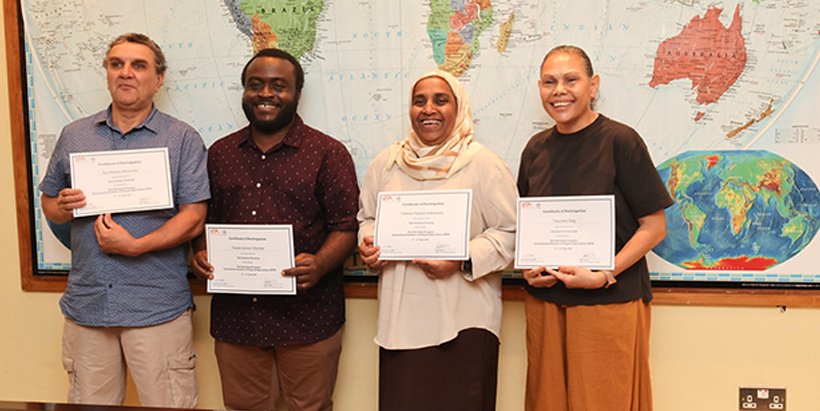
The Australian delegates heartily pose with their certificate of participation after the weeklong training.

In a special edition of IITA’s Knowledge Café Seminar, Prof Yasmina and Samson presented research on the transformation of the local food system in Australia. They highlighted efforts to support sustainable nutrition and food security through engagement with Indigenous communities and science-based solutions. The discussions opened doors for future collaboration in food safety, diet diversity, climate resilience, and youth capacity building.

The IITA Head of Plant Breeding, Dr Hapson Mushoriwa, concluded, “This engagement has been immensely rewarding. From advanced breeding technologies to practical field knowledge, we’ve strengthened our collective understanding and the foundation for a long-term collaboration between IITA and the Center for Nutrition and Food Science at the University of Queensland.”

Looking ahead, both institutions have agreed to pursue a formal partnership agreement that fosters joint research, student exchanges, co-publications, and private sector engagement. These efforts aim to develop tropical crop innovations with real-world impact, particularly in food-insecure communities and underserved populations.

‘Together, we are moving yam research forward, from lab to farm and farm to table,’ Dr Mushoriwa concluded.

Contributed by Folake Oduntan

Related Stories:

IITA-Australia collaboration promises productive investments in agriculture

Australia and IITA to strengthen partnership for climate-responsive agriculture in Africa

Visiting Scientist discusses transfer of technologies on yam breeding between IITA and Jamaican Institution


Contributed by

Related news

No items found

Leave a Reply

Your email address will not be published. Required fields are marked *

Scroll to Top
Olaosebikan, Olamide

Olamide Deborah Nwanze is a Senior Research Associate specializing in gender mainstreaming research to inform participatory and inclusive breeding, variety development, and seed systems policies regarding root, tuber, and banana (RTB) crops in the International Institute of Tropical Agriculture Headquarters, Ibadan, Nigeria. She is a PhD candidate at the University of Ibadan and holds an MSc and B. Agric in Agricultural Extension and Rural Development. Olamide is a fellow of the African Women in Agricultural Research and Development – Gender Responsive Agricultural Systems Policy (AWARD-GRASP) and the Gender Responsive Researchers Equipped for Agricultural Transformation (GREAT). She seeks to apply her gender-mainstreaming learnings, gender-responsive research, and policy development, and review expertise to facilitate women, youth, children, and vulnerable social group’s access to and adoption of agricultural Innovations that guarantee food, nutrition, income, and livelihood security in Africa. Her current roles include mentoring research fellows, development of guides and training manuals, implementation and adaptation of gender frameworks and tools, value chain actors’ engagement as citizen science partners, policy review and redesign, data management, and analysis. Her current research explores mixed methods and participatory and interdisciplinary approaches to capture and highlight gender dynamics, needs, preferences, and challenges stakeholders face within the agricultural livelihood value chain to prioritize gender-inclusive strategies in breeding programs, policy design, and implementation.

At IITA, she contributes to the implementation of the CGIAR Accelerated Breeding Initiative and Genetic Innovation Programs; participatory and gender research within the NextGen CassavaHarvestPlusRTBFoods, and Tricot-ClimMob 1000Farms Projects; and gender knowledge communication via the G-LENS webinar series, video documentary, policy briefspublications, and blogs.


Recent publications

de Sousa, K., van Etten, J., Manners, R. Bello, A., Teeken, B., Olaosebikan, O., et al. 2024. The tricot approach: an agile framework for decentralized on-farm testing supported by citizen science. A retrospective. Agron. Sustain. Dev. 44, 8. https://doi.org/10.1007/s13593-023-00937-1

Madu, T., Onwuka, S., Nwafor, S., Onyemauwa, N., Ejechi, M., Ofoeze, M., Ukeje, B., Eluagu, C., Olaosebikan, O., Okoye, B., 2024. Gender-Inclusive Consumer Studies Improve Cassava Breeding in Nigeria in: Frontiers in Sociology, volume 9, number: 1224504, doi: 10.3389/fsoc.2024.1224504

Olaosebikan, O.; Bello, A.; Utoblo, O.; Okoye, B.; Olutegbe, N.; Garner, E.; Teeken, B.; Bryan, E.; Forsythe, L.; Cole, S.; Madu, T. 2023.  Stressors and Resilience within the Cassava Value Chain in Nigeria: Preferred Cassava Variety Traits and Response Strategies of Men and Women to Inform Breeding. Sustainability 15, 7837. https://doi.org/10.3390/su15107837

Okoye, B., Ofoeze, M., Ejechi, M., Onwuka, S., Nwafor, S., Onyemauwa, N., Ukeje, B., Eluagu, C., Obidiegwu, J.*, Olaosebikan, O., Madu, T.* 2023. Prioritizing preferred traits in the yam value chain in Nigeria: a gender situation analysis in: Frontiers in Sociology, volume 8, number: 1232626, pages 1 – 9, ISSN 2297-7775, 2023. https://www.frontiersin.org/articles/10.3389/fsoc.2023.1232626/full

Olaosebikan, O., Bello, A. A., de Sousa, K., Ndjouenkeu, R., Adesokan, M., Alamu, E. O., Agbona, A., van Etten, J., Kegah, F. N.*, Dufour, D., Bouniol, A., Teeken, B. 2023. Consumer acceptability of cassava gari-eba food products across cultural and environmental settings using the triadic comparison of technologies approach (tricot) in: Journal of the Science of Food and Agriculture,

Teeken, B., Olaosebikan, O., Bello, A. A., Madu, T.*, Cole, S. M. 2023. Qualitative assessment on the positionality and preferences of dyads in relation to cassava-related activities: working with tricot trial citizen scientists https://hdl.handle.net/10568/138326 Type: Manual

Bouniol, A., Ceballos, H., Bello, A. A., Teeken, B., Olaosebikan, O., Owoade, D., Agbona, A., Fotso Kuate, A., Madu, T.*, Okoye, B.*, Ofoeze, M.*, Nwafor, S.*, Onyemauwa, N.*, Adinsi, L.*, Forsythe, L., Dufour, D. 2023. Varietal impact on women’s labour, workload and related drudgery in processing root, tuber and banana crops: focus on cassava in sub-Saharan Africa in: Journal of the Science of Food and Agriculture, pages 1 – 25, ISSN 0022-5142,

Bello, A. A., Agbona, A., Olaosebikan, O., Edughaen, G., Dufour, D., Bouniol, A., Iluebbey, P., Ndjouenkeu, R.*, Rabbi, I. Y., Teeken, B. 2023. Genetic and environmental effects on processing productivity and food product yield: drudgery of women’s work in: Journal of the Science of Food and Agriculture, pages 1 – 32, ISSN 0022-5142, 5

Cavicchioli, M., Zimbiti, T., Teeken, B., Nwanze, D.O., Liani, M., Parkes, E. & Bello, A. 2023. IITA-Gender Responsive Breeding Training Report. Genetic Resources Center, IITA-HQ, Ibadan, 21-23 September, 2022. Ibadan, Nigeria: IITA, (34 p.).https://hdl.handle.net/10568/131368

Agbona, A. Peteti P., Teeken B., Olaosebikan O. Bello, A. A., Parkes, E., Rabbi, I. Y., Mueller, L., Egesi, C., Kulakow, P. 2022. Data Management in Multi-disciplinary African RTB Crop Breeding Programs. In: Williamson, H.F., Leonelli, S. (eds) Towards Responsible Plant Data Linkage: Data Challenges for Agricultural Research and Development. Springer, Cham. https://doi.org/10.1007/978-3-031-13276-6_5

Lora Forsythe, Pricilla Marimo, Sarah Mayanja, Olamide D. Olaosebikan, Esme Stuart, Bela Teeken, Benjamin Okoye, Tessy Madu, (2021). Cross-product Gender Analysis of RTBfoods Step 2 Gendered Food Mapping on RTB Products. Understanding the Drivers of Trait Preferences and the Development of Multi-user RTB Product Profiles, WP1. London, UK: RTBfoods Field Scientific Report, 30 p.

Teeken, B., Garner, E., Agbona, A., Balogun, I., Olaosebikan, O., Bello, A., Madu, T., Okoye, B., Egesi, C., Kulakow, P. and Tufan, H.A. 2021. Beyond “Women’s Traits”: Exploring How Gender, Social Difference, and Household Characteristics Influence Trait Preferences. Frontiers Sustainable Food Systems 5:740926. https://doi.org/10.3389/fsufs.2021.740926

Teeken, B., Agbona, A., Bello, A., Olaosebikan, O., Alamu, E., Adesokan, M., Awoyale, W., Madu, T., Okoye, B., Chijioke, U., Owoade, D., Okoro, M., Bouniol, A., Dufour, D., Hershey, C., Rabbi, I., Maziya‐Dixon, B., Egesi, C., Tufan, H. and Kulakow, P. (020. Understanding cassava varietal preferences through pairwise ranking of gari‐eba and fufu prepared by local farmer–processors. Int J Food Sci Technol. https://doi.org/10.1111/ijfs.14862

Bela Teeken, Olamide Olaosebikan, Ireti Balogun, Benjamin Okoye, Tessy Madu, Steven Cole, Abolore Bello, Elizabeth Parkes. (2020). Piloting the G+ customer and product profile tools for gender-responsive cassava breeding in Nigeria. Nigeria: International Institute of Tropical Agriculture (IITA). https://hdl.handle.net/20.500.11766/13000