
IITA NEWS

Advancing Togo’s national soil information system for sustainable agriculture
July 25, 2025

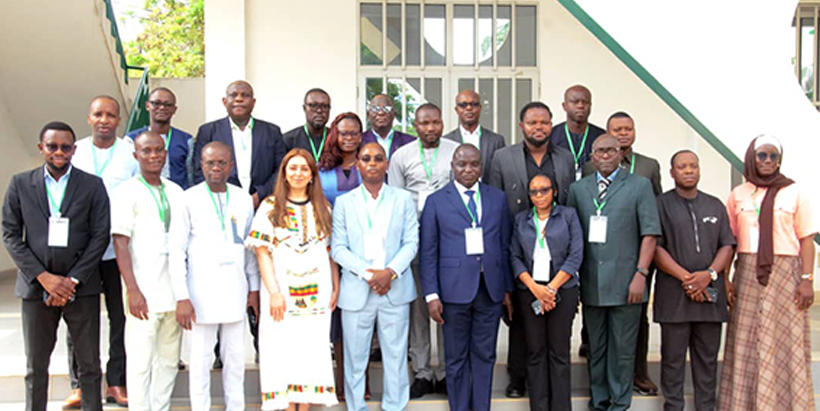
Stakeholders at the SIS Workshop in Togo.

Lomé hosted a three-day workshop to advance and promote Togo’s Soil Information System (SIS), known as FertiTogo. The SIS provides information on soil fertility maps, which are valuable for ensuring sustainable farming and boosting food security.

The Regional Hub for Fertilizer and Soil Health for West Africa and the Sahel organized the workshop from 17 to 19 June 2025. They were hosted by the Ministry of Agriculture and Institut Togolais de Recherche Agronomique (ITRA). The workshop brought together government officials, technical experts, and development partners to strengthen Togo’s capacity for soil data management, aiming to boost agricultural productivity through sustainable soil management practices. Key goals of the workshop were to facilitate further development of the existing soil information system in Togo, technical and human capacity assessment, lab capacity assessment, and planning a trial for site-specific nutrient recommendations using AgWise in Togo.

Togo faces significant challenges related to outdated soil fertility maps, soil degradation, and inefficient fertilizer use. To combat these challenges, the Regional Hub aims to co-facilitate the improvement of FertiTogo, an interactive digital platform for sustainable crop fertilization. The workshop was inspired by the SIS framework developed by CABI and ISRIC – World Soil Information and was tailored to meet the specific needs of Togo and the Regional Hub. The framework has been successfully tested through extensive stakeholder consultations in Zambia (April 2024), Ghana (October 2024), and Kenya (February 2025), adding to the national SIS development efforts in those countries.

The first two days of the workshop focused on enhancing accessibility and public use of the existing SIS and exploring sustainable technical options for software and hosting within Togo. They also focused on identifying stakeholders’ capacity gaps and training needs and securing additional soil data from government and research institutions. Developing a financially sustainable model for the SIS was discussed, as was engaging key partners for large-scale SIS development.

On the third day, the workshop conducted a preliminary technical assessment of participating organizations’ capabilities in critical SIS implementation and management areas. These included software capabilities: GIS tools (ArcGIS, QGIS), database management systems (PostgreSQL), OGC web services, containerization (Docker, Kubernetes), and version control systems. There was also a focus on IT infrastructure: hosting options (on-premises, cloud providers such as AWS, Azure, Google Cloud, regional providers), maintenance, high-performance computing, mobile data collection apps (ODK), and help desk systems. The third day also focused on advancing the development of site-specific nutrient recommendations. This was achieved through in-depth discussions on the availability of relevant data and the role of on-farm fertilizer response trials. These are essential inputs for the AgWise decision support tools to generate context-specific fertilizer recommendations.

Participants further discussed the project’s human resources, including the roles of soil scientists, laboratory staff, data curators, GIS analysts, data scientists, developers, and technical support personnel in improving SIS, laboratory services, nutrient omission trial management, and nutrient management recommendations.

However, developing a sustainable SIS faces challenges such as capacity gaps, data quality concerns, governance and policy issues, data security, retention of skilled personnel, and inadequate technical infrastructure. Addressing these issues requires strong collaboration among all relevant stakeholders. To support this goal, the workshop was conducted to unite stakeholders to explore solutions for a sustainable SIS and the challenges hindering its development.

The workshop’s output comprehensively evaluated the project’s specific capacity-building and technical development needs. This was an important step toward ensuring that Togolese farmers and policymakers are supported with the necessary data for more productive, efficient, and climate-smart agricultural practices.

About the Regional Hub for Fertilizer and Soil Health for West Africa and the Sahel

The Fertilizer and Soil Health Hub for West Africa and the Sahel is a collaborative initiative to promote soil health and sustainable fertilizer use in the region. Launched in 2024 as a sub-program of the Economic Community of West African States (ECOWAS), the Hub brings together diverse stakeholders who include the International Institute of Tropical Agriculture (IITA), International Fertilizer Development Center (IFDC), OCP Africa, African Plant Nutrition Institute (APNI), University Mohammed VI Polytechnic (UM6P), and the World Bank through the Accelerating Impacts of CGIAR Climate Research for Africa (AICCRA) project.

The Regional Hub, established by a consortium of organizations, aligns directly with the needs outlined in the Roadmap for Fertilizer and Soil Health inscribed by ECOWAS, World Bank (AICCRA project), and IFDC (September 2023). This strategic alignment underscores the Hub’s direct relevance to the summit’s critical discussions on addressing Africa’s soil health challenges and enhancing agricultural productivity.

The Regional Hub headquarters is at the IITA campus in Ibadan, Nigeria.

Contributed by the Regional Hub Implementation Team


Contributed by

Related news

No items found

Leave a Reply

Your email address will not be published. Required fields are marked *

Scroll to Top
Olaosebikan, Olamide

Olamide Deborah Nwanze is a Senior Research Associate specializing in gender mainstreaming research to inform participatory and inclusive breeding, variety development, and seed systems policies regarding root, tuber, and banana (RTB) crops in the International Institute of Tropical Agriculture Headquarters, Ibadan, Nigeria. She is a PhD candidate at the University of Ibadan and holds an MSc and B. Agric in Agricultural Extension and Rural Development. Olamide is a fellow of the African Women in Agricultural Research and Development – Gender Responsive Agricultural Systems Policy (AWARD-GRASP) and the Gender Responsive Researchers Equipped for Agricultural Transformation (GREAT). She seeks to apply her gender-mainstreaming learnings, gender-responsive research, and policy development, and review expertise to facilitate women, youth, children, and vulnerable social group’s access to and adoption of agricultural Innovations that guarantee food, nutrition, income, and livelihood security in Africa. Her current roles include mentoring research fellows, development of guides and training manuals, implementation and adaptation of gender frameworks and tools, value chain actors’ engagement as citizen science partners, policy review and redesign, data management, and analysis. Her current research explores mixed methods and participatory and interdisciplinary approaches to capture and highlight gender dynamics, needs, preferences, and challenges stakeholders face within the agricultural livelihood value chain to prioritize gender-inclusive strategies in breeding programs, policy design, and implementation.

At IITA, she contributes to the implementation of the CGIAR Accelerated Breeding Initiative and Genetic Innovation Programs; participatory and gender research within the NextGen CassavaHarvestPlusRTBFoods, and Tricot-ClimMob 1000Farms Projects; and gender knowledge communication via the G-LENS webinar series, video documentary, policy briefspublications, and blogs.


Recent publications

de Sousa, K., van Etten, J., Manners, R. Bello, A., Teeken, B., Olaosebikan, O., et al. 2024. The tricot approach: an agile framework for decentralized on-farm testing supported by citizen science. A retrospective. Agron. Sustain. Dev. 44, 8. https://doi.org/10.1007/s13593-023-00937-1

Madu, T., Onwuka, S., Nwafor, S., Onyemauwa, N., Ejechi, M., Ofoeze, M., Ukeje, B., Eluagu, C., Olaosebikan, O., Okoye, B., 2024. Gender-Inclusive Consumer Studies Improve Cassava Breeding in Nigeria in: Frontiers in Sociology, volume 9, number: 1224504, doi: 10.3389/fsoc.2024.1224504

Olaosebikan, O.; Bello, A.; Utoblo, O.; Okoye, B.; Olutegbe, N.; Garner, E.; Teeken, B.; Bryan, E.; Forsythe, L.; Cole, S.; Madu, T. 2023.  Stressors and Resilience within the Cassava Value Chain in Nigeria: Preferred Cassava Variety Traits and Response Strategies of Men and Women to Inform Breeding. Sustainability 15, 7837. https://doi.org/10.3390/su15107837

Okoye, B., Ofoeze, M., Ejechi, M., Onwuka, S., Nwafor, S., Onyemauwa, N., Ukeje, B., Eluagu, C., Obidiegwu, J.*, Olaosebikan, O., Madu, T.* 2023. Prioritizing preferred traits in the yam value chain in Nigeria: a gender situation analysis in: Frontiers in Sociology, volume 8, number: 1232626, pages 1 – 9, ISSN 2297-7775, 2023. https://www.frontiersin.org/articles/10.3389/fsoc.2023.1232626/full

Olaosebikan, O., Bello, A. A., de Sousa, K., Ndjouenkeu, R., Adesokan, M., Alamu, E. O., Agbona, A., van Etten, J., Kegah, F. N.*, Dufour, D., Bouniol, A., Teeken, B. 2023. Consumer acceptability of cassava gari-eba food products across cultural and environmental settings using the triadic comparison of technologies approach (tricot) in: Journal of the Science of Food and Agriculture,

Teeken, B., Olaosebikan, O., Bello, A. A., Madu, T.*, Cole, S. M. 2023. Qualitative assessment on the positionality and preferences of dyads in relation to cassava-related activities: working with tricot trial citizen scientists https://hdl.handle.net/10568/138326 Type: Manual

Bouniol, A., Ceballos, H., Bello, A. A., Teeken, B., Olaosebikan, O., Owoade, D., Agbona, A., Fotso Kuate, A., Madu, T.*, Okoye, B.*, Ofoeze, M.*, Nwafor, S.*, Onyemauwa, N.*, Adinsi, L.*, Forsythe, L., Dufour, D. 2023. Varietal impact on women’s labour, workload and related drudgery in processing root, tuber and banana crops: focus on cassava in sub-Saharan Africa in: Journal of the Science of Food and Agriculture, pages 1 – 25, ISSN 0022-5142,

Bello, A. A., Agbona, A., Olaosebikan, O., Edughaen, G., Dufour, D., Bouniol, A., Iluebbey, P., Ndjouenkeu, R.*, Rabbi, I. Y., Teeken, B. 2023. Genetic and environmental effects on processing productivity and food product yield: drudgery of women’s work in: Journal of the Science of Food and Agriculture, pages 1 – 32, ISSN 0022-5142, 5

Cavicchioli, M., Zimbiti, T., Teeken, B., Nwanze, D.O., Liani, M., Parkes, E. & Bello, A. 2023. IITA-Gender Responsive Breeding Training Report. Genetic Resources Center, IITA-HQ, Ibadan, 21-23 September, 2022. Ibadan, Nigeria: IITA, (34 p.).https://hdl.handle.net/10568/131368

Agbona, A. Peteti P., Teeken B., Olaosebikan O. Bello, A. A., Parkes, E., Rabbi, I. Y., Mueller, L., Egesi, C., Kulakow, P. 2022. Data Management in Multi-disciplinary African RTB Crop Breeding Programs. In: Williamson, H.F., Leonelli, S. (eds) Towards Responsible Plant Data Linkage: Data Challenges for Agricultural Research and Development. Springer, Cham. https://doi.org/10.1007/978-3-031-13276-6_5

Lora Forsythe, Pricilla Marimo, Sarah Mayanja, Olamide D. Olaosebikan, Esme Stuart, Bela Teeken, Benjamin Okoye, Tessy Madu, (2021). Cross-product Gender Analysis of RTBfoods Step 2 Gendered Food Mapping on RTB Products. Understanding the Drivers of Trait Preferences and the Development of Multi-user RTB Product Profiles, WP1. London, UK: RTBfoods Field Scientific Report, 30 p.

Teeken, B., Garner, E., Agbona, A., Balogun, I., Olaosebikan, O., Bello, A., Madu, T., Okoye, B., Egesi, C., Kulakow, P. and Tufan, H.A. 2021. Beyond “Women’s Traits”: Exploring How Gender, Social Difference, and Household Characteristics Influence Trait Preferences. Frontiers Sustainable Food Systems 5:740926. https://doi.org/10.3389/fsufs.2021.740926

Teeken, B., Agbona, A., Bello, A., Olaosebikan, O., Alamu, E., Adesokan, M., Awoyale, W., Madu, T., Okoye, B., Chijioke, U., Owoade, D., Okoro, M., Bouniol, A., Dufour, D., Hershey, C., Rabbi, I., Maziya‐Dixon, B., Egesi, C., Tufan, H. and Kulakow, P. (020. Understanding cassava varietal preferences through pairwise ranking of gari‐eba and fufu prepared by local farmer–processors. Int J Food Sci Technol. https://doi.org/10.1111/ijfs.14862

Bela Teeken, Olamide Olaosebikan, Ireti Balogun, Benjamin Okoye, Tessy Madu, Steven Cole, Abolore Bello, Elizabeth Parkes. (2020). Piloting the G+ customer and product profile tools for gender-responsive cassava breeding in Nigeria. Nigeria: International Institute of Tropical Agriculture (IITA). https://hdl.handle.net/20.500.11766/13000