
IITA NEWS

Scaling up High-Quality Cassava Peel technology for livestock in Rwanda
August 15, 2025

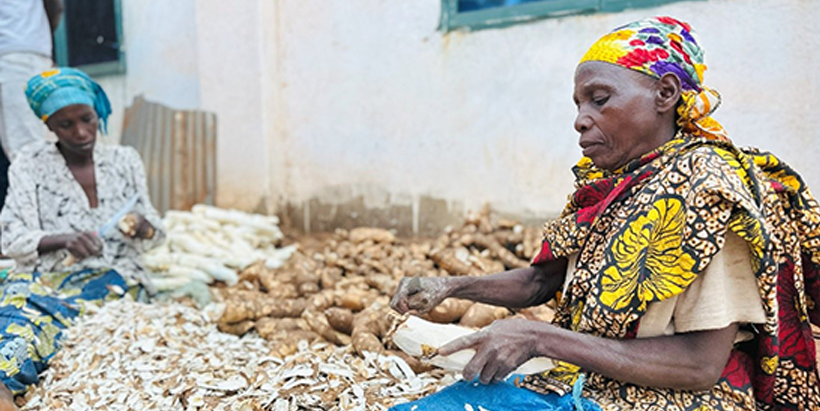
Women peeling the cassava roots in Kamonyi District, Nyamiyaga Sector

Rwanda’s livestock farmers are grappling with rising feed costs, particularly maize-based ingredients, which now sell for around 400-600 Rwf (USD 0.28-0.41) per kilogram. In contrast, High-Quality Cassava Peel (HQCP) mash, produced from processed cassava peels, costs only 200-250 Rwf (USD 0.14-0.17) per kilogram, yet delivers the same nutritional value as maize in feed formulation.

To address gaps in livestock feed production in Rwanda, IITACGIAR has been promoting High Quality Cassava Peels (HQCP) technology as a cost-effective and sustainable feed ingredient through ongoing efforts to scale innovation in sub-Saharan Africa.

The technology was introduced under the Rural-Urban Nexus (RUNRES) project, funded by the Swiss Agency for Development and Cooperation (SDC), as part of efforts to reduce reliance on maize for livestock feed, thereby freeing up maize for human consumption and lowering feed imports.
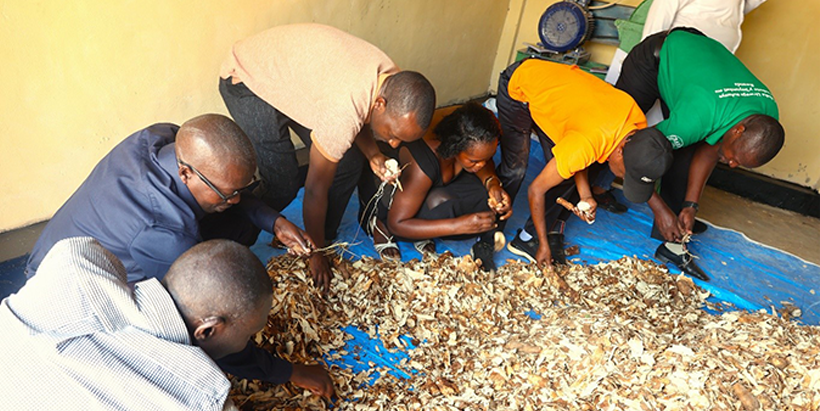
Trained entrepreneurs sorting cassava peels before grinding.

“Producing animal feed from cassava peels will cut the amount of cereals previously imported for mixing with other feeds. This will increase income for farmers and livestock keepers, especially since imported feed is expensive, and often in short supply,” said Jules Mutabazi, researcher at the Rwanda Agriculture and Animal Resources Development Board (RAB).

Following successful piloting, IITA-CGIAR is scaling HQCP production among cassava and animal feed entrepreneurs to expand access to affordable feed for cattle, goats, pigs, and poultry, while creating new agribusiness opportunities.

From 5 to 6 August 2025, IITA, through its Gwiza-Muhinzi project (funded by the European Union) and RUNRES, hosted a two-day, hands-on training in Rwanda entitled “Advanced practical training on High-Quality Cassava Peel processing into animal feed” for 35 cassava and animal feed entrepreneurs. The sessions, led by International Livestock Research Institute (ILRI) Scientist, Dr Iheanacho Okike, covered the full production process: sorting of wet peels, grating/milling of wet peels, dewatering, pulverizing, sun drying, milling of dried mash, and storing, so participants can replicate the process in their enterprises.
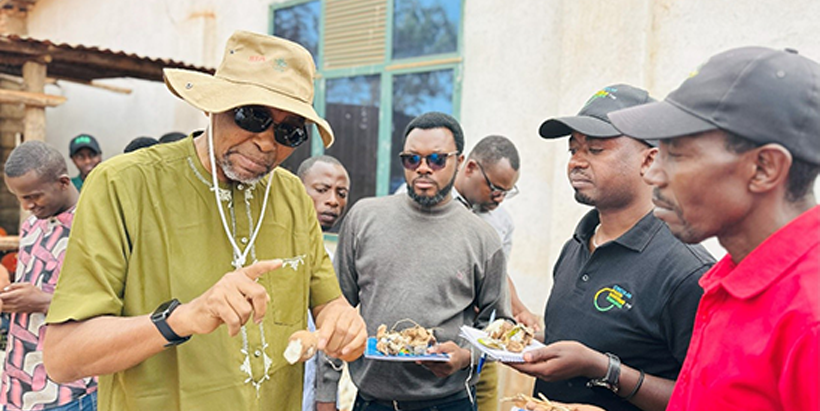
Dr Okike Iheanacho explaining the cassava peels sorting to livestock/cassava entrepreneurs

“Wasting cassava peels is like throwing money away. By processing those peels into HQCP feed, we create value from waste, address the rising cost of livestock feed, and reduce environmental impact. This is a win-win for farmers, processors, and the planet,” said Dr Okike.

For Jean Claude Munyaneza Kabayiza, a cassava seed entrepreneur and CEO of Holly Agriculture Company in Eastern Province, the training strengthened his resolve to start a cassava peel processing unit.

“I already had this project in mind, but it gave me even further clarity after this training. I may not start with a large factory, but I can begin with a small or medium-scale unit that processes cassava while ensuring no residue is wasted,” he said.

Participants also noted the direct cost savings HQCP offers;

“This cassava peel flour is helping us reduce the cost of animal feed. It is cheaper than the maize feed we normally buy, and it still has the high quality and nutrients our livestock need,” said Noella Umutoni, animal feed entrepreneur from Bugesera District.

By turning agricultural waste into a valuable resource, HQCP technology offers a practical solution to feed affordability, challenges, and availability, supporting Rwanda’s livestock industry and broader food security goals.

Contributed by Ritha Bumwe


Contributed by

Related news

No items found

Leave a Reply

Your email address will not be published. Required fields are marked *

Scroll to Top
Olaosebikan, Olamide

Olamide Deborah Nwanze is a Senior Research Associate specializing in gender mainstreaming research to inform participatory and inclusive breeding, variety development, and seed systems policies regarding root, tuber, and banana (RTB) crops in the International Institute of Tropical Agriculture Headquarters, Ibadan, Nigeria. She is a PhD candidate at the University of Ibadan and holds an MSc and B. Agric in Agricultural Extension and Rural Development. Olamide is a fellow of the African Women in Agricultural Research and Development – Gender Responsive Agricultural Systems Policy (AWARD-GRASP) and the Gender Responsive Researchers Equipped for Agricultural Transformation (GREAT). She seeks to apply her gender-mainstreaming learnings, gender-responsive research, and policy development, and review expertise to facilitate women, youth, children, and vulnerable social group’s access to and adoption of agricultural Innovations that guarantee food, nutrition, income, and livelihood security in Africa. Her current roles include mentoring research fellows, development of guides and training manuals, implementation and adaptation of gender frameworks and tools, value chain actors’ engagement as citizen science partners, policy review and redesign, data management, and analysis. Her current research explores mixed methods and participatory and interdisciplinary approaches to capture and highlight gender dynamics, needs, preferences, and challenges stakeholders face within the agricultural livelihood value chain to prioritize gender-inclusive strategies in breeding programs, policy design, and implementation.

At IITA, she contributes to the implementation of the CGIAR Accelerated Breeding Initiative and Genetic Innovation Programs; participatory and gender research within the NextGen CassavaHarvestPlusRTBFoods, and Tricot-ClimMob 1000Farms Projects; and gender knowledge communication via the G-LENS webinar series, video documentary, policy briefspublications, and blogs.


Recent publications

de Sousa, K., van Etten, J., Manners, R. Bello, A., Teeken, B., Olaosebikan, O., et al. 2024. The tricot approach: an agile framework for decentralized on-farm testing supported by citizen science. A retrospective. Agron. Sustain. Dev. 44, 8. https://doi.org/10.1007/s13593-023-00937-1

Madu, T., Onwuka, S., Nwafor, S., Onyemauwa, N., Ejechi, M., Ofoeze, M., Ukeje, B., Eluagu, C., Olaosebikan, O., Okoye, B., 2024. Gender-Inclusive Consumer Studies Improve Cassava Breeding in Nigeria in: Frontiers in Sociology, volume 9, number: 1224504, doi: 10.3389/fsoc.2024.1224504

Olaosebikan, O.; Bello, A.; Utoblo, O.; Okoye, B.; Olutegbe, N.; Garner, E.; Teeken, B.; Bryan, E.; Forsythe, L.; Cole, S.; Madu, T. 2023.  Stressors and Resilience within the Cassava Value Chain in Nigeria: Preferred Cassava Variety Traits and Response Strategies of Men and Women to Inform Breeding. Sustainability 15, 7837. https://doi.org/10.3390/su15107837

Okoye, B., Ofoeze, M., Ejechi, M., Onwuka, S., Nwafor, S., Onyemauwa, N., Ukeje, B., Eluagu, C., Obidiegwu, J.*, Olaosebikan, O., Madu, T.* 2023. Prioritizing preferred traits in the yam value chain in Nigeria: a gender situation analysis in: Frontiers in Sociology, volume 8, number: 1232626, pages 1 – 9, ISSN 2297-7775, 2023. https://www.frontiersin.org/articles/10.3389/fsoc.2023.1232626/full

Olaosebikan, O., Bello, A. A., de Sousa, K., Ndjouenkeu, R., Adesokan, M., Alamu, E. O., Agbona, A., van Etten, J., Kegah, F. N.*, Dufour, D., Bouniol, A., Teeken, B. 2023. Consumer acceptability of cassava gari-eba food products across cultural and environmental settings using the triadic comparison of technologies approach (tricot) in: Journal of the Science of Food and Agriculture,

Teeken, B., Olaosebikan, O., Bello, A. A., Madu, T.*, Cole, S. M. 2023. Qualitative assessment on the positionality and preferences of dyads in relation to cassava-related activities: working with tricot trial citizen scientists https://hdl.handle.net/10568/138326 Type: Manual

Bouniol, A., Ceballos, H., Bello, A. A., Teeken, B., Olaosebikan, O., Owoade, D., Agbona, A., Fotso Kuate, A., Madu, T.*, Okoye, B.*, Ofoeze, M.*, Nwafor, S.*, Onyemauwa, N.*, Adinsi, L.*, Forsythe, L., Dufour, D. 2023. Varietal impact on women’s labour, workload and related drudgery in processing root, tuber and banana crops: focus on cassava in sub-Saharan Africa in: Journal of the Science of Food and Agriculture, pages 1 – 25, ISSN 0022-5142,

Bello, A. A., Agbona, A., Olaosebikan, O., Edughaen, G., Dufour, D., Bouniol, A., Iluebbey, P., Ndjouenkeu, R.*, Rabbi, I. Y., Teeken, B. 2023. Genetic and environmental effects on processing productivity and food product yield: drudgery of women’s work in: Journal of the Science of Food and Agriculture, pages 1 – 32, ISSN 0022-5142, 5

Cavicchioli, M., Zimbiti, T., Teeken, B., Nwanze, D.O., Liani, M., Parkes, E. & Bello, A. 2023. IITA-Gender Responsive Breeding Training Report. Genetic Resources Center, IITA-HQ, Ibadan, 21-23 September, 2022. Ibadan, Nigeria: IITA, (34 p.).https://hdl.handle.net/10568/131368

Agbona, A. Peteti P., Teeken B., Olaosebikan O. Bello, A. A., Parkes, E., Rabbi, I. Y., Mueller, L., Egesi, C., Kulakow, P. 2022. Data Management in Multi-disciplinary African RTB Crop Breeding Programs. In: Williamson, H.F., Leonelli, S. (eds) Towards Responsible Plant Data Linkage: Data Challenges for Agricultural Research and Development. Springer, Cham. https://doi.org/10.1007/978-3-031-13276-6_5

Lora Forsythe, Pricilla Marimo, Sarah Mayanja, Olamide D. Olaosebikan, Esme Stuart, Bela Teeken, Benjamin Okoye, Tessy Madu, (2021). Cross-product Gender Analysis of RTBfoods Step 2 Gendered Food Mapping on RTB Products. Understanding the Drivers of Trait Preferences and the Development of Multi-user RTB Product Profiles, WP1. London, UK: RTBfoods Field Scientific Report, 30 p.

Teeken, B., Garner, E., Agbona, A., Balogun, I., Olaosebikan, O., Bello, A., Madu, T., Okoye, B., Egesi, C., Kulakow, P. and Tufan, H.A. 2021. Beyond “Women’s Traits”: Exploring How Gender, Social Difference, and Household Characteristics Influence Trait Preferences. Frontiers Sustainable Food Systems 5:740926. https://doi.org/10.3389/fsufs.2021.740926

Teeken, B., Agbona, A., Bello, A., Olaosebikan, O., Alamu, E., Adesokan, M., Awoyale, W., Madu, T., Okoye, B., Chijioke, U., Owoade, D., Okoro, M., Bouniol, A., Dufour, D., Hershey, C., Rabbi, I., Maziya‐Dixon, B., Egesi, C., Tufan, H. and Kulakow, P. (020. Understanding cassava varietal preferences through pairwise ranking of gari‐eba and fufu prepared by local farmer–processors. Int J Food Sci Technol. https://doi.org/10.1111/ijfs.14862

Bela Teeken, Olamide Olaosebikan, Ireti Balogun, Benjamin Okoye, Tessy Madu, Steven Cole, Abolore Bello, Elizabeth Parkes. (2020). Piloting the G+ customer and product profile tools for gender-responsive cassava breeding in Nigeria. Nigeria: International Institute of Tropical Agriculture (IITA). https://hdl.handle.net/20.500.11766/13000