
NEWS

Paving the way to sustainable cassava and plantain quality seed production in the Republic of Gabon
November 28, 2025


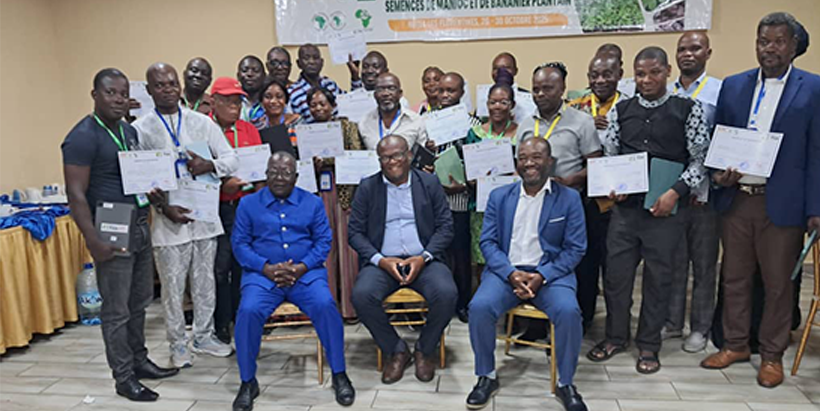
IITA presented certificates to officials from the Ministry of Agriculture in Gabon upon completion of the training

IITACGIAR is at the forefront of cassava and banana seed production in Gabon. The Ministry of Agriculture, in partnership with the International Institute of Tropical Agriculture (IITA), organized a two-week phased-in training to accelerate the modernization of agriculture and strengthen the national seed production through the technical assistance to the Projet d’Appui au Programme GRAINE-Phase 1 (PAPG1), under the framework of the Technologies of African Agricultural Transformation (TAAT) program. This two-week program targeted heads of agricultural division services and top government officials within the Ministry of Agriculture in Libreville, from 26 October to 5 November 2025. TAAT is a flagship program of the African Development Bank‘s Feed Africa Strategy. It aims to double crop, livestock, and fish productivity by providing over 40 million African smallholder farmers with proven technologies. Since its inception in 2018, TAAT has supported the Feed Africa Initiative by providing the necessary, productivity-enhancing, and food-processing technologies. The program has also been responsible for implementing inclusion strategies within the bank’s financing of large-scale regional and national agriculture investment projects, driving agricultural transformation across the continent.

More than ever, the Ministry of Agriculture in Gabon has demonstrated its commitment to fostering strong ties with IITA to build pathways for sustainable agrifood systems by maximizing modernized technologies for cassava and plantain seed production, aiming to become self-sufficient in the cassava and plantain value chain. The training aimed to incorporate hands-on practices using innovative digital solutions, such as the Cassava Business Connector and PlantVillage NURU, in agricultural extension services. The training also provided an avenue for participants to reflect on improving extension services to farmers and chart a strategic plan to build technical capacity across all levels of the Ministry.

“We are laying the foundation for a high-performing, digitalized agricultural extension system, one that can better support producers, address the challenges of crop diseases, and ensure Gabon’s autonomy in seed production,” stated Arnaud Kombila Mussavu, Director General of Agriculture in the Ministry.

Participants explored key topics including seed legislation, varietal identification, phytosanitary surveillance, soil fertility management, irrigation, tissue culture, and vitroplants acclimatization. They also held practical field sessions, equipping officials to respond to rising threats from fungal, viral, and insect pests.
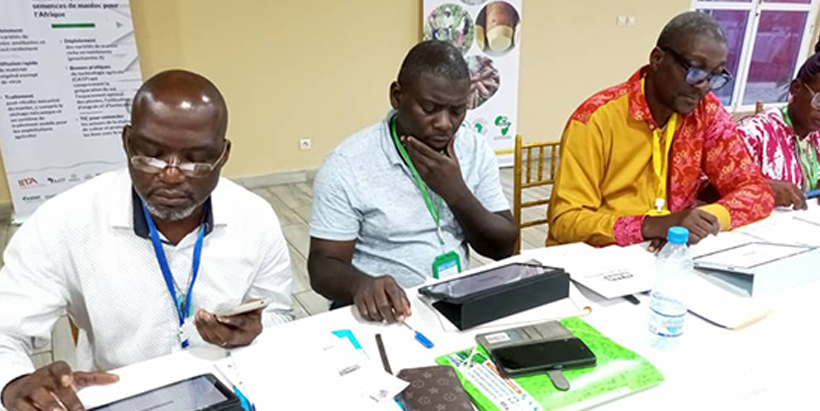
Ministry officials test the newly provided tablets that will be used for data collection and disease identification

Digital agriculture was a central theme. IITA experts introduced tools such as SeedTracker, Akilimo, Cassava Business Connector, and PlantVillage NURU, platforms designed to streamline data collection, improve planning, and strengthen contingency responses. Twenty-five tablets were handed over to the departmental service heads by IITA to support this cause.

The training workshop also highlighted opportunities for cassava seed multiplication technologies, notably the deployment of Semi-Autotrophic Hydroponics (SAH) technology, a novel approach in the cassava rapid multiplication, which will accelerate the multiplication of clean cassava planting materials to reach millions of farmers.

Moreover, the private partner commended IITA for its success in plantain tissue culture, a breakthrough rarely achieved worldwide due to the crop’s vulnerability to disease contamination. “Let me commend IITA. Many institutions only manage to multiply dessert bananas. Plantain is far more complex, yet IITA has shown its expertise in plantain seed production,” said Dr Sulaimana Assani, Director General of SOCIETE AGRITEC-Gabon (AGRITEC), a private company and a sub-grantee of IITA under the project, in charge of plantain vitroplant acclimatization.
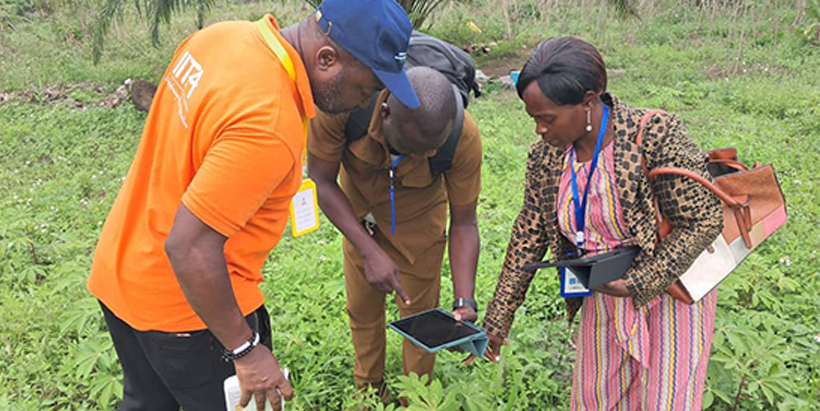
Ministry of Agriculture officials test the newly provided tablets that will be used for data collection and disease identification on the field

On the other hand, Voga Moudoubou, representative of the PAPG1 National Coordinator, presented the project’s achievements in the infrastructure component across six provinces nationwide. He emphasized the importance of the investment made by the Government of Gabon to support the development of the agriculture sector, provide access to modern agricultural infrastructure, and enhance local capacities at all levels.

In his closing remarks, the Director General of Agriculture in the Ministry of Agriculture expressed his satisfaction with IITA’s technical assistance. He underscored the impactful and transformative change brought about by the deployment of IITA technologies and innovative solutions in seed production, and the need to sustain this collaboration. He reiterated the vision of the new presidential initiative, which aims to promote local poultry production using locally produced animal feed. This initiative presents an opportunity for IITA to expand its intervention in Gabon by integrating maize and soybeans into new investments and supporting the country in transitioning towards a more self-sufficient and diversified economy.

Contributed by Fotso Apollin, Ritha Bumwe, and Zozo Rachel


Contributed by

Recent stories

No items found

Leave a Reply

Your email address will not be published. Required fields are marked *

Scroll to Top
Olaosebikan, Olamide

Olamide Deborah Nwanze is a Senior Research Associate specializing in gender mainstreaming research to inform participatory and inclusive breeding, variety development, and seed systems policies regarding root, tuber, and banana (RTB) crops in the International Institute of Tropical Agriculture Headquarters, Ibadan, Nigeria. She is a PhD candidate at the University of Ibadan and holds an MSc and B. Agric in Agricultural Extension and Rural Development. Olamide is a fellow of the African Women in Agricultural Research and Development – Gender Responsive Agricultural Systems Policy (AWARD-GRASP) and the Gender Responsive Researchers Equipped for Agricultural Transformation (GREAT). She seeks to apply her gender-mainstreaming learnings, gender-responsive research, and policy development, and review expertise to facilitate women, youth, children, and vulnerable social group’s access to and adoption of agricultural Innovations that guarantee food, nutrition, income, and livelihood security in Africa. Her current roles include mentoring research fellows, development of guides and training manuals, implementation and adaptation of gender frameworks and tools, value chain actors’ engagement as citizen science partners, policy review and redesign, data management, and analysis. Her current research explores mixed methods and participatory and interdisciplinary approaches to capture and highlight gender dynamics, needs, preferences, and challenges stakeholders face within the agricultural livelihood value chain to prioritize gender-inclusive strategies in breeding programs, policy design, and implementation.

At IITA, she contributes to the implementation of the CGIAR Accelerated Breeding Initiative and Genetic Innovation Programs; participatory and gender research within the NextGen CassavaHarvestPlusRTBFoods, and Tricot-ClimMob 1000Farms Projects; and gender knowledge communication via the G-LENS webinar series, video documentary, policy briefspublications, and blogs.


Recent publications

de Sousa, K., van Etten, J., Manners, R. Bello, A., Teeken, B., Olaosebikan, O., et al. 2024. The tricot approach: an agile framework for decentralized on-farm testing supported by citizen science. A retrospective. Agron. Sustain. Dev. 44, 8. https://doi.org/10.1007/s13593-023-00937-1

Madu, T., Onwuka, S., Nwafor, S., Onyemauwa, N., Ejechi, M., Ofoeze, M., Ukeje, B., Eluagu, C., Olaosebikan, O., Okoye, B., 2024. Gender-Inclusive Consumer Studies Improve Cassava Breeding in Nigeria in: Frontiers in Sociology, volume 9, number: 1224504, doi: 10.3389/fsoc.2024.1224504

Olaosebikan, O.; Bello, A.; Utoblo, O.; Okoye, B.; Olutegbe, N.; Garner, E.; Teeken, B.; Bryan, E.; Forsythe, L.; Cole, S.; Madu, T. 2023.  Stressors and Resilience within the Cassava Value Chain in Nigeria: Preferred Cassava Variety Traits and Response Strategies of Men and Women to Inform Breeding. Sustainability 15, 7837. https://doi.org/10.3390/su15107837

Okoye, B., Ofoeze, M., Ejechi, M., Onwuka, S., Nwafor, S., Onyemauwa, N., Ukeje, B., Eluagu, C., Obidiegwu, J.*, Olaosebikan, O., Madu, T.* 2023. Prioritizing preferred traits in the yam value chain in Nigeria: a gender situation analysis in: Frontiers in Sociology, volume 8, number: 1232626, pages 1 – 9, ISSN 2297-7775, 2023. https://www.frontiersin.org/articles/10.3389/fsoc.2023.1232626/full

Olaosebikan, O., Bello, A. A., de Sousa, K., Ndjouenkeu, R., Adesokan, M., Alamu, E. O., Agbona, A., van Etten, J., Kegah, F. N.*, Dufour, D., Bouniol, A., Teeken, B. 2023. Consumer acceptability of cassava gari-eba food products across cultural and environmental settings using the triadic comparison of technologies approach (tricot) in: Journal of the Science of Food and Agriculture,

Teeken, B., Olaosebikan, O., Bello, A. A., Madu, T.*, Cole, S. M. 2023. Qualitative assessment on the positionality and preferences of dyads in relation to cassava-related activities: working with tricot trial citizen scientists https://hdl.handle.net/10568/138326 Type: Manual

Bouniol, A., Ceballos, H., Bello, A. A., Teeken, B., Olaosebikan, O., Owoade, D., Agbona, A., Fotso Kuate, A., Madu, T.*, Okoye, B.*, Ofoeze, M.*, Nwafor, S.*, Onyemauwa, N.*, Adinsi, L.*, Forsythe, L., Dufour, D. 2023. Varietal impact on women’s labour, workload and related drudgery in processing root, tuber and banana crops: focus on cassava in sub-Saharan Africa in: Journal of the Science of Food and Agriculture, pages 1 – 25, ISSN 0022-5142,

Bello, A. A., Agbona, A., Olaosebikan, O., Edughaen, G., Dufour, D., Bouniol, A., Iluebbey, P., Ndjouenkeu, R.*, Rabbi, I. Y., Teeken, B. 2023. Genetic and environmental effects on processing productivity and food product yield: drudgery of women’s work in: Journal of the Science of Food and Agriculture, pages 1 – 32, ISSN 0022-5142, 5

Cavicchioli, M., Zimbiti, T., Teeken, B., Nwanze, D.O., Liani, M., Parkes, E. & Bello, A. 2023. IITA-Gender Responsive Breeding Training Report. Genetic Resources Center, IITA-HQ, Ibadan, 21-23 September, 2022. Ibadan, Nigeria: IITA, (34 p.).https://hdl.handle.net/10568/131368

Agbona, A. Peteti P., Teeken B., Olaosebikan O. Bello, A. A., Parkes, E., Rabbi, I. Y., Mueller, L., Egesi, C., Kulakow, P. 2022. Data Management in Multi-disciplinary African RTB Crop Breeding Programs. In: Williamson, H.F., Leonelli, S. (eds) Towards Responsible Plant Data Linkage: Data Challenges for Agricultural Research and Development. Springer, Cham. https://doi.org/10.1007/978-3-031-13276-6_5

Lora Forsythe, Pricilla Marimo, Sarah Mayanja, Olamide D. Olaosebikan, Esme Stuart, Bela Teeken, Benjamin Okoye, Tessy Madu, (2021). Cross-product Gender Analysis of RTBfoods Step 2 Gendered Food Mapping on RTB Products. Understanding the Drivers of Trait Preferences and the Development of Multi-user RTB Product Profiles, WP1. London, UK: RTBfoods Field Scientific Report, 30 p.

Teeken, B., Garner, E., Agbona, A., Balogun, I., Olaosebikan, O., Bello, A., Madu, T., Okoye, B., Egesi, C., Kulakow, P. and Tufan, H.A. 2021. Beyond “Women’s Traits”: Exploring How Gender, Social Difference, and Household Characteristics Influence Trait Preferences. Frontiers Sustainable Food Systems 5:740926. https://doi.org/10.3389/fsufs.2021.740926

Teeken, B., Agbona, A., Bello, A., Olaosebikan, O., Alamu, E., Adesokan, M., Awoyale, W., Madu, T., Okoye, B., Chijioke, U., Owoade, D., Okoro, M., Bouniol, A., Dufour, D., Hershey, C., Rabbi, I., Maziya‐Dixon, B., Egesi, C., Tufan, H. and Kulakow, P. (020. Understanding cassava varietal preferences through pairwise ranking of gari‐eba and fufu prepared by local farmer–processors. Int J Food Sci Technol. https://doi.org/10.1111/ijfs.14862

Bela Teeken, Olamide Olaosebikan, Ireti Balogun, Benjamin Okoye, Tessy Madu, Steven Cole, Abolore Bello, Elizabeth Parkes. (2020). Piloting the G+ customer and product profile tools for gender-responsive cassava breeding in Nigeria. Nigeria: International Institute of Tropical Agriculture (IITA). https://hdl.handle.net/20.500.11766/13000