
IITA NEWS

IITA celebrates five decades of fruitful partnership with NAQS
December 9, 2025

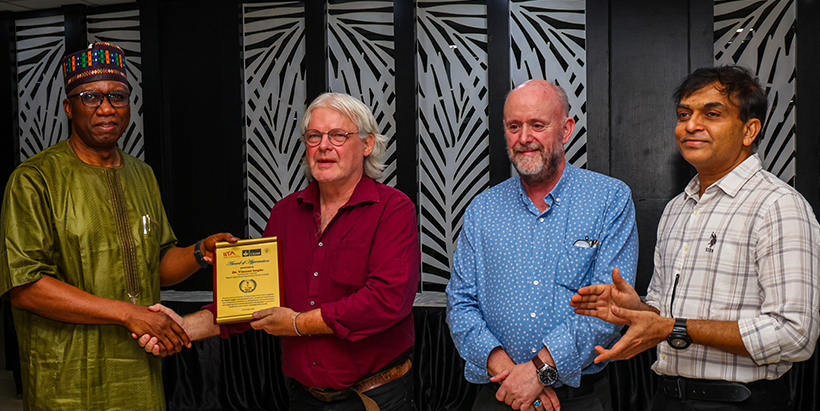
Dr Bernard Vanlauwe, IITA Deputy Director General, Research for Development (R4D) presenting an award of appreciation to Dr Vincent Isegbe, Controller General of NAQS, during the dinner.

The IITA Germplasm Health Unit (GHU) hosted a warm and reflective commemorative dinner to honor more than five decades of impactful partnership with the Nigeria Agricultural Quarantine Service (NAQS) recently. The evening marked a longstanding collaboration that has strengthened safe germplasm exchange, ensured phytosanitary compliance, and facilitated the development of resilient agricultural systems in Nigeria and across Africa.

The NAQS delegation was led by Comptroller General (CG) Dr Vincent Isegbe and included senior officials such as Southwest Zonal Coordinator, Dr Joy Ivbade Ichue; Special Adviser on Technical Matters, Dr Akindele Ogunfunmilayo; and Dr Kazeem Adewale, Head of the NAQS Post-entry Quarantine Station in Ibadan, along with about 20 officers.

The event was presided over by IITA Deputy Director General for Research for Development (R4D), Dr Bernard Vanlauwe, representing the IITA Director General, and by Professor Michael Abberton, Director of the West Africa Hub and Head of the Genetic Resources Center (GRC). Other IITA participants included Head of Breeding, Dr Hapson Mushoriwa; Pathology and Mycotoxin/Aflasafe Lead, Dr Alejandro Ortega-Beltrán; Molecular Geneticist, Dr Ranjana Bhattacharjee; and Head of Communication, Katherine Lopez.
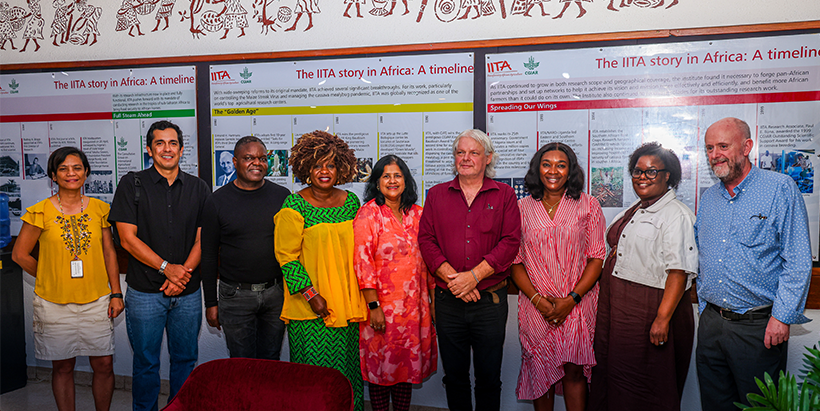
NAQS officials and IITA scientists with their spouses gathered for a group photograph after the celebratory dinner.

GHU members Oluwole Oguntade and Deborah Ajamu introduced the guests and anchored the program.

In his welcome remarks, Dr Lava Kumar, Head of IITA-GHU, highlighted that the IITA–NAQS partnership dates back to IITA’s early years and has grown into a mutually beneficial collaboration rooted in trust, shared purpose, and a longstanding commitment to plant health and biosecurity. He recalled NAQS’ 2021 “Service Support Award” to IITA, which recognized the Institute’s contributions to fulfilling the NAQS mandate.

Dr Vanlauwe commended NAQS for its unwavering collaboration and applauded initiatives led by Dr Isegbe to strengthen the agency, including major staff recruitment and the establishment of a new diagnostic laboratory in Benue State. Prof. Abberton emphasized the importance of international germplasm exchange, highlighting NAQS’s role as a frontline defense against transboundary pests and diseases and its strong cooperation with IITA’s GHU in supporting genebanks and crop improvement programs.

The centerpiece of the evening was the presentation of the “Award of Best Enabling Partner” to NAQS. Delivered by Dr Vanlauwe, the award recognized NAQS’ steadfast commitment to national biosecurity, its leadership in safeguarding agricultural resources, and its contribution to global food security and biodiversity conservation.

Receiving the award, Dr Vincent Isegbe expressed deep gratitude to IITA for its dedication to research, innovation, and capacity building. He underscored IITA’s vital role in improving food security and enhancing livelihoods across Nigeria, noting that its contributions are acknowledged and appreciated by the Federal Ministry of Agriculture and Food Security.

Dr Isegbe also highlighted NAQS’ mandate to prevent the entry and spread of pests, diseases, and contaminants, protecting plant, animal, and aquatic resources while enabling international trade. He noted that NAQS currently certifies more than 30 export commodities—from grains and oil seeds to roots, tubers, spices, honey, and even cow horns—supporting a thriving agribusiness sector.

IITA further recognized two NAQS units—the Southwest Zonal Station (received by Dr Joy Ivbade Ichue) and the Post-entry Quarantine Station (received by Dr Kazeem)—with “Awards of Appreciation” for their longstanding collaboration.

In closing, Dr Kumar acknowledged the professionalism of NAQS officers who, while trusting IITA’s commitment to international phytosanitary standards, continue to uphold the principle of “trust but verify,” ensuring full compliance with national and global regulations.

The celebration marked a significant milestone and reaffirmed the shared vision of IITA and NAQS in building safe, resilient, and productive agricultural systems for Nigeria and the region.

Contributed by Folake Oduntan


Contributed by

Related news

No items found

Leave a Reply

Your email address will not be published. Required fields are marked *

Scroll to Top
Olaosebikan, Olamide

Olamide Deborah Nwanze is a Senior Research Associate specializing in gender mainstreaming research to inform participatory and inclusive breeding, variety development, and seed systems policies regarding root, tuber, and banana (RTB) crops in the International Institute of Tropical Agriculture Headquarters, Ibadan, Nigeria. She is a PhD candidate at the University of Ibadan and holds an MSc and B. Agric in Agricultural Extension and Rural Development. Olamide is a fellow of the African Women in Agricultural Research and Development – Gender Responsive Agricultural Systems Policy (AWARD-GRASP) and the Gender Responsive Researchers Equipped for Agricultural Transformation (GREAT). She seeks to apply her gender-mainstreaming learnings, gender-responsive research, and policy development, and review expertise to facilitate women, youth, children, and vulnerable social group’s access to and adoption of agricultural Innovations that guarantee food, nutrition, income, and livelihood security in Africa. Her current roles include mentoring research fellows, development of guides and training manuals, implementation and adaptation of gender frameworks and tools, value chain actors’ engagement as citizen science partners, policy review and redesign, data management, and analysis. Her current research explores mixed methods and participatory and interdisciplinary approaches to capture and highlight gender dynamics, needs, preferences, and challenges stakeholders face within the agricultural livelihood value chain to prioritize gender-inclusive strategies in breeding programs, policy design, and implementation.

At IITA, she contributes to the implementation of the CGIAR Accelerated Breeding Initiative and Genetic Innovation Programs; participatory and gender research within the NextGen CassavaHarvestPlusRTBFoods, and Tricot-ClimMob 1000Farms Projects; and gender knowledge communication via the G-LENS webinar series, video documentary, policy briefspublications, and blogs.


Recent publications

de Sousa, K., van Etten, J., Manners, R. Bello, A., Teeken, B., Olaosebikan, O., et al. 2024. The tricot approach: an agile framework for decentralized on-farm testing supported by citizen science. A retrospective. Agron. Sustain. Dev. 44, 8. https://doi.org/10.1007/s13593-023-00937-1

Madu, T., Onwuka, S., Nwafor, S., Onyemauwa, N., Ejechi, M., Ofoeze, M., Ukeje, B., Eluagu, C., Olaosebikan, O., Okoye, B., 2024. Gender-Inclusive Consumer Studies Improve Cassava Breeding in Nigeria in: Frontiers in Sociology, volume 9, number: 1224504, doi: 10.3389/fsoc.2024.1224504

Olaosebikan, O.; Bello, A.; Utoblo, O.; Okoye, B.; Olutegbe, N.; Garner, E.; Teeken, B.; Bryan, E.; Forsythe, L.; Cole, S.; Madu, T. 2023.  Stressors and Resilience within the Cassava Value Chain in Nigeria: Preferred Cassava Variety Traits and Response Strategies of Men and Women to Inform Breeding. Sustainability 15, 7837. https://doi.org/10.3390/su15107837

Okoye, B., Ofoeze, M., Ejechi, M., Onwuka, S., Nwafor, S., Onyemauwa, N., Ukeje, B., Eluagu, C., Obidiegwu, J.*, Olaosebikan, O., Madu, T.* 2023. Prioritizing preferred traits in the yam value chain in Nigeria: a gender situation analysis in: Frontiers in Sociology, volume 8, number: 1232626, pages 1 – 9, ISSN 2297-7775, 2023. https://www.frontiersin.org/articles/10.3389/fsoc.2023.1232626/full

Olaosebikan, O., Bello, A. A., de Sousa, K., Ndjouenkeu, R., Adesokan, M., Alamu, E. O., Agbona, A., van Etten, J., Kegah, F. N.*, Dufour, D., Bouniol, A., Teeken, B. 2023. Consumer acceptability of cassava gari-eba food products across cultural and environmental settings using the triadic comparison of technologies approach (tricot) in: Journal of the Science of Food and Agriculture,

Teeken, B., Olaosebikan, O., Bello, A. A., Madu, T.*, Cole, S. M. 2023. Qualitative assessment on the positionality and preferences of dyads in relation to cassava-related activities: working with tricot trial citizen scientists https://hdl.handle.net/10568/138326 Type: Manual

Bouniol, A., Ceballos, H., Bello, A. A., Teeken, B., Olaosebikan, O., Owoade, D., Agbona, A., Fotso Kuate, A., Madu, T.*, Okoye, B.*, Ofoeze, M.*, Nwafor, S.*, Onyemauwa, N.*, Adinsi, L.*, Forsythe, L., Dufour, D. 2023. Varietal impact on women’s labour, workload and related drudgery in processing root, tuber and banana crops: focus on cassava in sub-Saharan Africa in: Journal of the Science of Food and Agriculture, pages 1 – 25, ISSN 0022-5142,

Bello, A. A., Agbona, A., Olaosebikan, O., Edughaen, G., Dufour, D., Bouniol, A., Iluebbey, P., Ndjouenkeu, R.*, Rabbi, I. Y., Teeken, B. 2023. Genetic and environmental effects on processing productivity and food product yield: drudgery of women’s work in: Journal of the Science of Food and Agriculture, pages 1 – 32, ISSN 0022-5142, 5

Cavicchioli, M., Zimbiti, T., Teeken, B., Nwanze, D.O., Liani, M., Parkes, E. & Bello, A. 2023. IITA-Gender Responsive Breeding Training Report. Genetic Resources Center, IITA-HQ, Ibadan, 21-23 September, 2022. Ibadan, Nigeria: IITA, (34 p.).https://hdl.handle.net/10568/131368

Agbona, A. Peteti P., Teeken B., Olaosebikan O. Bello, A. A., Parkes, E., Rabbi, I. Y., Mueller, L., Egesi, C., Kulakow, P. 2022. Data Management in Multi-disciplinary African RTB Crop Breeding Programs. In: Williamson, H.F., Leonelli, S. (eds) Towards Responsible Plant Data Linkage: Data Challenges for Agricultural Research and Development. Springer, Cham. https://doi.org/10.1007/978-3-031-13276-6_5

Lora Forsythe, Pricilla Marimo, Sarah Mayanja, Olamide D. Olaosebikan, Esme Stuart, Bela Teeken, Benjamin Okoye, Tessy Madu, (2021). Cross-product Gender Analysis of RTBfoods Step 2 Gendered Food Mapping on RTB Products. Understanding the Drivers of Trait Preferences and the Development of Multi-user RTB Product Profiles, WP1. London, UK: RTBfoods Field Scientific Report, 30 p.

Teeken, B., Garner, E., Agbona, A., Balogun, I., Olaosebikan, O., Bello, A., Madu, T., Okoye, B., Egesi, C., Kulakow, P. and Tufan, H.A. 2021. Beyond “Women’s Traits”: Exploring How Gender, Social Difference, and Household Characteristics Influence Trait Preferences. Frontiers Sustainable Food Systems 5:740926. https://doi.org/10.3389/fsufs.2021.740926

Teeken, B., Agbona, A., Bello, A., Olaosebikan, O., Alamu, E., Adesokan, M., Awoyale, W., Madu, T., Okoye, B., Chijioke, U., Owoade, D., Okoro, M., Bouniol, A., Dufour, D., Hershey, C., Rabbi, I., Maziya‐Dixon, B., Egesi, C., Tufan, H. and Kulakow, P. (020. Understanding cassava varietal preferences through pairwise ranking of gari‐eba and fufu prepared by local farmer–processors. Int J Food Sci Technol. https://doi.org/10.1111/ijfs.14862

Bela Teeken, Olamide Olaosebikan, Ireti Balogun, Benjamin Okoye, Tessy Madu, Steven Cole, Abolore Bello, Elizabeth Parkes. (2020). Piloting the G+ customer and product profile tools for gender-responsive cassava breeding in Nigeria. Nigeria: International Institute of Tropical Agriculture (IITA). https://hdl.handle.net/20.500.11766/13000