CGIAR highlights Africa–China opportunities for resilient agrifood systems in Beijing
December 9, 2025
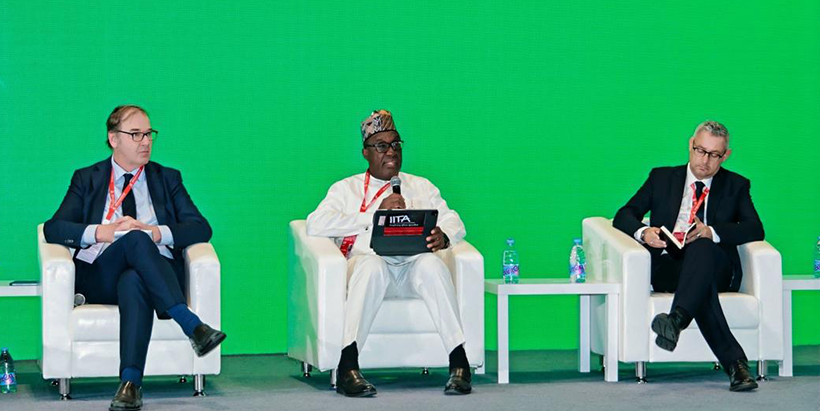
Dr Simeon Ehui with other panelists during the panel session.
At the recent 2025 World Agrifood Innovation (WAFI) Conference in Pinggu, Beijing,IITA Director General and CGIAR Regional Director for Continental Africa, Dr Simeon Ehui, joined global leaders, government officials, researchers, and private sector innovators to deliver a compelling address on the future of resilient agrifood systems and Africa–China cooperation.
Speaking during the high-level dialogue and the launch of the International Cooperation Initiative, Dr Ehui emphasized that resilience is no longer an abstract goal but “the design principle we must apply to every seed, every service, and every supply chain.” He underscored the urgency of transforming agrifood systems as climate shocks intensify, supply chains face repeated disruptions, and millions of African livelihoods remain vulnerable.
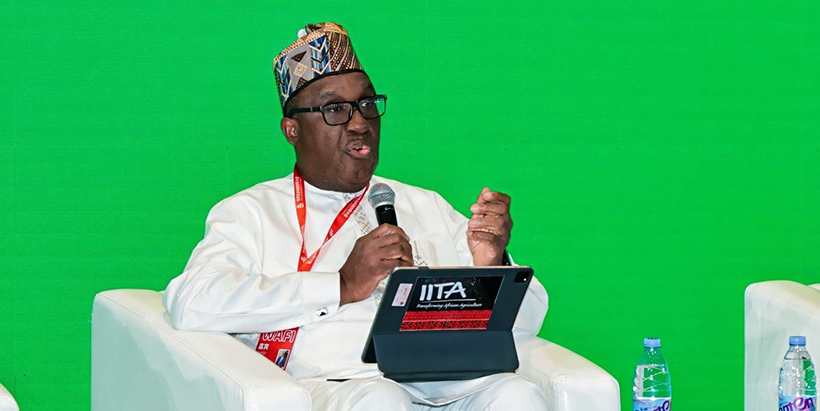
Dr Simeon Ehui during his presentation.
Representing CGIAR and IITA, Dr Ehui highlighted the organizations’ comparative advantage: turning science into scalable innovations. He shared examples of Africa-wide impact, including climate-resilient varieties of maize, cassava, cowpea, soybean, rice, and banana; regenerative agronomy packages; digital advisory services reaching millions via SMS, apps, and radio; and strengthened seed systems that ensure high-quality planting material reaches last-mile farmers.
Africa–China partnerships for transformation
A central theme of Dr Ehui’s address was the opportunity for deeper, more strategic Africa–China collaboration. He noted China’s strengths in seed technology, irrigation, mechanization, digital infrastructure, and renewable energy also, Africa’s growing markets, youth talent, and need for climate-smart solutions.
“Together, we can co-create technologies, build value chains, and shape investment models that work at continental scale,” he said.
Dr Ehui outlined four priority areas where cooperation can accelerate impact:
Co-creation of climate-resilient technologies: Joint breeding pipelines for heat-tolerant, drought-resistant, biofortified, and pest-resilient crops—co-developed and tested by African and Chinese research teams.
Mechanization and postharvest innovation: Scaling affordable two-wheel tractors, planters, threshers, and solar-powered drying and cold storage systems, complemented by local manufacturing networks.
Digital agronomy and open innovation platforms: Building interoperable data ecosystems that integrate weather, soil, crop, and market information using advanced technologies including 5G, IoT, and remote sensing.
Blended finance for resilient value chains: Risk-sharing instruments that mobilize private capital, support seed companies, and reward climate-smart practices.
With the launch of the International Cooperation Initiative, CGIAR and IITA proposed a five-pillar framework to move from “cooperation to co-creation”:
Joint R&D and proof-of-scale through multi-country breeding and agronomy pipelines.
Open digital infrastructure with common standards and shared data governance.
Resilient value chain platforms for priority staples and orphan crops.
Performance-based finance that rewards resilience, inclusion, and low emissions.
Talent and enterprise exchange for young scientists, engineers, and agripreneurs.
Dr Ehui described a vision of success where farmers grow climate-ready varieties, SMEs adopt efficient mechanization, digital advisory becomes borderless, and women and youth lead thriving agribusinesses across Africa.
He urged governments to align regulatory pathways and invest in climate-smart rural infrastructure; investors to support blended-finance instruments and data systems; researchers and private sector players to adopt shared R&D and data standards; and farmer organizations to co-design and evaluate solutions.
“Resilience is achievable and profitable when we design for it,” Dr Ehui concluded. “Africa–China partnerships can help us move faster and farther—from labs to livelihoods, from pilots to portfolios, from cooperation to co-investment.”
The participation of IITA and CGIAR at this high-level forum reinforces the institute’s commitment to building globally connected, locally impactful solutions that strengthen food systems and improve livelihoods across Africa and beyond.
Contributed by ’Timilehin Osunde
Olamide Deborah Nwanze is a Senior Research Associate specializing in gender mainstreaming research to inform participatory and inclusive breeding, variety development, and seed systems policies regarding root, tuber, and banana (RTB) crops in the International Institute of Tropical Agriculture Headquarters, Ibadan, Nigeria. She is a PhD candidate at the University of Ibadan and holds an MSc and B. Agric in Agricultural Extension and Rural Development. Olamide is a fellow of the African Women in Agricultural Research and Development – Gender Responsive Agricultural Systems Policy (AWARD-GRASP) and the Gender Responsive Researchers Equipped for Agricultural Transformation (GREAT). She seeks to apply her gender-mainstreaming learnings, gender-responsive research, and policy development, and review expertise to facilitate women, youth, children, and vulnerable social group’s access to and adoption of agricultural Innovations that guarantee food, nutrition, income, and livelihood security in Africa. Her current roles include mentoring research fellows, development of guides and training manuals, implementation and adaptation of gender frameworks and tools, value chain actors’ engagement as citizen science partners, policy review and redesign, data management, and analysis. Her current research explores mixed methods and participatory and interdisciplinary approaches to capture and highlight gender dynamics, needs, preferences, and challenges stakeholders face within the agricultural livelihood value chain to prioritize gender-inclusive strategies in breeding programs, policy design, and implementation.
de Sousa, K., van Etten, J., Manners, R. Bello, A., Teeken, B., Olaosebikan, O., et al. 2024. The tricot approach: an agile framework for decentralized on-farm testing supported by citizen science. A retrospective. Agron. Sustain. Dev. 44, 8. https://doi.org/10.1007/s13593-023-00937-1
Madu, T., Onwuka, S., Nwafor, S., Onyemauwa, N., Ejechi, M., Ofoeze, M., Ukeje, B., Eluagu, C., Olaosebikan, O., Okoye, B., 2024. Gender-Inclusive Consumer Studies Improve Cassava Breeding in Nigeria in: Frontiers in Sociology, volume 9, number: 1224504, doi: 10.3389/fsoc.2024.1224504
Olaosebikan, O.; Bello, A.; Utoblo, O.; Okoye, B.; Olutegbe, N.; Garner, E.; Teeken, B.; Bryan, E.; Forsythe, L.; Cole, S.; Madu, T. 2023. Stressors and Resilience within the Cassava Value Chain in Nigeria: Preferred Cassava Variety Traits and Response Strategies of Men and Women to Inform Breeding. Sustainability 15, 7837. https://doi.org/10.3390/su15107837
Okoye, B., Ofoeze, M., Ejechi, M., Onwuka, S., Nwafor, S., Onyemauwa, N., Ukeje, B., Eluagu, C., Obidiegwu, J.*, Olaosebikan, O., Madu, T.* 2023. Prioritizing preferred traits in the yam value chain in Nigeria: a gender situation analysis in: Frontiers in Sociology, volume 8, number: 1232626, pages 1 – 9, ISSN 2297-7775, 2023. https://www.frontiersin.org/articles/10.3389/fsoc.2023.1232626/full
Olaosebikan, O., Bello, A. A., de Sousa, K., Ndjouenkeu, R., Adesokan, M., Alamu, E. O., Agbona, A., van Etten, J., Kegah, F. N.*, Dufour, D., Bouniol, A., Teeken, B. 2023. Consumer acceptability of cassava gari-eba food products across cultural and environmental settings using the triadic comparison of technologies approach (tricot) in: Journal of the Science of Food and Agriculture,
Teeken, B., Olaosebikan, O., Bello, A. A., Madu, T.*, Cole, S. M. 2023. Qualitative assessment on the positionality and preferences of dyads in relation to cassava-related activities: working with tricot trial citizen scientists https://hdl.handle.net/10568/138326 Type: Manual
Bouniol, A., Ceballos, H., Bello, A. A., Teeken, B., Olaosebikan, O., Owoade, D., Agbona, A., Fotso Kuate, A., Madu, T.*, Okoye, B.*, Ofoeze, M.*, Nwafor, S.*, Onyemauwa, N.*, Adinsi, L.*, Forsythe, L., Dufour, D. 2023. Varietal impact on women’s labour, workload and related drudgery in processing root, tuber and banana crops: focus on cassava in sub-Saharan Africa in: Journal of the Science of Food and Agriculture, pages 1 – 25, ISSN 0022-5142,
Bello, A. A., Agbona, A., Olaosebikan, O., Edughaen, G., Dufour, D., Bouniol, A., Iluebbey, P., Ndjouenkeu, R.*, Rabbi, I. Y., Teeken, B. 2023. Genetic and environmental effects on processing productivity and food product yield: drudgery of women’s work in: Journal of the Science of Food and Agriculture, pages 1 – 32, ISSN 0022-5142, 5
Cavicchioli, M., Zimbiti, T., Teeken, B., Nwanze, D.O., Liani, M., Parkes, E. & Bello, A. 2023. IITA-Gender Responsive Breeding Training Report. Genetic Resources Center, IITA-HQ, Ibadan, 21-23 September, 2022. Ibadan, Nigeria: IITA, (34 p.).https://hdl.handle.net/10568/131368
Agbona, A. Peteti P., Teeken B., Olaosebikan O. Bello, A. A., Parkes, E., Rabbi, I. Y., Mueller, L., Egesi, C., Kulakow, P. 2022. Data Management in Multi-disciplinary African RTB Crop Breeding Programs. In: Williamson, H.F., Leonelli, S. (eds) Towards Responsible Plant Data Linkage: Data Challenges for Agricultural Research and Development. Springer, Cham. https://doi.org/10.1007/978-3-031-13276-6_5
Lora Forsythe, Pricilla Marimo, Sarah Mayanja, Olamide D. Olaosebikan, Esme Stuart, Bela Teeken, Benjamin Okoye, Tessy Madu, (2021). Cross-product Gender Analysis of RTBfoods Step 2 Gendered Food Mapping on RTB Products. Understanding the Drivers of Trait Preferences and the Development of Multi-user RTB Product Profiles, WP1. London, UK: RTBfoods Field Scientific Report, 30 p.
Teeken, B., Garner, E., Agbona, A., Balogun, I., Olaosebikan, O., Bello, A., Madu, T., Okoye, B., Egesi, C., Kulakow, P. and Tufan, H.A. 2021. Beyond “Women’s Traits”: Exploring How Gender, Social Difference, and Household Characteristics Influence Trait Preferences. Frontiers Sustainable Food Systems 5:740926. https://doi.org/10.3389/fsufs.2021.740926
Teeken, B., Agbona, A., Bello, A., Olaosebikan, O., Alamu, E., Adesokan, M., Awoyale, W., Madu, T., Okoye, B., Chijioke, U., Owoade, D., Okoro, M., Bouniol, A., Dufour, D., Hershey, C., Rabbi, I., Maziya‐Dixon, B., Egesi, C., Tufan, H. and Kulakow, P. (020. Understanding cassava varietal preferences through pairwise ranking of gari‐eba and fufu prepared by local farmer–processors. Int J Food Sci Technol.https://doi.org/10.1111/ijfs.14862
Bela Teeken, Olamide Olaosebikan, Ireti Balogun, Benjamin Okoye, Tessy Madu, Steven Cole, Abolore Bello, Elizabeth Parkes. (2020). Piloting the G+ customer and product profile tools for gender-responsive cassava breeding in Nigeria. Nigeria: International Institute of Tropical Agriculture (IITA). https://hdl.handle.net/20.500.11766/13000