Jigawa State and IITA are sowing the seeds of agricultural transformation
December 22, 2025
Dr Simeon Ehui with Governor Umar Namadi.
What began as a conversation on the sidelines of the Africa Food Systems Summit in Dakar, Senegal in September took firm roots in Ibadan, Nigeria with the visit of Mallam Umar Namadi, Executive Governor of Jigawa State, to IITA’s headquarters recently.
Welcomed by IITA-CGIAR’s Director General, Dr Simeon Ehui, the Governor led a high-level delegation on a visit that underscored agriculture’s central role in Jigawa State’s development strategy—and the power of science-driven partnerships to unlock that potential.
Standing before IITA scientists and leadership, Governor Namadi spoke with clarity and conviction. In Jigawa State, agriculture is more than an economic sector—it is the backbone of society. Nearly 90 percent of the population depends on it, and it contributes over 60 percent of the State’s Gross Domestic Product. For Governor Namadi, transforming agriculture is synonymous with transforming lives.
Over the past two and a half years, his administration has pursued an ambitious reform agenda: scaling up mechanization, deploying Nigeria’s largest agricultural extension network, introducing digital farmer databases and input vouchers, expanding climate-smart irrigation, and rolling out a comprehensive agricultural policy to guide transformation from 2024 to 2030. The goal is clear—to shift from subsistence farming to a modern, resilient, and commercially competitive agricultural economy.
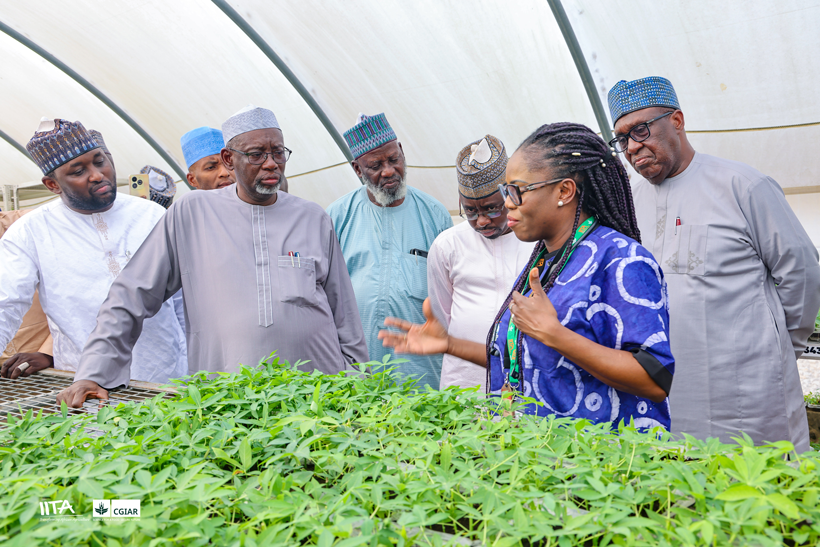
Governor Umar Namadi with Dr Simeon Ehui at the SAH screenhouse listening to Dr Mercy Diebiru-Ojo.
While Governor Namadi highlighted some of the challenges ahead like climate change, soil degradation, heat stress, and emerging pests threatening yields, he emphasized that addressing them requires science, innovation, and strong institutional partnerships—precisely why Jigawa turned to IITA.
Our science that meets food security needs
In his welcome address, Dr Ehui highlighted the natural alignment between Jigawa’s priorities and IITA’s mission: generating and delivering innovations that tackle hunger, poverty, malnutrition, and environmental degradation.
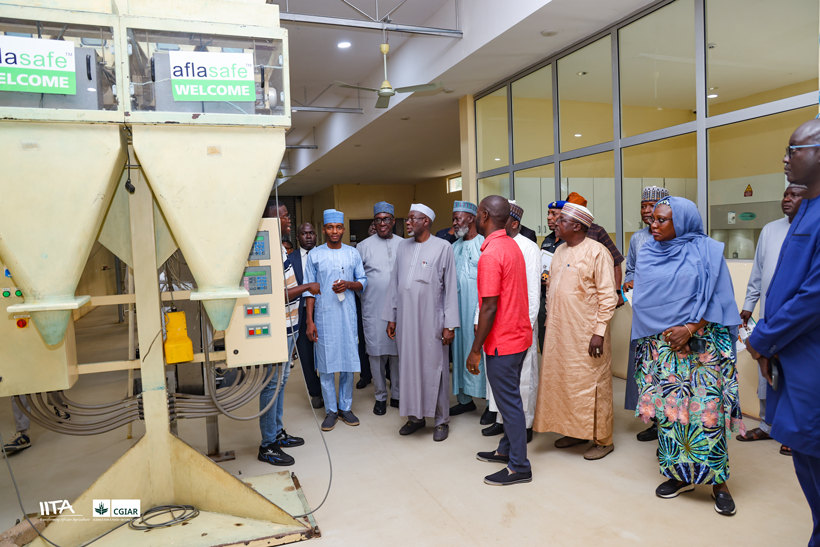
overnor Umar Namadi with Dr Simeon Ehui and the delegation at the Aflasafe building at the IITA Campus, Ibadan.
From resilient seed systems and digital soil intelligence to youth agribusiness incubation, mechanization, irrigation solutions, and biological control technologies such as Aflasafe, the Governor and his team were introduced to innovations that are not confined to laboratories—but ready for adaptation and scale.
“These solutions are practical, proven, and designed for impact,” Dr Ehui noted, stressing that IITA’s work across Nigeria and Africa demonstrates how research can translate into real productivity gains and livelihood improvements for farmers and agribusinesses alike.
The visit also marked tangible progress in an already growing collaboration. Through the WATEA initiative, IITA-CGIAR is supporting young women in Jigawa to build skills, link with agrifood SMEs, and establish sustainable enterprises.
Governor Namadi’s decision to allocate land in Malam Madori for IITA’s cowpea breeding program further signaled Jigawa’s readiness to co-invest in long-term scientific solutions with regional and national impact.
The high point of the visit was the signing of a Memorandum of Understanding with the Jigawa Agricultural Transformation Agency (JATA). More than a formal document, the MoU provides a flexible framework to co-design and implement programs focused on improved crop varieties, integrated pest management, soil health, value chain development, and youth-led agribusiness.
As Governor Namadi aptly put it, the partners were not merely signing an agreement—they were “sowing a seed”: a seed of collaboration, shared responsibility, and commitment to the farmers, women, and youth of Jigawa State.
Mapping the road to impact
The sense of momentum was further reinforced during the wrap-up session, where both teams reflected on the visit and, crucially, agreed on a clear pathway from dialogue to delivery.
The Director General of JATA, Dr Saifullahi Umar Basirka noted that the tour of IITA’s facilities revealed a strong convergence between the State’s priorities and the Institute’s technological strengths. From agribusiness infrastructure and digital agriculture to soil health management, germplasm resources, and soil mapping, the delegation saw solutions that directly respond to Jigawa’s transformation goals.
A detailed presentation by Dr Abdoulaye Tahirou IITA Deputy Director General Partnership for Delivery and Scaling demonstrated how the Institute’s technologies and programs are already contributing to food security and improved livelihoods across Africa—and how these same innovations can be tailored to Jigawa State’s specific agro-ecological and socio-economic context.
To ensure momentum is sustained, IITA outlined a phased roadmap for implementation. In the first six months, the focus will be on governance and collaboration structures, joint planning and needs assessment, and the development of concept notes to guide program design and resource mobilization. Between six and eighteen months, attention will shift to infrastructure setup, deployment of digital tools, and the commencement of on-the-ground implementation. Beyond eighteen months, the partnership will emphasize capacity building, knowledge transfer, and the scaling and sustainability of joint interventions.
Responding to the roadmap, Jigawa’s agriculture leadership affirmed that the proposed approach captures the State’s expectations, particularly in priority areas such as agribusiness development, digital agriculture, soil health, soil mapping, and access to improved genetic resources.
In his closing remarks, Dr Ehui expressed deep appreciation to the Governor, the agriculture leadership, and the entire delegation for what he described as a clear demonstration of commitment to Jigawa’s agricultural future. The exchange, he noted, showed strong alignment and effective teamwork between both institutions.
“Our ambition is to move quickly from discussion to implementation,” he emphasized. “This partnership is not a one-off engagement—it marks the beginning of sustained collaboration and expanded joint action.”
That spirit was symbolically reinforced with the presentation of a commemorative plaque from Dr Ehui to Governor Namadi, marking not an endpoint, but the formal beginning of a shared journey.
As the meeting came to a close, results from the engagements between both sides will be seen in the years ahead—healthier soils, higher productivity, resilient farming systems, thriving agribusinesses, empowered youth, and improved livelihoods across Jigawa State, delivering food security, prosperity, and opportunity for generations to come.
Contributed by ’Timilehin Osunde and Ochuwa Daramola
Olamide Deborah Nwanze is a Senior Research Associate specializing in gender mainstreaming research to inform participatory and inclusive breeding, variety development, and seed systems policies regarding root, tuber, and banana (RTB) crops in the International Institute of Tropical Agriculture Headquarters, Ibadan, Nigeria. She is a PhD candidate at the University of Ibadan and holds an MSc and B. Agric in Agricultural Extension and Rural Development. Olamide is a fellow of the African Women in Agricultural Research and Development – Gender Responsive Agricultural Systems Policy (AWARD-GRASP) and the Gender Responsive Researchers Equipped for Agricultural Transformation (GREAT). She seeks to apply her gender-mainstreaming learnings, gender-responsive research, and policy development, and review expertise to facilitate women, youth, children, and vulnerable social group’s access to and adoption of agricultural Innovations that guarantee food, nutrition, income, and livelihood security in Africa. Her current roles include mentoring research fellows, development of guides and training manuals, implementation and adaptation of gender frameworks and tools, value chain actors’ engagement as citizen science partners, policy review and redesign, data management, and analysis. Her current research explores mixed methods and participatory and interdisciplinary approaches to capture and highlight gender dynamics, needs, preferences, and challenges stakeholders face within the agricultural livelihood value chain to prioritize gender-inclusive strategies in breeding programs, policy design, and implementation.
de Sousa, K., van Etten, J., Manners, R. Bello, A., Teeken, B., Olaosebikan, O., et al. 2024. The tricot approach: an agile framework for decentralized on-farm testing supported by citizen science. A retrospective. Agron. Sustain. Dev. 44, 8. https://doi.org/10.1007/s13593-023-00937-1
Madu, T., Onwuka, S., Nwafor, S., Onyemauwa, N., Ejechi, M., Ofoeze, M., Ukeje, B., Eluagu, C., Olaosebikan, O., Okoye, B., 2024. Gender-Inclusive Consumer Studies Improve Cassava Breeding in Nigeria in: Frontiers in Sociology, volume 9, number: 1224504, doi: 10.3389/fsoc.2024.1224504
Olaosebikan, O.; Bello, A.; Utoblo, O.; Okoye, B.; Olutegbe, N.; Garner, E.; Teeken, B.; Bryan, E.; Forsythe, L.; Cole, S.; Madu, T. 2023. Stressors and Resilience within the Cassava Value Chain in Nigeria: Preferred Cassava Variety Traits and Response Strategies of Men and Women to Inform Breeding. Sustainability 15, 7837. https://doi.org/10.3390/su15107837
Okoye, B., Ofoeze, M., Ejechi, M., Onwuka, S., Nwafor, S., Onyemauwa, N., Ukeje, B., Eluagu, C., Obidiegwu, J.*, Olaosebikan, O., Madu, T.* 2023. Prioritizing preferred traits in the yam value chain in Nigeria: a gender situation analysis in: Frontiers in Sociology, volume 8, number: 1232626, pages 1 – 9, ISSN 2297-7775, 2023. https://www.frontiersin.org/articles/10.3389/fsoc.2023.1232626/full
Olaosebikan, O., Bello, A. A., de Sousa, K., Ndjouenkeu, R., Adesokan, M., Alamu, E. O., Agbona, A., van Etten, J., Kegah, F. N.*, Dufour, D., Bouniol, A., Teeken, B. 2023. Consumer acceptability of cassava gari-eba food products across cultural and environmental settings using the triadic comparison of technologies approach (tricot) in: Journal of the Science of Food and Agriculture,
Teeken, B., Olaosebikan, O., Bello, A. A., Madu, T.*, Cole, S. M. 2023. Qualitative assessment on the positionality and preferences of dyads in relation to cassava-related activities: working with tricot trial citizen scientists https://hdl.handle.net/10568/138326 Type: Manual
Bouniol, A., Ceballos, H., Bello, A. A., Teeken, B., Olaosebikan, O., Owoade, D., Agbona, A., Fotso Kuate, A., Madu, T.*, Okoye, B.*, Ofoeze, M.*, Nwafor, S.*, Onyemauwa, N.*, Adinsi, L.*, Forsythe, L., Dufour, D. 2023. Varietal impact on women’s labour, workload and related drudgery in processing root, tuber and banana crops: focus on cassava in sub-Saharan Africa in: Journal of the Science of Food and Agriculture, pages 1 – 25, ISSN 0022-5142,
Bello, A. A., Agbona, A., Olaosebikan, O., Edughaen, G., Dufour, D., Bouniol, A., Iluebbey, P., Ndjouenkeu, R.*, Rabbi, I. Y., Teeken, B. 2023. Genetic and environmental effects on processing productivity and food product yield: drudgery of women’s work in: Journal of the Science of Food and Agriculture, pages 1 – 32, ISSN 0022-5142, 5
Cavicchioli, M., Zimbiti, T., Teeken, B., Nwanze, D.O., Liani, M., Parkes, E. & Bello, A. 2023. IITA-Gender Responsive Breeding Training Report. Genetic Resources Center, IITA-HQ, Ibadan, 21-23 September, 2022. Ibadan, Nigeria: IITA, (34 p.).https://hdl.handle.net/10568/131368
Agbona, A. Peteti P., Teeken B., Olaosebikan O. Bello, A. A., Parkes, E., Rabbi, I. Y., Mueller, L., Egesi, C., Kulakow, P. 2022. Data Management in Multi-disciplinary African RTB Crop Breeding Programs. In: Williamson, H.F., Leonelli, S. (eds) Towards Responsible Plant Data Linkage: Data Challenges for Agricultural Research and Development. Springer, Cham. https://doi.org/10.1007/978-3-031-13276-6_5
Lora Forsythe, Pricilla Marimo, Sarah Mayanja, Olamide D. Olaosebikan, Esme Stuart, Bela Teeken, Benjamin Okoye, Tessy Madu, (2021). Cross-product Gender Analysis of RTBfoods Step 2 Gendered Food Mapping on RTB Products. Understanding the Drivers of Trait Preferences and the Development of Multi-user RTB Product Profiles, WP1. London, UK: RTBfoods Field Scientific Report, 30 p.
Teeken, B., Garner, E., Agbona, A., Balogun, I., Olaosebikan, O., Bello, A., Madu, T., Okoye, B., Egesi, C., Kulakow, P. and Tufan, H.A. 2021. Beyond “Women’s Traits”: Exploring How Gender, Social Difference, and Household Characteristics Influence Trait Preferences. Frontiers Sustainable Food Systems 5:740926. https://doi.org/10.3389/fsufs.2021.740926
Teeken, B., Agbona, A., Bello, A., Olaosebikan, O., Alamu, E., Adesokan, M., Awoyale, W., Madu, T., Okoye, B., Chijioke, U., Owoade, D., Okoro, M., Bouniol, A., Dufour, D., Hershey, C., Rabbi, I., Maziya‐Dixon, B., Egesi, C., Tufan, H. and Kulakow, P. (020. Understanding cassava varietal preferences through pairwise ranking of gari‐eba and fufu prepared by local farmer–processors. Int J Food Sci Technol.https://doi.org/10.1111/ijfs.14862
Bela Teeken, Olamide Olaosebikan, Ireti Balogun, Benjamin Okoye, Tessy Madu, Steven Cole, Abolore Bello, Elizabeth Parkes. (2020). Piloting the G+ customer and product profile tools for gender-responsive cassava breeding in Nigeria. Nigeria: International Institute of Tropical Agriculture (IITA). https://hdl.handle.net/20.500.11766/13000