
IITA NEWS

ACSAM delegates hail IITA youth model as Africa’s blueprint in agricultural transformation
February 13, 2026

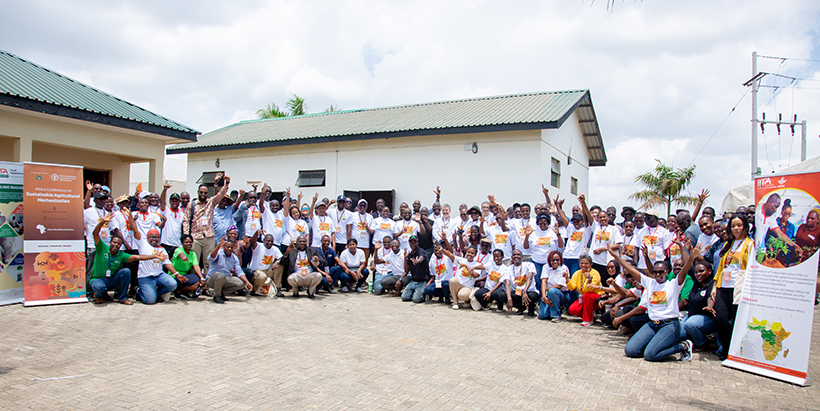
ACSAM delegates with IITA youth participants and staff during the field visit. (Photo credit: FAO).

When over 100 delegates from the Africa Conference on Sustainable Agricultural Mechanization (ACSAM) visited the IITACGIAR Youth Incubation Centre on 6 February in Dar es Salaam, they witnessed a demonstration of a model that turned four days of conference deliberations into a tangible reality. The key takeaways endorsed by 400 stakeholders were not merely theoretical ideals; they were already operational, scalable, and transforming lives in Tanzania.

“What you are doing truly reflects the discussions we have had over the past three days,” said Mark Fynn, Policy Officer at the UN Food and Agriculture Organization (FAO). “We sincerely thank IITA for hosting us and demonstrating that these discussions are not just theoretical but are being actively implemented on the ground. We are excited to witness this in action.”
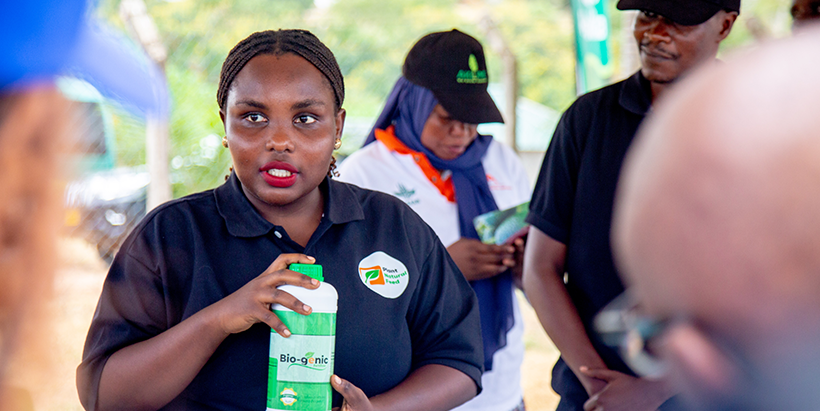
IITA youth beneficiary demonstrates a bio-fertilizer product developed through the program's training and mentorship. (Photo credit: FAO).
IITA youth beneficiary demonstrates a bio-fertilizer product developed through the program’s training and mentorship. (Photo credit: FAO).

The four-day gathering, organized by FAO from 3-6 February 2026, brought together approximately 400 participants, including representatives of farming communities, mechanization practitioners, researchers, development partners, government officials, extension officers, civil society organizations, thought leaders, and private-sector actors. The conference explored new pathways for sustainable agricultural mechanization and produced several recommendations. Remarkably, the IITA Youth Incubation Centre is already implementing many of them.

In line with the conference theme of enhancing investment and financing, the Center presented its partnerships-driven model involving municipal councils, financial institutions, and the various Foundations. Through these collaborations, youth gain access to soft loans at 10% interest, financed by municipal internal revenue. To date, the Center has supported 16 youth and women’s groups, each comprising an average of 5 members, totaling approximately USD 7,200 per group. These funds have enabled enterprises in poultry production, cassava value addition, organic fertilizer production, maize milling, fruit and vegetable farming, and financial literacy services.

Advancing service-based mechanization business models, program graduates now operate youth-led farming enterprises, mechanized agro-processing ventures, and agribusiness start-ups. Many have transitioned into self-employment as professional service providers or cooperative members, creating jobs and strengthening local value chains.

Responding to the conference’s call for African solutions to African challenges and for stronger mechanization ecosystems, IITA showcased its two-decade partnership with Intermech Engineering Limited (IEL), a Tanzania-based company that manufactures agricultural implements and agro- and food-processing machinery tailored to local conditions.

What began as an initiative to adapt cassava processing equipment has evolved into a national and regional hub for postharvest and processing technologies, serving farming communities across the region.

“At IITA-CGIAR, we recognize that mechanization only works when it fits the local context,” said Dr Frederick Baijukya, IITA Country Representative for Tanzania. “Our approach goes beyond importing technologies. We collaborate closely with local artisans, engineers, and the private sector partners to co-create, co-engineer, and adapt machinery that is functional, maintainable, and sustainably adopted by farmers and agribusiness.”

While opportunities remain to further strengthen the model, the Center’s impact underscores its potential for replication across the continent. Since its establishment, it has trained and supported more than 10,000 youth and women farmers in Dar es Salaam, Newala, Mafinga, Dodoma, and Singida through hands-on practical knowledge transfer and technology adoption.

For delegates from across Africa, the Center offered more than inspiration; it presented a blueprint. The model demonstrates that sustainable agricultural mechanization depends on adapting proven approaches to local contexts, expanding youth access to finance and technology, and building partnerships that reinforce local capacity and long-term resilience.

Contributed by Gloriana Ndibalema and Hadi Rashid


Contributed by

Related news

No items found

Leave a Reply

Your email address will not be published. Required fields are marked *

Scroll to Top
Olaosebikan, Olamide

Olamide Deborah Nwanze is a Senior Research Associate specializing in gender mainstreaming research to inform participatory and inclusive breeding, variety development, and seed systems policies regarding root, tuber, and banana (RTB) crops in the International Institute of Tropical Agriculture Headquarters, Ibadan, Nigeria. She is a PhD candidate at the University of Ibadan and holds an MSc and B. Agric in Agricultural Extension and Rural Development. Olamide is a fellow of the African Women in Agricultural Research and Development – Gender Responsive Agricultural Systems Policy (AWARD-GRASP) and the Gender Responsive Researchers Equipped for Agricultural Transformation (GREAT). She seeks to apply her gender-mainstreaming learnings, gender-responsive research, and policy development, and review expertise to facilitate women, youth, children, and vulnerable social group’s access to and adoption of agricultural Innovations that guarantee food, nutrition, income, and livelihood security in Africa. Her current roles include mentoring research fellows, development of guides and training manuals, implementation and adaptation of gender frameworks and tools, value chain actors’ engagement as citizen science partners, policy review and redesign, data management, and analysis. Her current research explores mixed methods and participatory and interdisciplinary approaches to capture and highlight gender dynamics, needs, preferences, and challenges stakeholders face within the agricultural livelihood value chain to prioritize gender-inclusive strategies in breeding programs, policy design, and implementation.

At IITA, she contributes to the implementation of the CGIAR Accelerated Breeding Initiative and Genetic Innovation Programs; participatory and gender research within the NextGen CassavaHarvestPlusRTBFoods, and Tricot-ClimMob 1000Farms Projects; and gender knowledge communication via the G-LENS webinar series, video documentary, policy briefspublications, and blogs.


Recent publications

de Sousa, K., van Etten, J., Manners, R. Bello, A., Teeken, B., Olaosebikan, O., et al. 2024. The tricot approach: an agile framework for decentralized on-farm testing supported by citizen science. A retrospective. Agron. Sustain. Dev. 44, 8. https://doi.org/10.1007/s13593-023-00937-1

Madu, T., Onwuka, S., Nwafor, S., Onyemauwa, N., Ejechi, M., Ofoeze, M., Ukeje, B., Eluagu, C., Olaosebikan, O., Okoye, B., 2024. Gender-Inclusive Consumer Studies Improve Cassava Breeding in Nigeria in: Frontiers in Sociology, volume 9, number: 1224504, doi: 10.3389/fsoc.2024.1224504

Olaosebikan, O.; Bello, A.; Utoblo, O.; Okoye, B.; Olutegbe, N.; Garner, E.; Teeken, B.; Bryan, E.; Forsythe, L.; Cole, S.; Madu, T. 2023.  Stressors and Resilience within the Cassava Value Chain in Nigeria: Preferred Cassava Variety Traits and Response Strategies of Men and Women to Inform Breeding. Sustainability 15, 7837. https://doi.org/10.3390/su15107837

Okoye, B., Ofoeze, M., Ejechi, M., Onwuka, S., Nwafor, S., Onyemauwa, N., Ukeje, B., Eluagu, C., Obidiegwu, J.*, Olaosebikan, O., Madu, T.* 2023. Prioritizing preferred traits in the yam value chain in Nigeria: a gender situation analysis in: Frontiers in Sociology, volume 8, number: 1232626, pages 1 – 9, ISSN 2297-7775, 2023. https://www.frontiersin.org/articles/10.3389/fsoc.2023.1232626/full

Olaosebikan, O., Bello, A. A., de Sousa, K., Ndjouenkeu, R., Adesokan, M., Alamu, E. O., Agbona, A., van Etten, J., Kegah, F. N.*, Dufour, D., Bouniol, A., Teeken, B. 2023. Consumer acceptability of cassava gari-eba food products across cultural and environmental settings using the triadic comparison of technologies approach (tricot) in: Journal of the Science of Food and Agriculture,

Teeken, B., Olaosebikan, O., Bello, A. A., Madu, T.*, Cole, S. M. 2023. Qualitative assessment on the positionality and preferences of dyads in relation to cassava-related activities: working with tricot trial citizen scientists https://hdl.handle.net/10568/138326 Type: Manual

Bouniol, A., Ceballos, H., Bello, A. A., Teeken, B., Olaosebikan, O., Owoade, D., Agbona, A., Fotso Kuate, A., Madu, T.*, Okoye, B.*, Ofoeze, M.*, Nwafor, S.*, Onyemauwa, N.*, Adinsi, L.*, Forsythe, L., Dufour, D. 2023. Varietal impact on women’s labour, workload and related drudgery in processing root, tuber and banana crops: focus on cassava in sub-Saharan Africa in: Journal of the Science of Food and Agriculture, pages 1 – 25, ISSN 0022-5142,

Bello, A. A., Agbona, A., Olaosebikan, O., Edughaen, G., Dufour, D., Bouniol, A., Iluebbey, P., Ndjouenkeu, R.*, Rabbi, I. Y., Teeken, B. 2023. Genetic and environmental effects on processing productivity and food product yield: drudgery of women’s work in: Journal of the Science of Food and Agriculture, pages 1 – 32, ISSN 0022-5142, 5

Cavicchioli, M., Zimbiti, T., Teeken, B., Nwanze, D.O., Liani, M., Parkes, E. & Bello, A. 2023. IITA-Gender Responsive Breeding Training Report. Genetic Resources Center, IITA-HQ, Ibadan, 21-23 September, 2022. Ibadan, Nigeria: IITA, (34 p.).https://hdl.handle.net/10568/131368

Agbona, A. Peteti P., Teeken B., Olaosebikan O. Bello, A. A., Parkes, E., Rabbi, I. Y., Mueller, L., Egesi, C., Kulakow, P. 2022. Data Management in Multi-disciplinary African RTB Crop Breeding Programs. In: Williamson, H.F., Leonelli, S. (eds) Towards Responsible Plant Data Linkage: Data Challenges for Agricultural Research and Development. Springer, Cham. https://doi.org/10.1007/978-3-031-13276-6_5

Lora Forsythe, Pricilla Marimo, Sarah Mayanja, Olamide D. Olaosebikan, Esme Stuart, Bela Teeken, Benjamin Okoye, Tessy Madu, (2021). Cross-product Gender Analysis of RTBfoods Step 2 Gendered Food Mapping on RTB Products. Understanding the Drivers of Trait Preferences and the Development of Multi-user RTB Product Profiles, WP1. London, UK: RTBfoods Field Scientific Report, 30 p.

Teeken, B., Garner, E., Agbona, A., Balogun, I., Olaosebikan, O., Bello, A., Madu, T., Okoye, B., Egesi, C., Kulakow, P. and Tufan, H.A. 2021. Beyond “Women’s Traits”: Exploring How Gender, Social Difference, and Household Characteristics Influence Trait Preferences. Frontiers Sustainable Food Systems 5:740926. https://doi.org/10.3389/fsufs.2021.740926

Teeken, B., Agbona, A., Bello, A., Olaosebikan, O., Alamu, E., Adesokan, M., Awoyale, W., Madu, T., Okoye, B., Chijioke, U., Owoade, D., Okoro, M., Bouniol, A., Dufour, D., Hershey, C., Rabbi, I., Maziya‐Dixon, B., Egesi, C., Tufan, H. and Kulakow, P. (020. Understanding cassava varietal preferences through pairwise ranking of gari‐eba and fufu prepared by local farmer–processors. Int J Food Sci Technol. https://doi.org/10.1111/ijfs.14862

Bela Teeken, Olamide Olaosebikan, Ireti Balogun, Benjamin Okoye, Tessy Madu, Steven Cole, Abolore Bello, Elizabeth Parkes. (2020). Piloting the G+ customer and product profile tools for gender-responsive cassava breeding in Nigeria. Nigeria: International Institute of Tropical Agriculture (IITA). https://hdl.handle.net/20.500.11766/13000