
IITA NEWS

Strengthening seed systems in Liberia: EU-project improving access to high-quality coffee seedlings via regional seedling nursery hubs
April 13, 2026
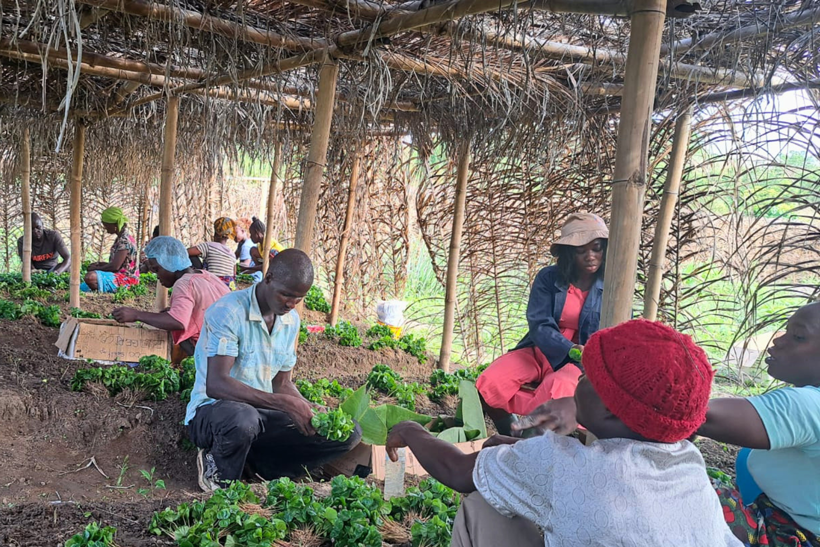
Coffee Germplasm Seedling Garden at CARI developed by the EU-Seeds4Liberia Project (Credit: George A. Harris, AfricaRice -Liberia Station)
In Liberia, the EU-funded Seeds4Liberia Project is expanding access to high-quality coffee seedlings from research facilities to farming communities through a centralized coffee nursery hub model.

National context

In the pre-war Liberia era, coffee was a high economic crop, especially Liberica coffee, which is unique to the country. The coffee sector in Liberia produced 5 percent of the world’s coffee. However, the 14-year civil war destroyed coffee production systems. Post-war, Liberian farmers relied on informal seed distribution networks to keep their farms alive, facing a high risk of loss from climate adversities including pests and diseases affecting low-yielding varieties and non-availability of good quality planting materials. As part of the revitalization efforts of Liberia’s coffee sector, the EU-backed project has established four centralized seedling nursery hubs to improve access to high-quality coffee seedlings for producers in Liberia’s central, eastern, and northwestern regions. The model was conceptualized and employed after the distribution of 267,000 coffee seedlings to farmers in 2025.
“The idea of centralizing coffee seedling nursery hubs in project-producing counties came about after one of our monitoring missions to beneficiary communities,” said Dr. Ranjana Bhattacharjee, Project Coffee Lead. “We observed that coffee nurseries established by the farmers in different communities after receiving the seedlings from IITA/CARI were poorly managed, showing the need for a different approach to increase access to high-quality seedlings from research gates.”
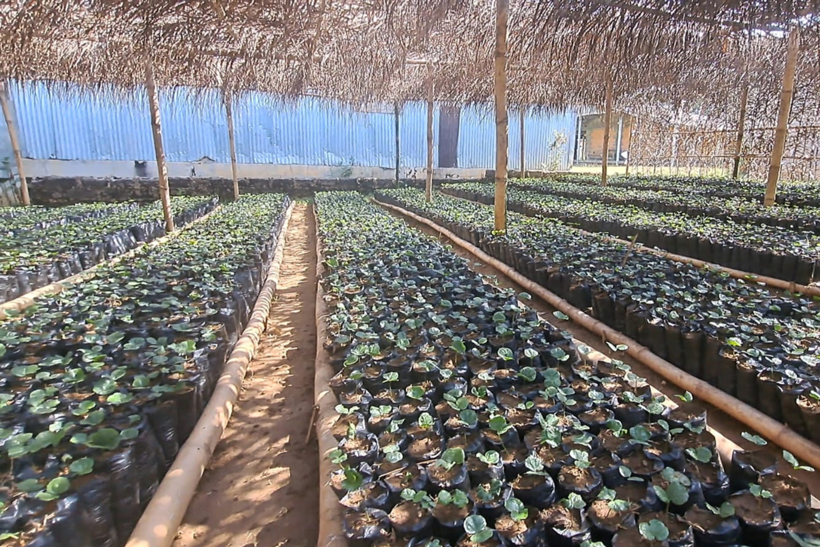
Coffee nursery hub established by the EU-funded Seeds4Liberia Project in Montserrado County (Credit: George A. Harris, AfricaRice-Liberia Station)
The International Institute of Tropical Agriculture (IITA), in collaboration with the Ministry of Agriculture (MoA), the Central Agricultural Research Institute (CARI), the Liberia Agricultural Commodity Regulatory Authority (LACRA), and the Seeds Development and Certification Agency (SDCA), worked together to identify ideal locations across the selected regions in Liberia to establish the centralized seedling nursery hubs.
“We partnered with collaborating government institutions like CARI, LACRA, MoA, and SDCA to identify ideal access points for seedling producers and distribution,” said Dr. Ranjana Bhattacharjee. “We were specifically looking at all of the ideal topographic characteristics for establishing the regional centralized coffee seedling nursery hubs.”
IITA, through the EU-funded Seeds4Liberia Project, is expected to transfer 400,000 coffee seedlings across the four centralized nursery hubs in Bong, Lofa Nimba, and Montserrado in 2026. These nursery hubs will act as centralized seedling distribution hubs to benefit coffee-producing farmers from Bomi, Bong, Montserrado, Lofa, and Nimba counties as well as other counties where coffee can be successfully grown. Eventually, they will become business hubs wherein high-quality coffee seedlings will be produced every year and distributed to farmers. In addition to improving access to high-quality coffee seedlings, the nursery hubs will also serve as centers for capacity strengthening of extension officers as well as farmers through knowledge transfer and improve beneficiary skills on best coffee nursery production practices.
“These nursery hubs are not only access points for high-quality seedlings but are knowledge centers wherein beneficiaries will be trained on best agronomic and management practices,” said Dr. Ranjana Bhattacharjee, Coffee Value Chain Lead, EU-funded Seeds4Liberia Project. “Knowledge transfer will cover topics such as good agronomic practices including proper planting hole sizes, pruning techniques, fertilizer and insecticide application, soil fertility management, and pest and disease control among others,” said Dr. Richard Asare, Senior Scientist in Coffee Value Chain, Seeds4Liberia Project.
IITA is one of the implementing institutions of the EU-funded Seeds4Liberia Project. Under the project, IITA leads cassava, coffee, and soybean value chains, WorldFish leads the fish value chain, while AfricaRice—the project’s lead implementing organization—oversees the rice component. The project is implemented in collaboration with the MoA,), the National Fisheries Authority (NaFAA), LACRA, and SDCA.

Accomplishment so far

Under the EU-funded project, IITA has completed a germplasm collection and diversity study on Liberica, Robusta, and Arabica coffee from across Liberia, established a 2-hectare national coffee gene bank and a 1-hectare Liberica mother garden at CARI, and developed pre-germination nurseries with 400,000 seedlings for distribution in 2026 through the four established centralized seedling nursery hubs, along with a conventional growth chamber for stem-cuttings for transplanting in the mother garden plot. So far, coffee has been transplanted in 135 hectares of farmers’ fields by 362 farmers, while training has been provided to about 30 extension workers, farmer leaders, and college interns in 2025 covering topics such as good agronomic practices in coffee, climate-smart coffee, and agroforestry systems. As Liberia embarks on revamping its seed systems, including coffee, to diversify its economy, the EU-funded Seeds4Liberia Project is helping catalyze? national development frameworks such as the NADP. Contributed by: George A. Harris, Communication Officer, AfricaRice-Liberia Station/EU-funded Seeds4Liberia Project
DISCLAIMER: THE SEEDS4LIBERIA PROJECT IS FUNDED BY THE EUROPEAN UNION. ITS CONTENTS ARE THE SOLE RESPONSIBILITY OF THE AUTHOR AND IMPLEMENTING INSTITUTION(S) OF THE PROJECT AND DO NOT NECESSARILY REFLECT THE VIEWS OF THE EUROPEAN UNION.

Contributed by

Related news

No items found

Leave a Reply

Your email address will not be published. Required fields are marked *

Scroll to Top
Olaosebikan, Olamide

Olamide Deborah Nwanze is a Senior Research Associate specializing in gender mainstreaming research to inform participatory and inclusive breeding, variety development, and seed systems policies regarding root, tuber, and banana (RTB) crops in the International Institute of Tropical Agriculture Headquarters, Ibadan, Nigeria. She is a PhD candidate at the University of Ibadan and holds an MSc and B. Agric in Agricultural Extension and Rural Development. Olamide is a fellow of the African Women in Agricultural Research and Development – Gender Responsive Agricultural Systems Policy (AWARD-GRASP) and the Gender Responsive Researchers Equipped for Agricultural Transformation (GREAT). She seeks to apply her gender-mainstreaming learnings, gender-responsive research, and policy development, and review expertise to facilitate women, youth, children, and vulnerable social group’s access to and adoption of agricultural Innovations that guarantee food, nutrition, income, and livelihood security in Africa. Her current roles include mentoring research fellows, development of guides and training manuals, implementation and adaptation of gender frameworks and tools, value chain actors’ engagement as citizen science partners, policy review and redesign, data management, and analysis. Her current research explores mixed methods and participatory and interdisciplinary approaches to capture and highlight gender dynamics, needs, preferences, and challenges stakeholders face within the agricultural livelihood value chain to prioritize gender-inclusive strategies in breeding programs, policy design, and implementation.

At IITA, she contributes to the implementation of the CGIAR Accelerated Breeding Initiative and Genetic Innovation Programs; participatory and gender research within the NextGen CassavaHarvestPlusRTBFoods, and Tricot-ClimMob 1000Farms Projects; and gender knowledge communication via the G-LENS webinar series, video documentary, policy briefspublications, and blogs.


Recent publications

de Sousa, K., van Etten, J., Manners, R. Bello, A., Teeken, B., Olaosebikan, O., et al. 2024. The tricot approach: an agile framework for decentralized on-farm testing supported by citizen science. A retrospective. Agron. Sustain. Dev. 44, 8. https://doi.org/10.1007/s13593-023-00937-1

Madu, T., Onwuka, S., Nwafor, S., Onyemauwa, N., Ejechi, M., Ofoeze, M., Ukeje, B., Eluagu, C., Olaosebikan, O., Okoye, B., 2024. Gender-Inclusive Consumer Studies Improve Cassava Breeding in Nigeria in: Frontiers in Sociology, volume 9, number: 1224504, doi: 10.3389/fsoc.2024.1224504

Olaosebikan, O.; Bello, A.; Utoblo, O.; Okoye, B.; Olutegbe, N.; Garner, E.; Teeken, B.; Bryan, E.; Forsythe, L.; Cole, S.; Madu, T. 2023.  Stressors and Resilience within the Cassava Value Chain in Nigeria: Preferred Cassava Variety Traits and Response Strategies of Men and Women to Inform Breeding. Sustainability 15, 7837. https://doi.org/10.3390/su15107837

Okoye, B., Ofoeze, M., Ejechi, M., Onwuka, S., Nwafor, S., Onyemauwa, N., Ukeje, B., Eluagu, C., Obidiegwu, J.*, Olaosebikan, O., Madu, T.* 2023. Prioritizing preferred traits in the yam value chain in Nigeria: a gender situation analysis in: Frontiers in Sociology, volume 8, number: 1232626, pages 1 – 9, ISSN 2297-7775, 2023. https://www.frontiersin.org/articles/10.3389/fsoc.2023.1232626/full

Olaosebikan, O., Bello, A. A., de Sousa, K., Ndjouenkeu, R., Adesokan, M., Alamu, E. O., Agbona, A., van Etten, J., Kegah, F. N.*, Dufour, D., Bouniol, A., Teeken, B. 2023. Consumer acceptability of cassava gari-eba food products across cultural and environmental settings using the triadic comparison of technologies approach (tricot) in: Journal of the Science of Food and Agriculture,

Teeken, B., Olaosebikan, O., Bello, A. A., Madu, T.*, Cole, S. M. 2023. Qualitative assessment on the positionality and preferences of dyads in relation to cassava-related activities: working with tricot trial citizen scientists https://hdl.handle.net/10568/138326 Type: Manual

Bouniol, A., Ceballos, H., Bello, A. A., Teeken, B., Olaosebikan, O., Owoade, D., Agbona, A., Fotso Kuate, A., Madu, T.*, Okoye, B.*, Ofoeze, M.*, Nwafor, S.*, Onyemauwa, N.*, Adinsi, L.*, Forsythe, L., Dufour, D. 2023. Varietal impact on women’s labour, workload and related drudgery in processing root, tuber and banana crops: focus on cassava in sub-Saharan Africa in: Journal of the Science of Food and Agriculture, pages 1 – 25, ISSN 0022-5142,

Bello, A. A., Agbona, A., Olaosebikan, O., Edughaen, G., Dufour, D., Bouniol, A., Iluebbey, P., Ndjouenkeu, R.*, Rabbi, I. Y., Teeken, B. 2023. Genetic and environmental effects on processing productivity and food product yield: drudgery of women’s work in: Journal of the Science of Food and Agriculture, pages 1 – 32, ISSN 0022-5142, 5

Cavicchioli, M., Zimbiti, T., Teeken, B., Nwanze, D.O., Liani, M., Parkes, E. & Bello, A. 2023. IITA-Gender Responsive Breeding Training Report. Genetic Resources Center, IITA-HQ, Ibadan, 21-23 September, 2022. Ibadan, Nigeria: IITA, (34 p.).https://hdl.handle.net/10568/131368

Agbona, A. Peteti P., Teeken B., Olaosebikan O. Bello, A. A., Parkes, E., Rabbi, I. Y., Mueller, L., Egesi, C., Kulakow, P. 2022. Data Management in Multi-disciplinary African RTB Crop Breeding Programs. In: Williamson, H.F., Leonelli, S. (eds) Towards Responsible Plant Data Linkage: Data Challenges for Agricultural Research and Development. Springer, Cham. https://doi.org/10.1007/978-3-031-13276-6_5

Lora Forsythe, Pricilla Marimo, Sarah Mayanja, Olamide D. Olaosebikan, Esme Stuart, Bela Teeken, Benjamin Okoye, Tessy Madu, (2021). Cross-product Gender Analysis of RTBfoods Step 2 Gendered Food Mapping on RTB Products. Understanding the Drivers of Trait Preferences and the Development of Multi-user RTB Product Profiles, WP1. London, UK: RTBfoods Field Scientific Report, 30 p.

Teeken, B., Garner, E., Agbona, A., Balogun, I., Olaosebikan, O., Bello, A., Madu, T., Okoye, B., Egesi, C., Kulakow, P. and Tufan, H.A. 2021. Beyond “Women’s Traits”: Exploring How Gender, Social Difference, and Household Characteristics Influence Trait Preferences. Frontiers Sustainable Food Systems 5:740926. https://doi.org/10.3389/fsufs.2021.740926

Teeken, B., Agbona, A., Bello, A., Olaosebikan, O., Alamu, E., Adesokan, M., Awoyale, W., Madu, T., Okoye, B., Chijioke, U., Owoade, D., Okoro, M., Bouniol, A., Dufour, D., Hershey, C., Rabbi, I., Maziya‐Dixon, B., Egesi, C., Tufan, H. and Kulakow, P. (020. Understanding cassava varietal preferences through pairwise ranking of gari‐eba and fufu prepared by local farmer–processors. Int J Food Sci Technol. https://doi.org/10.1111/ijfs.14862

Bela Teeken, Olamide Olaosebikan, Ireti Balogun, Benjamin Okoye, Tessy Madu, Steven Cole, Abolore Bello, Elizabeth Parkes. (2020). Piloting the G+ customer and product profile tools for gender-responsive cassava breeding in Nigeria. Nigeria: International Institute of Tropical Agriculture (IITA). https://hdl.handle.net/20.500.11766/13000