
IITA NEWS

High-quality chromosome-level genome of the white star apple (Gambeya albida)
April 30, 2026

Chart
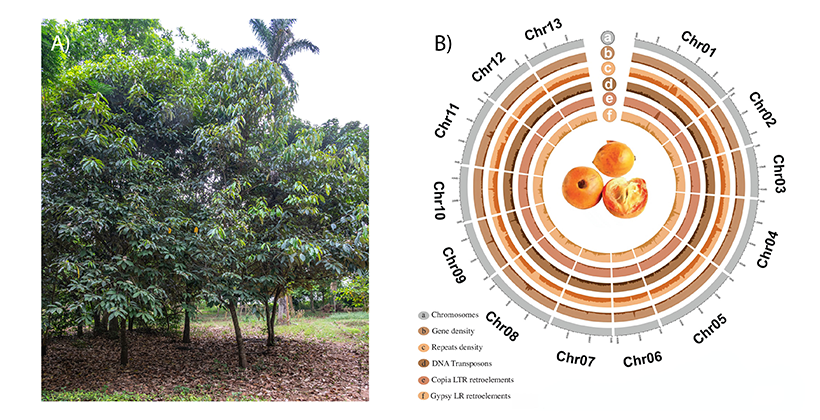
A) White apple tree at IITA Farm Unit. B) Circos plot displaying the chromosomes and the gene and repeat densities of the genome.

In a recent collaboration, Inqaba Biotec, Malimbe Foundation, the African BioGenome Project (AfricaBP), and IITA (Bioinformatics Unit and Forest Center) successfully produced the first chromosome-scale, annotated genome assembly of the white star apple (Gambeya albida), an iconic indigenous fruit tree of West and Central Africa. This achievement marks a significant step forward for African-led genomics, conservation, and agricultural research.

Scientists from the participating institutions jointly led the genome project. Dr Michael Landi (IITA Nairobi) was responsible for the assembly and annotation, and served as the lead author of the resulting manuscript. Abiodun Lukman Aroworamimo led the Inqaba Biotec in local sequencing services, while Dr Adewale Awoyemi of the IITA Forest Center provided ecological leadership. Dr Andreas Gisel (IITA Ibadan) provided bioinformatics support and access to IITA’s Bioinformatics high-performance computing, while Dr ThankGod Echezona Ebenezer guided the work under the AfricaBP ethics and data-governance framework.
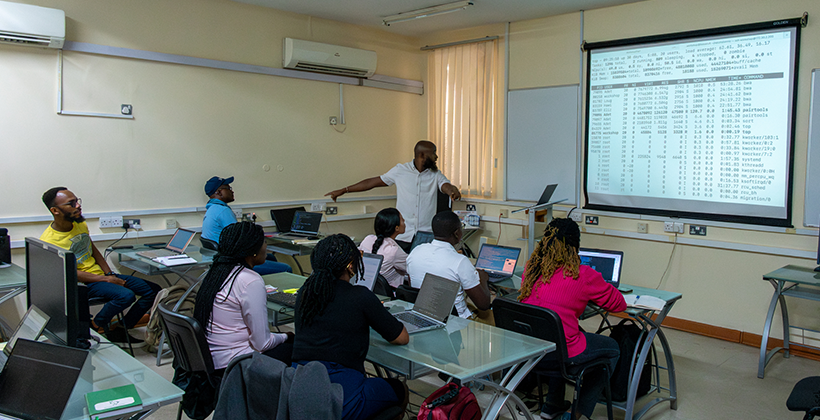
Class of the assembly workshop led by Dr Michael Landi.

The white star apple, known locally as Agbalumo, Udara, Agwaliba, and Alasa, is widely consumed across West and Central Africa, and is valued for its rich vitamin content, medicinal properties, cultural importance, and contribution to household incomes. Despite its economic and cultural relevance, the species has remained genetically under-characterized, limiting opportunities for its enhanced conservation, varietal improvement, and industrial applications. The new genome fills these critical gaps. Using PacBio HiFi long-read sequencing combined with Omni-C scaffolding, we produced an 822 Mbp haploid genome assembled into thirteen chromosomes. This resource provides, for the first time, a comprehensive view of the genetic basis underlying the fruit’s nutritional, medicinal, and metabolic properties.

This newly generated genome will support ongoing efforts to conserve the highly sought-after white star apple, which faces threats from habitat loss, overexploitation, and environmental change. It will also enable future research into fruit quality traits, phytochemical pathways, domestication potential, and improved propagation practices. For breeders, nutritionists, conservationists, and policymakers, the genome offers a foundational tool to unlock the species’ agricultural and economic potential.

Beyond its scientific value, the project demonstrates the rapidly expanding genomic capabilities within Africa. All the sequencing, assembly, annotation, and validation were conducted using local expertise and infrastructure. The collaboration also highlights strengthened partnerships among African research organizations, enabling high-impact genomic discoveries that directly benefit local communities and ecosystems.

The data have been made publicly available in the NCBI SRA repository, with a preprint accessible at Research Square. The manuscript is currently under peer review in Scientific Data.

Another outcome of this collaboration was the transfer of knowledge gained to 11 early-career African scientists from six countries, including the Benin Republic, Cameroon, Côte d’Ivoire, Ethiopia, Nigeria, and Zimbabwe. This was achieved through a 5-day (2-6 June 2025) workshop organized at the Bioscience in Ibadan, in collaboration with Inqaba Biotec, IITA Forest Center, IITA Bioinformatics Unit, and the AfricaBP. The workshop covered extensive theory, discussions, and hands-on sessions using the IITA’s Bioinformatics computing resources and the data from the white star apple project. The eleven beneficiaries were selected through a rigorous fellowship that attracted 260 applicants.

IITA, together with its partners, celebrates this achievement as a landmark contribution to African genomics. The institutions look forward to future collaborations that advance the understanding, conservation, and sustainable use of Africa’s plant biodiversity.

Contributed by Andreas Gisel


Contributed by

Related news

No items found

Leave a Reply

Your email address will not be published. Required fields are marked *

Scroll to Top
Olaosebikan, Olamide

Olamide Deborah Nwanze is a Senior Research Associate specializing in gender mainstreaming research to inform participatory and inclusive breeding, variety development, and seed systems policies regarding root, tuber, and banana (RTB) crops in the International Institute of Tropical Agriculture Headquarters, Ibadan, Nigeria. She is a PhD candidate at the University of Ibadan and holds an MSc and B. Agric in Agricultural Extension and Rural Development. Olamide is a fellow of the African Women in Agricultural Research and Development – Gender Responsive Agricultural Systems Policy (AWARD-GRASP) and the Gender Responsive Researchers Equipped for Agricultural Transformation (GREAT). She seeks to apply her gender-mainstreaming learnings, gender-responsive research, and policy development, and review expertise to facilitate women, youth, children, and vulnerable social group’s access to and adoption of agricultural Innovations that guarantee food, nutrition, income, and livelihood security in Africa. Her current roles include mentoring research fellows, development of guides and training manuals, implementation and adaptation of gender frameworks and tools, value chain actors’ engagement as citizen science partners, policy review and redesign, data management, and analysis. Her current research explores mixed methods and participatory and interdisciplinary approaches to capture and highlight gender dynamics, needs, preferences, and challenges stakeholders face within the agricultural livelihood value chain to prioritize gender-inclusive strategies in breeding programs, policy design, and implementation.

At IITA, she contributes to the implementation of the CGIAR Accelerated Breeding Initiative and Genetic Innovation Programs; participatory and gender research within the NextGen CassavaHarvestPlusRTBFoods, and Tricot-ClimMob 1000Farms Projects; and gender knowledge communication via the G-LENS webinar series, video documentary, policy briefspublications, and blogs.


Recent publications

de Sousa, K., van Etten, J., Manners, R. Bello, A., Teeken, B., Olaosebikan, O., et al. 2024. The tricot approach: an agile framework for decentralized on-farm testing supported by citizen science. A retrospective. Agron. Sustain. Dev. 44, 8. https://doi.org/10.1007/s13593-023-00937-1

Madu, T., Onwuka, S., Nwafor, S., Onyemauwa, N., Ejechi, M., Ofoeze, M., Ukeje, B., Eluagu, C., Olaosebikan, O., Okoye, B., 2024. Gender-Inclusive Consumer Studies Improve Cassava Breeding in Nigeria in: Frontiers in Sociology, volume 9, number: 1224504, doi: 10.3389/fsoc.2024.1224504

Olaosebikan, O.; Bello, A.; Utoblo, O.; Okoye, B.; Olutegbe, N.; Garner, E.; Teeken, B.; Bryan, E.; Forsythe, L.; Cole, S.; Madu, T. 2023.  Stressors and Resilience within the Cassava Value Chain in Nigeria: Preferred Cassava Variety Traits and Response Strategies of Men and Women to Inform Breeding. Sustainability 15, 7837. https://doi.org/10.3390/su15107837

Okoye, B., Ofoeze, M., Ejechi, M., Onwuka, S., Nwafor, S., Onyemauwa, N., Ukeje, B., Eluagu, C., Obidiegwu, J.*, Olaosebikan, O., Madu, T.* 2023. Prioritizing preferred traits in the yam value chain in Nigeria: a gender situation analysis in: Frontiers in Sociology, volume 8, number: 1232626, pages 1 – 9, ISSN 2297-7775, 2023. https://www.frontiersin.org/articles/10.3389/fsoc.2023.1232626/full

Olaosebikan, O., Bello, A. A., de Sousa, K., Ndjouenkeu, R., Adesokan, M., Alamu, E. O., Agbona, A., van Etten, J., Kegah, F. N.*, Dufour, D., Bouniol, A., Teeken, B. 2023. Consumer acceptability of cassava gari-eba food products across cultural and environmental settings using the triadic comparison of technologies approach (tricot) in: Journal of the Science of Food and Agriculture,

Teeken, B., Olaosebikan, O., Bello, A. A., Madu, T.*, Cole, S. M. 2023. Qualitative assessment on the positionality and preferences of dyads in relation to cassava-related activities: working with tricot trial citizen scientists https://hdl.handle.net/10568/138326 Type: Manual

Bouniol, A., Ceballos, H., Bello, A. A., Teeken, B., Olaosebikan, O., Owoade, D., Agbona, A., Fotso Kuate, A., Madu, T.*, Okoye, B.*, Ofoeze, M.*, Nwafor, S.*, Onyemauwa, N.*, Adinsi, L.*, Forsythe, L., Dufour, D. 2023. Varietal impact on women’s labour, workload and related drudgery in processing root, tuber and banana crops: focus on cassava in sub-Saharan Africa in: Journal of the Science of Food and Agriculture, pages 1 – 25, ISSN 0022-5142,

Bello, A. A., Agbona, A., Olaosebikan, O., Edughaen, G., Dufour, D., Bouniol, A., Iluebbey, P., Ndjouenkeu, R.*, Rabbi, I. Y., Teeken, B. 2023. Genetic and environmental effects on processing productivity and food product yield: drudgery of women’s work in: Journal of the Science of Food and Agriculture, pages 1 – 32, ISSN 0022-5142, 5

Cavicchioli, M., Zimbiti, T., Teeken, B., Nwanze, D.O., Liani, M., Parkes, E. & Bello, A. 2023. IITA-Gender Responsive Breeding Training Report. Genetic Resources Center, IITA-HQ, Ibadan, 21-23 September, 2022. Ibadan, Nigeria: IITA, (34 p.).https://hdl.handle.net/10568/131368

Agbona, A. Peteti P., Teeken B., Olaosebikan O. Bello, A. A., Parkes, E., Rabbi, I. Y., Mueller, L., Egesi, C., Kulakow, P. 2022. Data Management in Multi-disciplinary African RTB Crop Breeding Programs. In: Williamson, H.F., Leonelli, S. (eds) Towards Responsible Plant Data Linkage: Data Challenges for Agricultural Research and Development. Springer, Cham. https://doi.org/10.1007/978-3-031-13276-6_5

Lora Forsythe, Pricilla Marimo, Sarah Mayanja, Olamide D. Olaosebikan, Esme Stuart, Bela Teeken, Benjamin Okoye, Tessy Madu, (2021). Cross-product Gender Analysis of RTBfoods Step 2 Gendered Food Mapping on RTB Products. Understanding the Drivers of Trait Preferences and the Development of Multi-user RTB Product Profiles, WP1. London, UK: RTBfoods Field Scientific Report, 30 p.

Teeken, B., Garner, E., Agbona, A., Balogun, I., Olaosebikan, O., Bello, A., Madu, T., Okoye, B., Egesi, C., Kulakow, P. and Tufan, H.A. 2021. Beyond “Women’s Traits”: Exploring How Gender, Social Difference, and Household Characteristics Influence Trait Preferences. Frontiers Sustainable Food Systems 5:740926. https://doi.org/10.3389/fsufs.2021.740926

Teeken, B., Agbona, A., Bello, A., Olaosebikan, O., Alamu, E., Adesokan, M., Awoyale, W., Madu, T., Okoye, B., Chijioke, U., Owoade, D., Okoro, M., Bouniol, A., Dufour, D., Hershey, C., Rabbi, I., Maziya‐Dixon, B., Egesi, C., Tufan, H. and Kulakow, P. (020. Understanding cassava varietal preferences through pairwise ranking of gari‐eba and fufu prepared by local farmer–processors. Int J Food Sci Technol. https://doi.org/10.1111/ijfs.14862

Bela Teeken, Olamide Olaosebikan, Ireti Balogun, Benjamin Okoye, Tessy Madu, Steven Cole, Abolore Bello, Elizabeth Parkes. (2020). Piloting the G+ customer and product profile tools for gender-responsive cassava breeding in Nigeria. Nigeria: International Institute of Tropical Agriculture (IITA). https://hdl.handle.net/20.500.11766/13000