
Lack of quality seeds and difficulties getting essential agricultural inputs have been significant challenges for farmers across Burundi. The AID-I GLR project – known as Kugwiza Project in Burundi – is addressing this critical need by not only equipping farmers with the knowledge to acquire high-quality seeds, but also forging strong connections between farmers and local input suppliers so that quality seeds are available to farmers.
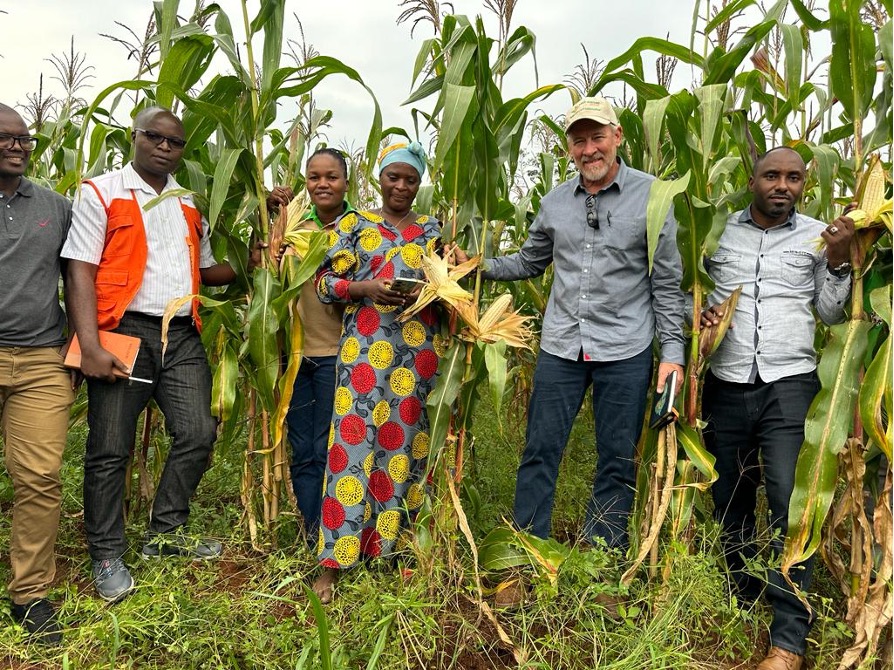
Consistent access to high-quality seeds and related inputs improves both productivity and profitability. By facilitating partnerships with local input suppliers, the project has created a reliable network to enhance timely access to essential agricultural inputs, going beyond quality seeds to also cover other essential inputs such as fertilizer and lime.
In Kayanza Province, World Vision Burundi leads a consortium of scaling partners whose goal is to empower small-scale farmers through good agronomic practices and better crop varieties. Triphonie Hakizimana is one such farmer. At 43, and a mother of four, she has been positively transformed by the project, which has changed her life and livelihood.
Here is how it happened. World Vision Burundi trained farmers on good agricultural practices to improve smallholder farming and livelihoods, including field preparation, fertilization with organic and mineral manure, line sowing, weeding, disease control, and seed preservation. This was coupled with access to certified, clean, high-yield seeds for common food crops such as beans, hybrid maize (bazooka), and orange-fleshed sweet potatoes, livestock-improvement practices, and advisory services, including brochures explaining the inputs.
“This knowledge has been very beneficial because, in the past, we used to plant in a disorganized way,” says Triphonie.
She lives in Muhanga Commune, Kayanza Province, where families typically rely on farming and livestock-keeping as their economic mainstays. Initially skeptical when the project distributed only a small pack of hybrid maize seeds, she quickly recognized the benefits of certified, high-yielding seeds and the improved farming techniques that accompanied the dissemination of the small-pack approach. “When I received the 100 grams of seeds, I thought it was a joke. But after the harvest, I was truly surprised. It was a learning experience because I planted these seeds near my old plots and prepared both fields similarly, yet the yields were completely different.”
The impact was significant in just one season (2024 A, October 2023–January 2024). The 100-gram seeds of bazooka hybrid maize on a 5 x 10-meter plot yielded 23 kilos, a marked difference from her previous yields of less than 150 kilos from a 50 x 50-meter plot. Her initial surprise blossomed into confidence as she observed the crop’s lush growth and climate resilience, withstanding disease and wind.
“Everyone who passed by my field asked questions about the plot planted with certified seeds,” she proudly recalls. “We are asking the Kugwiza Project to make more seeds available, as there will be high demand but not enough supply from the seed multipliers,” she cautions.
For the following cropping season, 2025A (October 2024–January 2025), inspired by her positive small-pack experience, Triphonie confidently purchased about 8 kg from an agro-dealer to plant on a larger 50 x 50-meter plot.
“We purchased the seeds from a seed shop located in our commune, ” Triphonie added.
Contributed by
Bumwe Ritha (IITA Rwanda), Patrick K. Mutuo and Christophe Gahungu (IITA Burundi)