
IITA NEWS

NDLEA Chairman visits IITA, explores science-based agricultural alternatives to illicit crop production
February 12, 2026
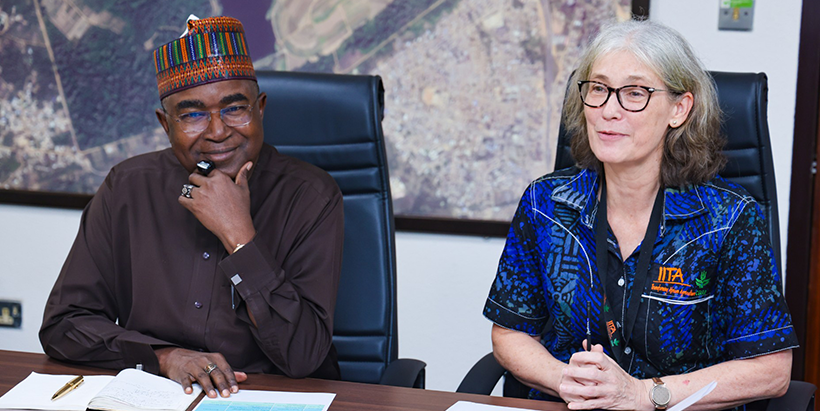
Chairman/Chief Executive Officer NDLEA, Brigadier General Mohammed Buba Marwa (L) and IITA Acting Director General and Deputy Director General Corporate Services, Hilde Koper-Limbourg (R), during the consultation and working visit.

IITA–CGIAR recently hosted the Chairman/Chief Executive Officer of the National Drug Law Enforcement Agency (NDLEA), Brigadier General Mohammed Buba Marwa (Rtd.), CON, OFR, on a working visit aimed at acknowledging IITA’s longstanding support and exploring collaborative pathways around sustainable livelihoods, youth empowerment, and alternatives to illicit crop production.

The NDLEA delegation was formally introduced and comprised key officials, including the Agency Secretary, Barrister Shadrach Haruna; the Chairman’s Chief of Staff, Colonel Aminu; Director of Accounts and Finance, Lucas Sunday; the Zonal Commander, Oba Obaniyi Adeoye; the Oyo State Commander, Adetula Oluwarotimi; the Osun State Commander, Yinka Joe-Fadile; coordinators of specialized units; officers of the Oyo State Command; and the Director of Media and Advocacy, Femi Babafemi, among others.
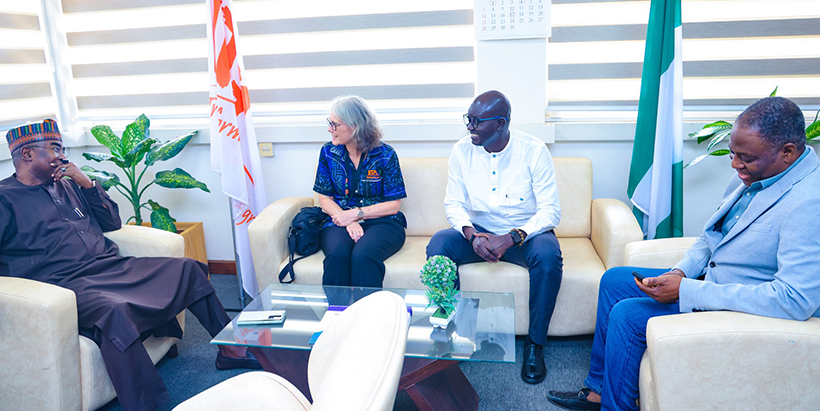
Hilde Koper-Limbourg and Chief of Staff to IITA Director General, Ibnou Dieng, welcoming NDLEA Chairman and his team to IITA.

Welcoming the delegation on behalf of the Director General, IITA Deputy Director General Corporate Services, Hilde Koper-Limbourg, highlighted IITA’s unique mandate as an agricultural research-for-development institute that not only generates innovations but also deliberately works to ensure those innovations reach end users. She referenced IITA’s experience with alternative crops programming, noting that when agriculture thrives as a business, it offers powerful, sustainable options for economic empowerment.

An introductory video showcased IITA’s footprint and impact, after which the Director of Strategic Planning and the Chief of Staff to the IITA Director General, Dr Ibnou Dieng, provided deeper insights into IITA’s global positioning. He explained that IITA, as part of the CGIAR-wide partnership, has access to nearly 9,000 scientists worldwide, working predominantly across the Global South. IITA currently operates in 25 countries, delivering end-to-end agricultural solutions spanning land, water, genetics, nutrition, and livelihoods.

Dr Dieng further spotlighted IITA’s 2024–2030 Strategy, which prioritizes nutrition security, job creation, climate resilience, and sustainable food systems. He noted that IITA holds the largest cowpea collection in the world, supports the reintroduction of improved varieties in conflict-affected regions, and is developing climate-smart, pest and disease-resistant crop varieties under its core pillars of Genetic Innovation, Resilient Agri-food Systems, and System Transformation.

The delegation was also introduced to a wide range of IITA innovations, including high-yielding and stress-resilient maize varieties; nutritious maize; early maturing cowpea; dual-purpose soybean varieties; Nodumax bio-inoculants; rapid cassava seed multiplication systems; Aflasafe for aflatoxin control; and Seed Tracker technologies, among others. Dieng concluded that there are over 100 technologies developed by IITA to explore.

Speaking on youth engagement, Noel Mulinganya, Program Coordinator, IITA Youth in Agribusiness, emphasized that young people are often the first adopters of IITA technologies. Through the IITA Youth in Agribusiness (IYA) program—now active in 19 locations—IITA provides training, access to finance, market linkages, tailored business opportunities, and mentorship, backed by location-specific needs assessment to recommend economically viable businesses for youth.

In his remarks, Brigadier General Marwa reflected on his first visit to IITA in 1973, describing it as formative. He underscored NDLEA’s interest in promoting licit agricultural alternatives to cannabis cultivation, particularly in communities where illicit crop production thrives. He called for science-based solutions that offer farmers compelling economic incentives to transition to legal crops. Citing the exploration of our local resources for industrial food and drug solutions, like the artemisia plant, harnessed to treat malaria.

Discussions explored viable alternatives such as cassava, soybean, poultry, fisheries, and value-added cassava products—including flour for bread aligned with Nigeria’s cassava inclusion policy. The visit concluded with a shared commitment to deepen collaboration, leveraging science, innovation, and evidence to deliver sustainable livelihoods, strengthen food systems, and address complex social challenges at their roots.


Scroll to Top
Olaosebikan, Olamide

Olamide Deborah Nwanze is a Senior Research Associate specializing in gender mainstreaming research to inform participatory and inclusive breeding, variety development, and seed systems policies regarding root, tuber, and banana (RTB) crops in the International Institute of Tropical Agriculture Headquarters, Ibadan, Nigeria. She is a PhD candidate at the University of Ibadan and holds an MSc and B. Agric in Agricultural Extension and Rural Development. Olamide is a fellow of the African Women in Agricultural Research and Development – Gender Responsive Agricultural Systems Policy (AWARD-GRASP) and the Gender Responsive Researchers Equipped for Agricultural Transformation (GREAT). She seeks to apply her gender-mainstreaming learnings, gender-responsive research, and policy development, and review expertise to facilitate women, youth, children, and vulnerable social group’s access to and adoption of agricultural Innovations that guarantee food, nutrition, income, and livelihood security in Africa. Her current roles include mentoring research fellows, development of guides and training manuals, implementation and adaptation of gender frameworks and tools, value chain actors’ engagement as citizen science partners, policy review and redesign, data management, and analysis. Her current research explores mixed methods and participatory and interdisciplinary approaches to capture and highlight gender dynamics, needs, preferences, and challenges stakeholders face within the agricultural livelihood value chain to prioritize gender-inclusive strategies in breeding programs, policy design, and implementation.

At IITA, she contributes to the implementation of the CGIAR Accelerated Breeding Initiative and Genetic Innovation Programs; participatory and gender research within the NextGen CassavaHarvestPlusRTBFoods, and Tricot-ClimMob 1000Farms Projects; and gender knowledge communication via the G-LENS webinar series, video documentary, policy briefspublications, and blogs.


Recent publications

de Sousa, K., van Etten, J., Manners, R. Bello, A., Teeken, B., Olaosebikan, O., et al. 2024. The tricot approach: an agile framework for decentralized on-farm testing supported by citizen science. A retrospective. Agron. Sustain. Dev. 44, 8. https://doi.org/10.1007/s13593-023-00937-1

Madu, T., Onwuka, S., Nwafor, S., Onyemauwa, N., Ejechi, M., Ofoeze, M., Ukeje, B., Eluagu, C., Olaosebikan, O., Okoye, B., 2024. Gender-Inclusive Consumer Studies Improve Cassava Breeding in Nigeria in: Frontiers in Sociology, volume 9, number: 1224504, doi: 10.3389/fsoc.2024.1224504

Olaosebikan, O.; Bello, A.; Utoblo, O.; Okoye, B.; Olutegbe, N.; Garner, E.; Teeken, B.; Bryan, E.; Forsythe, L.; Cole, S.; Madu, T. 2023.  Stressors and Resilience within the Cassava Value Chain in Nigeria: Preferred Cassava Variety Traits and Response Strategies of Men and Women to Inform Breeding. Sustainability 15, 7837. https://doi.org/10.3390/su15107837

Okoye, B., Ofoeze, M., Ejechi, M., Onwuka, S., Nwafor, S., Onyemauwa, N., Ukeje, B., Eluagu, C., Obidiegwu, J.*, Olaosebikan, O., Madu, T.* 2023. Prioritizing preferred traits in the yam value chain in Nigeria: a gender situation analysis in: Frontiers in Sociology, volume 8, number: 1232626, pages 1 – 9, ISSN 2297-7775, 2023. https://www.frontiersin.org/articles/10.3389/fsoc.2023.1232626/full

Olaosebikan, O., Bello, A. A., de Sousa, K., Ndjouenkeu, R., Adesokan, M., Alamu, E. O., Agbona, A., van Etten, J., Kegah, F. N.*, Dufour, D., Bouniol, A., Teeken, B. 2023. Consumer acceptability of cassava gari-eba food products across cultural and environmental settings using the triadic comparison of technologies approach (tricot) in: Journal of the Science of Food and Agriculture,

Teeken, B., Olaosebikan, O., Bello, A. A., Madu, T.*, Cole, S. M. 2023. Qualitative assessment on the positionality and preferences of dyads in relation to cassava-related activities: working with tricot trial citizen scientists https://hdl.handle.net/10568/138326 Type: Manual

Bouniol, A., Ceballos, H., Bello, A. A., Teeken, B., Olaosebikan, O., Owoade, D., Agbona, A., Fotso Kuate, A., Madu, T.*, Okoye, B.*, Ofoeze, M.*, Nwafor, S.*, Onyemauwa, N.*, Adinsi, L.*, Forsythe, L., Dufour, D. 2023. Varietal impact on women’s labour, workload and related drudgery in processing root, tuber and banana crops: focus on cassava in sub-Saharan Africa in: Journal of the Science of Food and Agriculture, pages 1 – 25, ISSN 0022-5142,

Bello, A. A., Agbona, A., Olaosebikan, O., Edughaen, G., Dufour, D., Bouniol, A., Iluebbey, P., Ndjouenkeu, R.*, Rabbi, I. Y., Teeken, B. 2023. Genetic and environmental effects on processing productivity and food product yield: drudgery of women’s work in: Journal of the Science of Food and Agriculture, pages 1 – 32, ISSN 0022-5142, 5

Cavicchioli, M., Zimbiti, T., Teeken, B., Nwanze, D.O., Liani, M., Parkes, E. & Bello, A. 2023. IITA-Gender Responsive Breeding Training Report. Genetic Resources Center, IITA-HQ, Ibadan, 21-23 September, 2022. Ibadan, Nigeria: IITA, (34 p.).https://hdl.handle.net/10568/131368

Agbona, A. Peteti P., Teeken B., Olaosebikan O. Bello, A. A., Parkes, E., Rabbi, I. Y., Mueller, L., Egesi, C., Kulakow, P. 2022. Data Management in Multi-disciplinary African RTB Crop Breeding Programs. In: Williamson, H.F., Leonelli, S. (eds) Towards Responsible Plant Data Linkage: Data Challenges for Agricultural Research and Development. Springer, Cham. https://doi.org/10.1007/978-3-031-13276-6_5

Lora Forsythe, Pricilla Marimo, Sarah Mayanja, Olamide D. Olaosebikan, Esme Stuart, Bela Teeken, Benjamin Okoye, Tessy Madu, (2021). Cross-product Gender Analysis of RTBfoods Step 2 Gendered Food Mapping on RTB Products. Understanding the Drivers of Trait Preferences and the Development of Multi-user RTB Product Profiles, WP1. London, UK: RTBfoods Field Scientific Report, 30 p.

Teeken, B., Garner, E., Agbona, A., Balogun, I., Olaosebikan, O., Bello, A., Madu, T., Okoye, B., Egesi, C., Kulakow, P. and Tufan, H.A. 2021. Beyond “Women’s Traits”: Exploring How Gender, Social Difference, and Household Characteristics Influence Trait Preferences. Frontiers Sustainable Food Systems 5:740926. https://doi.org/10.3389/fsufs.2021.740926

Teeken, B., Agbona, A., Bello, A., Olaosebikan, O., Alamu, E., Adesokan, M., Awoyale, W., Madu, T., Okoye, B., Chijioke, U., Owoade, D., Okoro, M., Bouniol, A., Dufour, D., Hershey, C., Rabbi, I., Maziya‐Dixon, B., Egesi, C., Tufan, H. and Kulakow, P. (020. Understanding cassava varietal preferences through pairwise ranking of gari‐eba and fufu prepared by local farmer–processors. Int J Food Sci Technol. https://doi.org/10.1111/ijfs.14862

Bela Teeken, Olamide Olaosebikan, Ireti Balogun, Benjamin Okoye, Tessy Madu, Steven Cole, Abolore Bello, Elizabeth Parkes. (2020). Piloting the G+ customer and product profile tools for gender-responsive cassava breeding in Nigeria. Nigeria: International Institute of Tropical Agriculture (IITA). https://hdl.handle.net/20.500.11766/13000