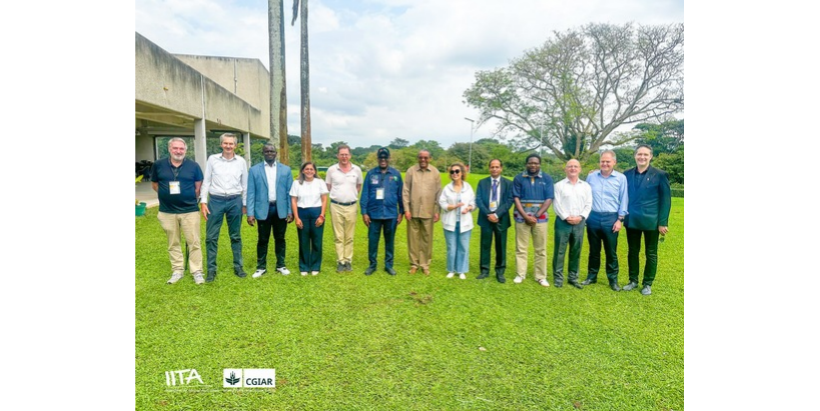
Senior leaders from across CGIAR left IITA’s Ibadan campus with renewed commitment to collaboration, stronger partnerships, and a future in which agriculture, nature, and innovation work together to address global food and nutrition challenges.
For one week in September 2026, IITA headquarters Ibadan campus played host to not one, not two, but three major CGIAR events one after the other: the first in-person CGIAR Board meeting (23–25 September), the CGIAR Futures Workshop (26–27 September), and the CGIAR Global Leadership Team (GLT) meeting (28–29 September).
Together, the events brought Board Chairs, funder representatives, Center Directors General, and senior leaders from across the CGIAR system to IITA headquarters.
For many participants, the meetings offered more than an opportunity to discuss governance and strategy. They created space to consider how CGIAR must evolve to meet a changing world—one shaped by climate change, demographic shifts, technological advances, geopolitical uncertainty, and growing pressure on food systems.
“The demand for CGIAR and the work that we do is going to be bigger and much more demanding than ever,” said Renaud Seligmann, Chair of the CGIAR System Council.
“For us to come together to address and tackle the problems of today and tomorrow, so we can make malnutrition, hunger, inequalities, and poverty history, is very important.”
Looking ahead to 2040
A central focus of the week was the CGIAR Futures Workshop, where participants explored possible scenarios for CGIAR through 2040 and discussed how the global research partnership can remain relevant, agile, and responsive.
For Professor Appolinaire Djikeng, Director General of the International Livestock Research Institute (ILRI), the discussions underscored the need for CGIAR to adapt to a rapidly changing landscape.
“The world is changing, and CGIAR has to be agile and flexible to deliver on those pressures,” Professor Djikeng said.
He emphasized that future agricultural solutions must be developed alongside environmental solutions.
“Agriculture can no longer be entertained alone. It has to be mixed with nature. We have to co-create solutions that demonstrate that agriculture cannot succeed if nature fails, and vice versa.”
That message was echoed by Dr Himanshu Pathak, Director General of the International Crops Research Institute for the Semi-Arid Tropics (ICRISAT), who said CGIAR’s future strategy must address food security, nutrition, environmental sustainability, and climate resilience together.
“We discussed what could be the roadmap for CGIAR to help not only Africa, but also the whole world,” Dr Pathak said. “The world can be food secure, nutrition secure, environment friendly, and climate resilient.”
A stronger, more connected CGIAR
The GLT meeting brought together Directors General from CGIAR Centers, the CGIAR Executive Managing Director, Dr Ismahane Elouafi, and other senior leaders to discuss how the system can work more effectively as one partnership.
Dr Baboucarr Manneh, Director General of the Africa Rice Center, described the meeting as highly productive and said leaders discussed ways to improve coordination, efficiency, and resource mobilization across the system.
“We had extremely good discussions on how we can improve the efficiencies of the system. We want to leverage our experience and expertise to mobilize more resources to be invested in agrifood systems, especially in Africa, Latin America, and Asia.”
He added that stronger coordination among CGIAR Centers, as well as closer collaboration with national partners, will be essential to increasing impact.
“Almost universally, we all agreed that this was one of the best GLT meetings that we had,” Dr Manneh said, commending IITA management and staff for hosting the gathering.
For Dr Simon Heck, Director General of the International Potato Center (CIP), the meetings reinforced the importance of building on the distinct strengths of each CGIAR Center while working toward shared goals.
“Going forward, I think we will be much more united as CGIAR,” Dr Heck said. “We will build on the advantages and capacities of each of our Centers across the world, working together more efficiently toward the common objectives and goals that we have agreed on.”
He noted that IITA and CIP already have a strong history of collaboration on root and tuber crops, which are expected to become increasingly important in future food systems.
“Root and tuber crops will become even more important into the future,” He added. “We have a common approach to how we do that here in Africa, while also linking our work in Latin America and Asia.”
Reimagining research for a changing world
The Futures Workshop also brought together voices beyond the CGIAR Centers, including leaders in agriculture, business, development, and innovation.
Dr Ndidi Okonkwo Nwuneli, Executive Chair of Sahel Consulting, described the workshop as an opportunity to reimagine CGIAR’s role in a changing global environment.
“It was a real pleasure to participate in this visioning exercise for CGIAR looking at 2040,” she said. “I joined a room of phenomenal, brilliant, committed leaders from across the world to reimagine what we could create together.”
“The world is changing with technology, climate change, and all the issues that we are facing around geopolitics. It is an urgent time to reimagine what the CGIAR system could do and how it could create impact from science and research in a collaborative landscape.”
She added a rallying call for the future: “Let’s create a future where no child goes to bed hungry and where every country is food self-sufficient.”
Similarly, AJ Poncin, Chief Transformation Officer at the International Maize and Wheat Improvement Center (CIMMYT), said the workshop enabled participants to think collectively about CGIAR’s next chapter.
“Stakeholders from across CGIAR and our governing bodies came together to brainstorm what 2040 could look like for CGIAR,” he said, “and what would be the best way for us to get there—to make a huge impact for the world, for agriculture, and for the smallholder farmers that we support.”
A historic moment for governance
The first in-person meeting of the reconstituted CGIAR Board also marked an important step in the evolution of CGIAR governance.
According to Professor Roel Merckx, Chair of the IITA Board, the new governance arrangement brings Center Board Chairs into the overarching CGIAR Board, strengthening the connection between the individual Centers and the wider system.
“We decided that all Center Board Chairs would be on the CGIAR Board of the entire system,” Professor Merckx said. “We were hopeful that it would be a better way to govern CGIAR, and after this meeting, we can say that we started in a very positive atmosphere.”
He described the gathering as a historic moment and praised IITA for hosting the meetings.
“The hospitality shown by IITA was tremendous. I thank all the IITA staff for making that possible.”
IITA at the center of global conversations
For IITA, hosting the meetings was an opportunity to demonstrate not only its research contributions to food systems transformation, but also the professionalism, operational strength, and hospitality of its staff and community.
As participants departed Ibadan for their respective Centers and countries, a common message emerged: CGIAR’s future depends on stronger collaboration, more effective partnerships, and a clear commitment to turning research into meaningful impact.
The week’s conversations may have focused on 2040, but their purpose was grounded in today’s urgent realities ensuring that science helps farmers adapt, food systems become more resilient, and communities across Africa, Asia, Latin America, and beyond have access to healthy and sustainable food.
As Dr Heck put it, leaders left IITA “energized, committed, and recommitted to the common purpose of CGIAR.”